


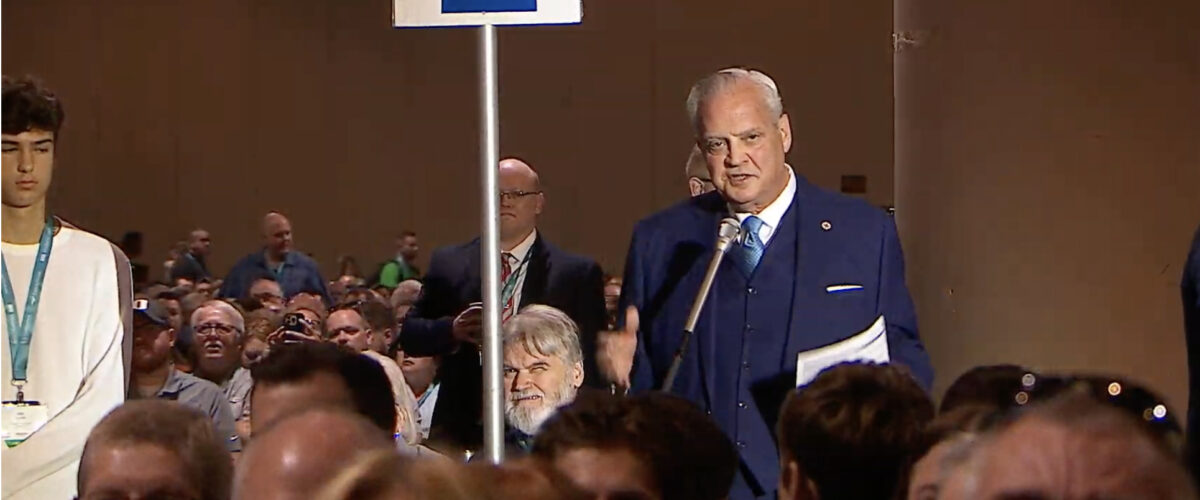
Although I left the Southern Baptist Convention several decades ago, I still keep up with them, especially during their annual meetings. This year’s SBC gathering, like all the others since I left, both saddened and disturbed me, including the constitutional vote on female pastors and the election of leaders who discount the clergy sexual abuse crisis.
When I left the SBC way back in 1994, I didn’t think things could get any worse. But I was wrong. After following the news from this year’s meeting, I decided to share my old SBC story for those (few) “moderates” who still remain.
I vividly remember the day I realized I had no viable future in the SBC. Like Don McLean’s classic rock song “American Pie,” I remember “the day the music died.” I was a young pastor, recently out of seminary, attending my first Pastor’s Conference at the SBC annual meeting. Baily Smith was preaching. You may remember he once said, “God Almighty does not hear the prayer of a Jew.”

Martin Thielen
During Smith’s fiery sermon, he viciously denounced liberalism, including belief in evolution, humanism and the Social Gospel, all of which I affirmed. He implied that people who rejected biblical inerrancy (which I did) would spend eternity in a devil’s hell. For 30 unbearable minutes, he continued his radical fundamentalist rant. All around me pastors clapped their hands and enthusiastically shouted, “Amen!” and “Preach it, brother!”
His intolerant, arrogant and ignorant views, combined with the overwhelmingly positive response it elicited, literally made me sick to my stomach. I got up from my seat and walked out of the auditorium.
In hindsight, I probably should have left the meeting, driven home, resigned my church, left the SBC and never returned. But at that point in my life, I wasn’t ready for such a drastic decision. It took another decade for me to finally arrive at that necessary ending.
How it began for me
I did not grow up in the life of the church. My first experience with Christianity came at age 15. At the time, I was a mixed-up young man searching for answers. Through a series of life-changing events, I landed in a conservative Southern Baptist church in Muskogee, Okla. At that church, I first heard the gospel message, affirmed faith in Christ, was baptized and fully immersed myself in the life of the congregation.
Soon thereafter, I felt a call to vocational ministry. After high school I attended Ouachita Baptist University, where I received an excellent education in religion. I had exceptional professors who taught me open-minded and progressive faith. After a short but positive stint in the insurance business, I went to Southern Baptist Theological Seminary — long before Al Mohler became president, gutted its great heritage and turned it into a bastion of fundamentalism. Upon graduation I landed at a county seat “First Church” pastorate. That congregation accepted, loved and affirmed me, giving me a joyful and healthy birth into pastoral ministry.
It’s hard to leave your family
However, during that decade of college, seminary and my first pastorate, the SBC began a dramatic shift toward religious-right fundamentalism. I grew increasingly uncomfortable with the direction it was taking. It felt toxic and grew worse every year. And then I attended the pastor’s meeting mentioned above.
Another speaker (I’m pretty sure it was Adrian Rodgers) at that same event said, “Brothers (and all the pastors were men), you don’t need to seek truth. You already have all the truth you need.” Then, holding up his Bible, he said, “You just need to proclaim the truth.” I still remember thinking, “If I ever come to a time or place when I stop seeking truth, I hope somebody will put me out of my misery.”
“I still remember thinking, ‘If I ever come to a time or place when I stop seeking truth, I hope somebody will put me out of my misery.’”
So why didn’t I leave the SBC right then? As many people know, it’s hard to leave your family, even when it’s dysfunctional. Plus, I was young and idealistic. I naively believed I and other “moderates” in the church eventually would win the day.
In the end, however, we lost the battle completely.
I also had selfish reasons for staying. I served a large church for my age with a promising future ahead of me. And I was ignorant of the broader Christian community. For example, I had no knowledge of Mainline churches. I did not know other places existed in the Christian family where people affirmed more progressive and open-minded faith. I never had visited a Methodist, Episcopal or Presbyterian church. My religious worldview was extremely provincial and narrow.
Over the next decade, I continued to experience significant professional opportunities. I published several books with Broadman Press, wrote dozens of articles in SBC publications, was on the speaking circuit, and served as pastor of tall-steeple churches.
And then, at a young age, I was invited to work at the Baptist Sunday School Board, working with pastors and music ministers throughout the country in the area of worship and preaching. The job included the highly visible job of editing Proclaim magazine, which went to virtually every pastor in the SBC. Although uncomfortable with the direction of the denomination, I loved my work and had too much to lose to seriously consider leaving.
But the drumbeat of religious-right fundamentalism continued to overtake the convention. Leaders demanded members believe in biblical inerrancy, told women they could not serve as clergy and must submit to their husbands, and became intensively partisan in their politics. Large numbers of professors at our seminaries and leaders at our agencies were being fired or forced out for being “liberals.”
The church that introduced me to Christ, who loved and educated me, and who had given me wonderful opportunities of service was, at least from my perspective, being destroyed. Finally, I came to believe the national leaders of the SBC were guilty of heresy. Not doctrinal heresy but heresy of spirit.
Their mean-spirited, arrogant, judgmental and intolerant positions were the exact opposite of the spirit of Jesus Christ. I no longer could avoid the frightening new realities of the SBC. I faced a spiritual and vocational crisis.
The cost of staying
Sick to my soul over these developments, I scheduled a lunch appointment with an older, wiser and respected pastor. He, like me, felt devastated over the toxic faith taking over our beloved church. However, with only a few years before his retirement, a denominational change was not a viable option for him. However, I was still in my thirties.
“The cost of staying — loss of integrity, identifying with a denomination I could no longer affirm and constant anxiety — was much higher than the cost of leaving.”
During lunch I kept talking to my older pastor friend about “the cost of leaving.” I moaned about losing my status, my financial compensation level, my publishing and teaching opportunities and the only denomination I had ever known. He listened with patience and compassion.
But then he said, “Martin, you’ve been telling me about the cost of leaving. Now I want you to tell me about the cost of staying.”
His question was a burning bush epiphany for me. I knew at that moment I no longer could stay in the SBC. The cost of staying — loss of integrity, identifying with a denomination I could no longer affirm and constant anxiety — was much higher than the cost of leaving. It was time to go. It’s a long story, but I eventually joined The United Methodist Church which, while (very) far from perfect, was a much better environment to live out my faith and ministerial vocation.
It has gotten worse
Tragically, since leaving the SBC three decades ago, things have gotten exponentially worse. Examples include the demonization of the LGBTQ community, the rejection of science, the advancement of conspiracy theories, the support of white Christian nationalism, extreme political partisanship, overwhelming discrimination against women, radical biblical literalism, the cover-up of sexual abuse, willful jettisoning of the example and teachings of Jesus, and the adoration of Donald Trump — who violates every value Southern Baptists claim to believe and who is arguably the most anti-Jesus president in American history.
I want to be clear that I deeply appreciate the many gifts the SBC gave me. I’ll forever be grateful for them. But over the past few decades, the SBC has become overwhelmingly destructive. Sadly, I believe it is now doing far more harm than good, including inflicting massive and irrevocable damage to the reputation of Jesus, the Christian faith and the American church.
So, for whatever it’s worth, here is my council for BNG readers who are still connected to the Southern Baptist Convention. If you are troubled by what the SBC has become, it’s past time for you to leave. Things are not going to change. They will only get worse, just as they have over the past several decades. And, as hard as it might be to leave, there are many other viable places for you to find Christian community including the Cooperative Baptist Fellowship, the Alliance of Baptists, almost any Mainline denomination, or even a simple house church with like-minded followers of Jesus.
It’s exceptionally late in the game to depart the SBC over the “fundamentalist takeover.” But as they say, “Better late than never.” That’s never been more true in the long, sad and tragic demise of the SBC.
Martin Thielen, a retired minister (SBC and UMC) and best-selling author, is the founder and author of www.DoubtersParish.com.