



Coming to faith as a teenager in the 1970s, I inherited a more or less modern and impoverished Christian notion of heaven — heaven as the good place way out there somewhere that you hope to go to when you die. (Or whisked away to in the rapture, as the loopy eschatology of The Late Great Planet Earth fantasized about.)
Revivalist evangelism consisted primarily in cajoling others into securing their reservation for this post mortem heaven. Salvation was reduced to a heaven-or-hell minimalism. This life was seen as little more than an elaborate SAT test for afterlife placement. In its crudest form, any real concern for the planet itself was shrugged off with a callous quip: “Who cares? It’s all going to burn.” A pie-in-the-sky, I’ll-fly-away-when-I-die, in-the-sweet-by-and-by theology of heaven is what I inherited and to some extent preached for more than 20 years.
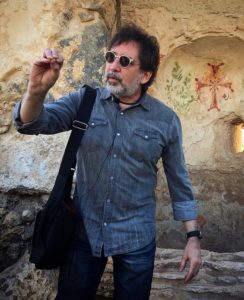
Brian Zahnd
But in my forties, my theology began to change, which is to say it finally began to develop in a serious fashion. Part of my theological shift entailed the embrace of a much more earthly faith. I rightly came to understand that an escapist faith that was unconcerned about God’s good earth and issues of justice in this life is a modern and maligned distortion of the apostolic faith and unworthy of being called Christian.
So I thoroughly rethought my theology and began to preach that Christian faith must inform and influence our entire life, including our ethics and politics. This was an absolutely essential theological correction. Amen!
But . . .
There is the pendulum effect, and this can be overdone. I don’t mean that an emphasis on Christ-informed ethics and prophetic social justice can be overdone, but I do mean if in our zeal for a this-world faith we lose sight of heaven, we have made a fatal mistake. I say “fatal” because a faith sans heaven places us on a trajectory that will eventually merge with fatalistic materialism.
Although an earthly faith is a necessity for all who seek to follow Jesus faithfully, we must make sure we are not using an earthly faith to mask a subtle capitulation to the spirit of the age — a zeitgeist that insists there is no heaven and the sole relevance of religion is found in its social value. Within this scheme, religion has no value of its own; it is simply a useful tool in the cause of all-important political or social pursuits.
“Christianity without transcendence degenerates into politics.”
To put it plainly, Christianity without transcendence degenerates into politics. Sadly, this is an all-too-common reality within a politicized Christianity.
Until we fully entered the modern era, Christians always understood themselves as pilgrims passing through this world on a journey toward the homeland of heaven. Heaven as our true telos was not escapism but the source of meaning for our earthly sojourn. Our spiritual forebears “confessed that they were strangers and pilgrims on the earth,” as we read in Hebrews 11:13). But this paradigm is now under significant pressure. Heaven is forsaken for earth as the be-all and end-all of human endeavor.
Without a robust theology of heaven, Christians are left homeless. Theologian Hans Boersma explains it like this:
Heaven is the Christian home. Augustine sketches his account of the heavenly city without worrying about whether the Platonic and Christian traditions are compatible on this point. Along with nearly all Christian theologians prior to modernity, he was convinced that the Christian faith is about heavenly participation and that this biblical insight allows for some kind of Platonist-Christian synthesis
If Christianity is embarrassed to speak of heaven out of fear of its cultured despisers, then it is a dying religion desperately begging for relevance according to terms set by an atheistic philosophy. A Christianity that cannot speak confidently of heaven has nothing to offer a disenchanted world. And before we can reenchant the world, we must first reenchant the Christian soul.
We’ve all heard the hackneyed warning against being so heavenly minded that we’re no earthly good. But this is not our problem. The problem of the disenchanted Christian soul is the exact opposite: We’re so enthralled by the material world that we have ceased to believe in any other.
To be heavenly minded is precisely what the Apostle Paul commends when he says in Colossians, “Set your minds on the things that are above, not on things that are on earth.” And it should be stressed that being heavenly minded is no impediment to understanding life in this world. As the wise Mr. Raven counseled Mr. Vane in George MacDonald’s Lilith, “If you understood any world besides your own, you would understand your own much better.”
“The modern soul is disenchanted because we have sealed off the soul from heaven.”
The modern soul is disenchanted because we have sealed off the soul from heaven. We have built a materialist ceiling over our heads and said, “There is nothing beyond the ceiling — all of reality exists beneath the ceiling.” We have assumed that unseen existences are an impossibility, but this is nothing other than a modern, materialist superstition. One of the problems with philosophical materialism is that it is incapable of accounting for the existence of matter at all!
Nevertheless, the spiritual component of our being discerns that there is something beyond the material veil, there is an eternal realm. It’s from the heavenly realm that the material realm gains meaning. And it’s not just the Greek philosophers who intuited that a realm of eternal Forms lies behind material shadows — the writer of Hebrews thinks the same thing.
In commenting on the tabernacle of Moses, the writer of Hebrews says, “(The priests) offer worship in a sanctuary that is a sketch and shadow of the heavenly one.” For that writer, the very real, very substantial temple of stone in Jerusalem was but a glimpse of the true and eternal heavenly temple. All that is true, good and beautiful in this world has its origin in the heavenly world.
Brian Zahnd is founder and lead pastor of Word of Life Church in St. Joseph, Mo. Known for his theologically informed preaching and his embrace of the deep and long history of the church, Zahnd is a frequent speaker at conferences, universities and seminaries around the world. As a pastor-theologian, he is the author of numerous titles, including The Wood Between the Worlds, When Everything’s On Fire, Faith in the Shadows, and Unseen Existences, from which this excerpt is drawn and is used here by permission of InterVarsity Press. ©2026 by Brian Zahnd.