

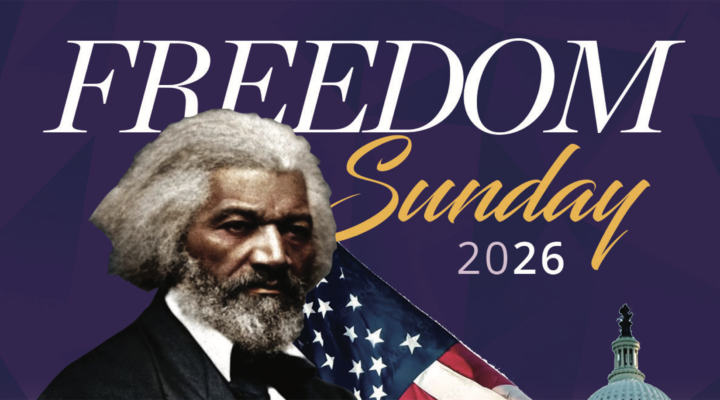
The Progressive National Baptist Convention’s “Freedom Sunday” will challenge its churches to speak prophetically and to ask what the nation’s 250th anniversary means to them.
The denomination co-founded by Martin Luther King Jr. in 1961 has provided its congregations with worship materials to call out the hope and hypocrisy embodied in Independence Day and the 250th anniversary.
“This suite of liturgical resources allows us to speak in a unified voice and collectively interrogate the future of our republic. Will it continue in the way of authoritarianism or fulfill the promise of a multiracial democracy?” the PNBC Social Action Commission explained.
The nation’s anniversary isn’t a celebration of what America has accomplished but an opportunity to engage in “a liturgy of resistance” focused on the unfinished fulfillment of Black equality, flourishing and power, the material says. “As a convention, we are not done singing and resisting Americanism baptized by white exceptionalism and brutal manifest destiny. We are not done believing that the same God who buried Pharaoh’s chariots is still working wonders for our freedom.”

David Peoples
The inspiration and language for “Freedom Sunday” was a 19th-century former slave, abolitionist and statesman, PBNC President David Peoples said.
“In 1852, Frederick Douglass stood in Rochester, N.Y., and refused to call July Fourth his own. He named the distance between the nation’s professed liberty and its practiced bondage. That distance, in too many forms, persists today in ways detrimental to Black health, Black education and Black power.”
PNBC’s effort comes as America250’s long-planned, bipartisan celebrations in Washington, D.C., were coopted by President Donald Trump and his rival project, Freedom 250, which is hosting partisan events themed around the president himself.
The liturgical materials PNBC provided for its July 5 observance include “A Call to Worship,” “A Litany of Freedom,” “A Pastoral Prayer” and the hymn “A Song of the Sea,” based on the passage in Exodus when the Israelites crossed the Red Sea.
“The Black Church has never sung because all was well. We sing because God has already moved, and no empire writes the final verse over our lives,” Peoples said. “It is time for us to resist the status quo and demand full inclusion in this democratic experiment.”
The liturgy also includes a reading from the keynote address Douglass delivered during the 1852 Independence Day celebration in Rochester, “What to the Slave Is the Fourth of July?”
“Your high independence only reveals the immeasurable distance between us. The blessings in which you, this day, rejoice, are not enjoyed in common,” he said. “The rich inheritance of justice, liberty, prosperity and independence, bequeathed by your fathers, is shared by you, not by me.”
Now it’s PNBC’s churches and pastors who must bring that message, the Social Action Commission says. “Our convention has always understood that the gospel demands confrontation with the powers that deal death and foreclose freedom.”