

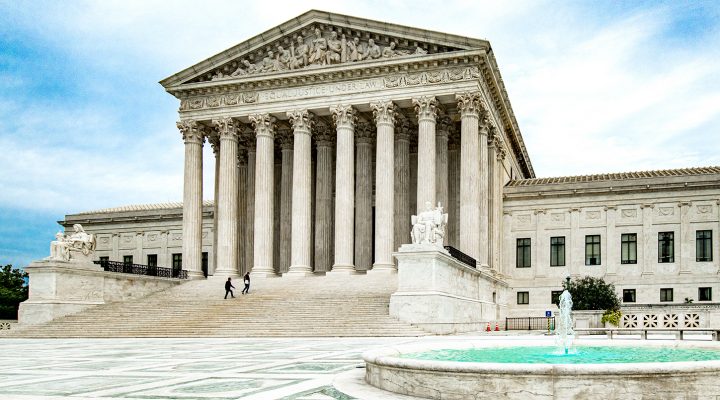
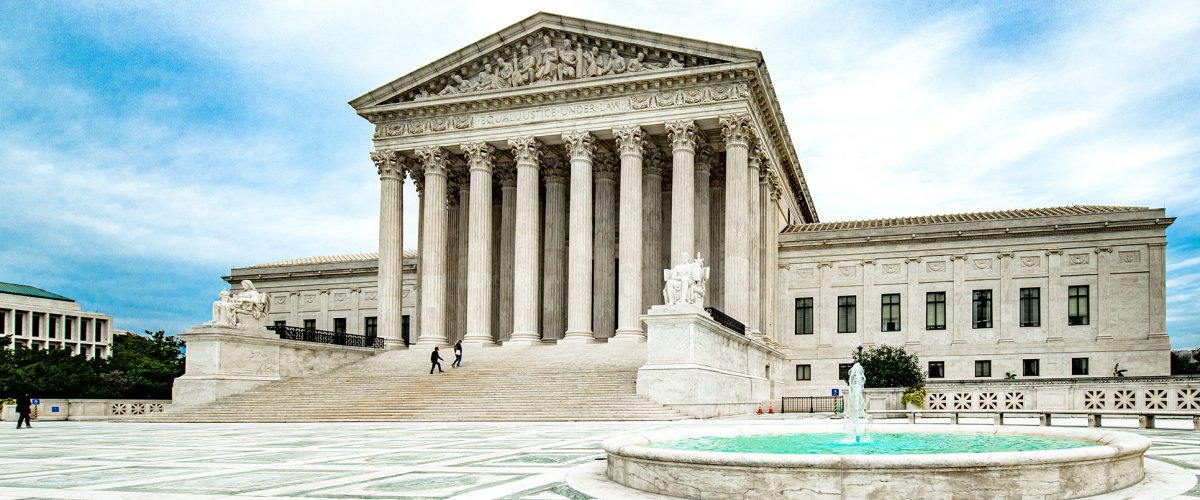
In siding with the Republican party in yet another decision loosening campaign spending limits, the U.S. Supreme Court is risking credibility as the supposedly nonpartisan third branch of government. Beyond that, it continues to deny the corrupting influence of the uber-wealthy on federal elections.
Handed down June 30, the last day of the high court’s current term, a 6-3 majority struck down “campaign coordination” limits on the amounts super PACs may give political candidates to spend on television advertising and other expenses, thereby handing the national GOP a major advantage ahead of this November’s midterm elections. Previously, under federal law, super PACs were charged up to four times the advertising rates of those offered directly to candidates for the presidency and Congress.
According to the latest figures filed with the Federal Election Commission May 31, the GOP already has a roughly 2-1 advantage in cash on hand a little more than four months before election day on Nov. 3. Because many more so-called super-PACs pour huge sums into the campaign coffers of Republican candidates than into those of Democrats, that gap will be multiplied this year.
Because many more so-called super-PACs pour huge sums into the campaign coffers of Republican candidates than into those of Democrats, that gap will be multiplied this year.
The June 30 decision – divided along ideological lines – lifts previous limits on how much political parties may spend on advertising and related expenses in collaboration with candidates. It is the latest in a series of rulings reversing previous spending limits dating to the post-Watergate period when bipartisan majorities in Congress believed big money was corrupting elections.
In those now seemingly faraway times, Supreme Court justices were seldom referred to in nakedly partisan terms, the assumption being that they generally stood above the fray of partisan wrangling. Today, unfortunately, they are more frequently referred to as appointees of either Republican or Democratic presidents. In this latest decision, all six justices in the majority were appointed by Republican chief executives, the three dissenting justices by Democrats, a trend more and more prevalent of late in key decisions of the court in many of its more volatile cases. Plainly put, this sad shift is destructive of the court’s credibility.
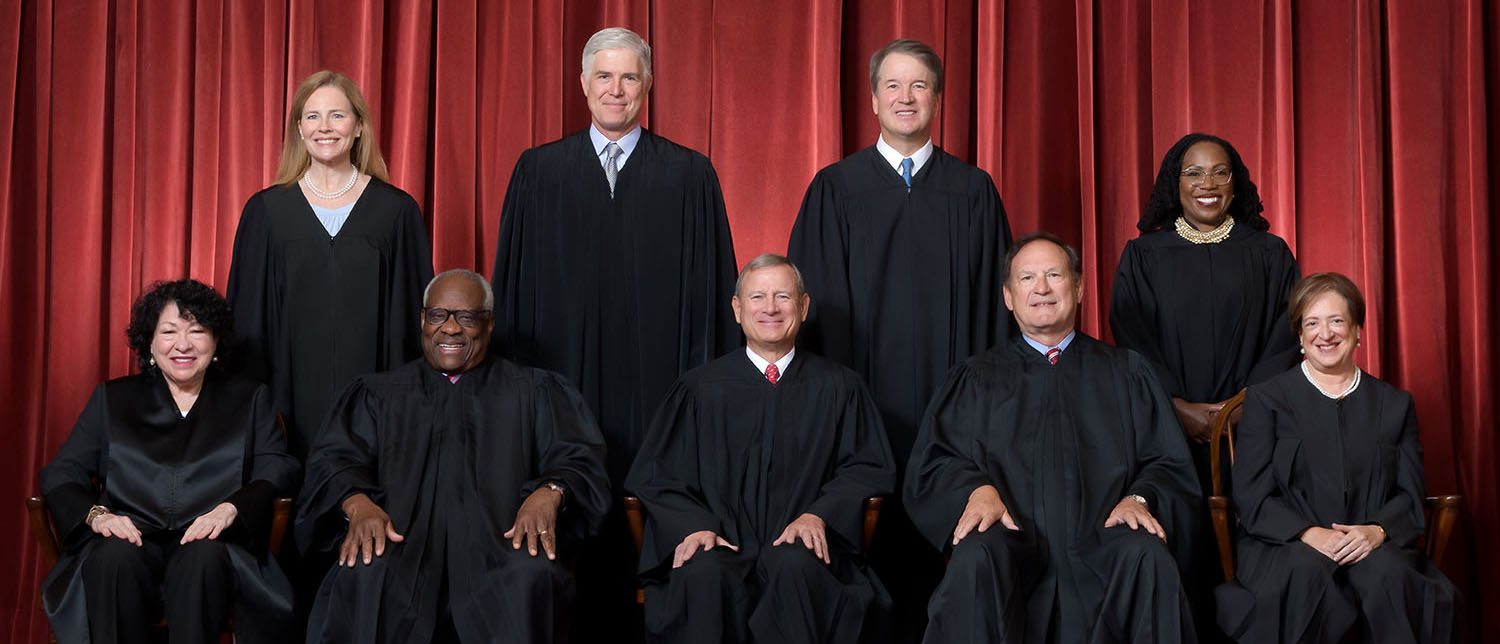
Formal group photograph of the Supreme Court as it was been comprised on June 30, 2022, after Justice Ketanji Brown Jackson joined the Court. The Justices are posed in front of red velvet drapes and arranged by seniority, with five seated and four standing.
Seated from left are Justices Sonia Sotomayor, Clarence Thomas, Chief Justice John G. Roberts, Jr., and Justices Samuel A. Alito and Elena Kagan. Standing from left are Justices Amy Coney Barrett, Neil M. Gorsuch, Brett M. Kavanaugh, and Ketanji Brown Jackson.
(Fred Schilling, Collection of the Supreme Court of the United States)
Among the half-dozen cases in recent years weakening spending restrictions, far and away the most significant was the 2010 decision in Citizens United v. Federal Election Commission, a 5-4 ruling that corporations and other outside groups may spend unlimited amounts on candidates for the presidency and Congress without disclosing their identity. The court’s rationale then, one reiterated in the latest decision as to super PACs, was that the free speech clause of the First Amendment applies equally to corporations as to individual citizens.
Writing for the majority in the most recent case, National Republican Senatorial Committee v. Federal Election Commission, Justice Brett M. Kavanaugh claimed the decision “treats all political parties equally.” Apparently oblivious to his own capacity for cynicism, he added: “Whether the Democratic Party, the Republican Party or other parties, all political parties and candidates going forward can compete equally under the same rules regarding coordinated expenditures and can structure their fund-raising, spending and political speech on a level playing field as they see fit within the law.”
Beyond that, it continues to deny the corrupting influence of the uber-wealthy on federal elections.
Justice Elena Kagan, dissenting along with Justices Sonia Sotomayor and Ketanji Brown Jackson, decried the majority ruling in this and other similar cases as “a legal regime increasingly unable to stop political corruption, and thus to preserve our institutions’ democratic legitimacy.”
Like all other rights we enjoy under the First Amendment to the Constitution – of religion, speech, press, assembly and the redress of grievances – that of political speech most assuredly cannot and must not be absolute.
To paraphrase the British moral philosopher Lord Acton’s timeless dictum concerning the corrupting influence of power, money in politics tends to corrupt — and unlimited amounts of money corrupt absolutely. That, tragically, is our current state of affairs.

Stan Hastey
Stan Hastey, a veteran Baptist journalist and first full-time leader of the Alliance of Baptists, was confirmed into the Episcopal Church in 2018. A member of the Church of Bethesda-by-the-Sea in Palm Beach, Fla., he serves that congregation as a lay reader