

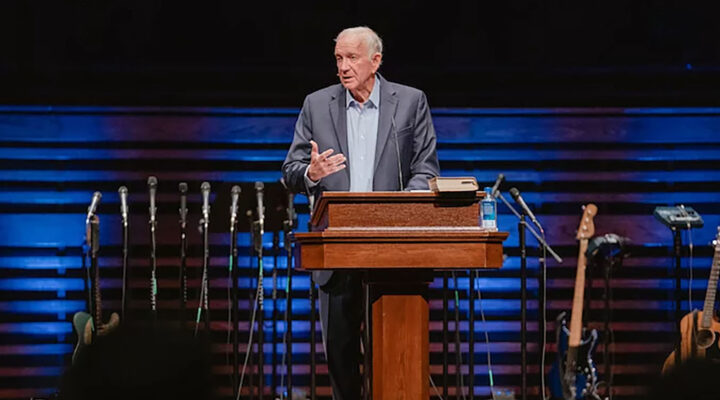
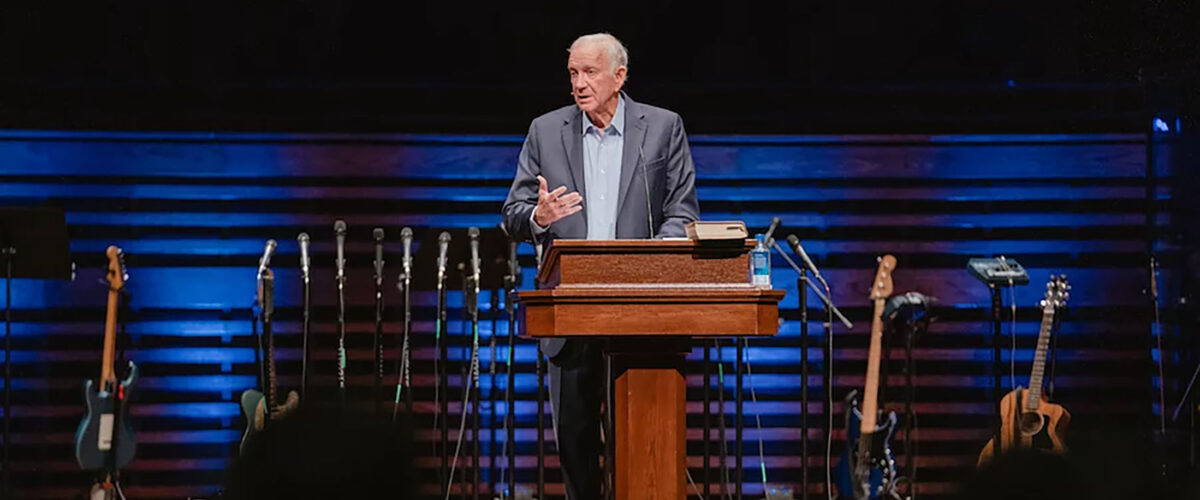
Robert B. Sloan was born and raised in West Texas — in don’t fence me in West Texas. Born in Coleman, raised in Abilene, he died in Houston, America’s fourth largest city on July 4, a fitting place and day to mark his legacy.
What stands in between is the story of how a smart, shy, kind, quiet, athletically gifted boy, raised in faith and farm in equal amounts, became a husband, father, scholar, teacher, preacher, educator and president of two academic institutions. Nothing about Robert Sloan’s life could ever be said to be constrained.
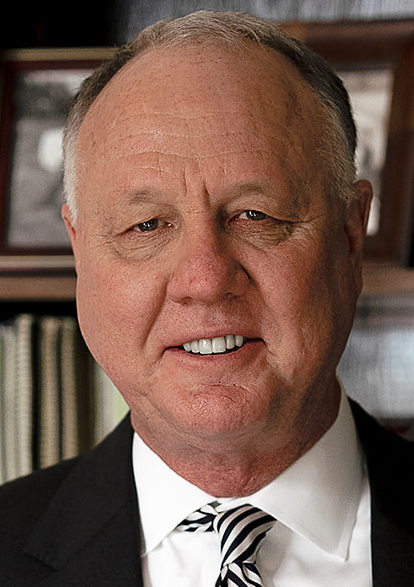
Carey Newman
To know Robert Sloan was to understand that the epicenter of his life was his family. Sloan won the lottery when he married Sue Collier. She steadied, advised, supported, loved, celebrated and gave. Sue was and is full of good, old-fashioned love. And theirs was a good, old-fashioned love story. Robert was the consummate father to his seven — yes, count ’em, seven — children, and nothing brought him more pride than their achievements and his 25 grandchildren. Robert’s family devotion knew no bounds. All else revolved around it.
Robert played baseball at Baylor as an undergraduate. His love of baseball was an equally enduring feature of his life. I know this firsthand. The 30-year argument over the relative merits of American League baseball (his favorite) and National League baseball (mine) came to be a parable of our relationship. I often wondered how he, such a purist on so many matters, came to embrace such innovations as the designated hitter and colored baseballs. But Robert Sloan was simply not predictable.
There was no predicting that he would earn his graduate degrees from Princeton and Basel (Switzerland); that he would begin his professional career in Roscoe, Texas; that he would land at Southwestern Seminary at precisely the right moment; that a turn of events would lead him back to Baylor in an endowed chair; that a chance ride to Houston with Baylor President Herb Reynolds would lead to Sloan becoming the founding dean of Truett Seminary; nor that the failed search for Reynolds’ successor would end up on the door step of Robert B. Sloan.
“Carey, I will neither put a rock in the stream, nor will I take it out if someone puts it there.”
“Carey, I will neither put a rock in the stream, nor will I take it out if someone puts it there,” he told me. The improbable occurred, right before the eyes of all. Robert Sloan became Baylor’s 12th president.
His election was at the height of the Baptist wars, and Sloan soon broke with the McCall-Reynolds vision of the university. But since its inception, Baylor always has had two trajectories — a focus on regional Baptist life and the development of a national university of international consequence. Sloan didn’t reject small and regional so much as he leaned into the founding charter and the vision of Samuel Palmer Brooks, a vision that imagined Baylor as a full-scale national and international university.
The Baylor of “Baylor 2012” was as much Baylor as Baylor ever had been. The problem — and maybe legitimately so — was that those to whom Robert turned to help him grow Baylor into the best Baylor could be didn’t understand Baylor at all — and didn’t want to. They wanted to use Baylor for their own ends. But the controversy over Baylor’s future showed once again that Sloan was someone who refused to be fenced in. The present Baylor administration’s touting of R-1 stands directly on the shoulders of Sloan’s “Baylor 2012” — even if this present administration has succumbed to institutional amnesia
But even Baylor didn’t fence Robert Sloan in. No, he was not done. Not even a little bit. He came to play life’s full nine innings. The years at the helm of Houston Christian University proved pivotal and fruitful. In a city that touches every language group, every ethnicity and all the cultures of the world, Sloan set out to build a great Christian university. And that he did. He transformed HCU.
It was a muggy late fall afternoon in West Palm Beach. Robert and I were walking from the apartment Leanne and I had at Flagler Towers on Palm Beach Atlantic College’s campus, where I taught at the time. We were headed to Chapel by the Lake, an outdoor amphitheater of First Baptist West Palm Beach. Minutes before the start of the service, Robert looked at me and asked, “Carey, what should I preach on tonight?” I looked at him, incredulously, not half believing he was really doing this. I resisted the temptation to select some obscure passage just to watch him squirm. Instead, I chose Romans 8. “Preach the last part. “Nothing shall separate us.”
Without notes, without preparation, without any prior inkling of what I might say as his text for the night, Robert preached the best sermon on Romans 8 I have ever heard. It was rhetorical. It was textual. It was theological. And it was deeply, deeply spiritual.
Robert loved such space. He thrived on freedom — the freedom of God’s Spirit, the freedom of God’s love. This July 4, an apt day for someone who found the endless sky of West Texas a lasting friend, demonstrated that even death could not fence in Robert Sloan’s Life. No, not even a little bit.
Carey C. Newman was a student of Robert Sloan and a longtime friend. He is a New Testament professor who gave the second half of his career to publishing, with leadership roles at Westminster John Knox Press, Baylor University Press and Fortress Press.