

Most American megachurches have rebounded well from the COVID-19 pandemic as more than 80% reported they are flourishing, according to a new report by Hartford Institute for Religion Research.
The study examined responses from 331 mostly Protestant congregations with 2,000 or more people attending in-person worship services on a typical weekend, which meets the traditional definition of a megachurch.
The rise of large-attendance churches during the past 50 years has resulted in “an astounding” one-third of Protestant churchgoers now attending churches that draw 1,000 or more worshipers on a weekend, the Hartford report states. “All signs indicate this shift will continue to accelerate toward a concentrated, increased number of attenders in larger congregations, as big-attendance churches grow, and the gap between larger and smaller congregations continues to widen.”
Megachurches account for 1% of American congregations but 17% of U.S. worshipers.
While megachurches account for fewer than 1% of American congregations, they draw 10 million weekly worshippers, the report says. “The count of megachurches is just under 2,000, a tiny slice of the total population of 335,000 Protestant churches, yet they represent roughly 17% of total worshipers in the nation’s churches.”
Megachurches, however, were heavily affected by the pandemic, with 88% canceling in-person gatherings, 71% taking out PPP loans and experiencing significant turnover in membership, and diminished attendance.
But just five years later, 45% say they have grown by 25% or more and 22% say they have grown between 5% and 25%.
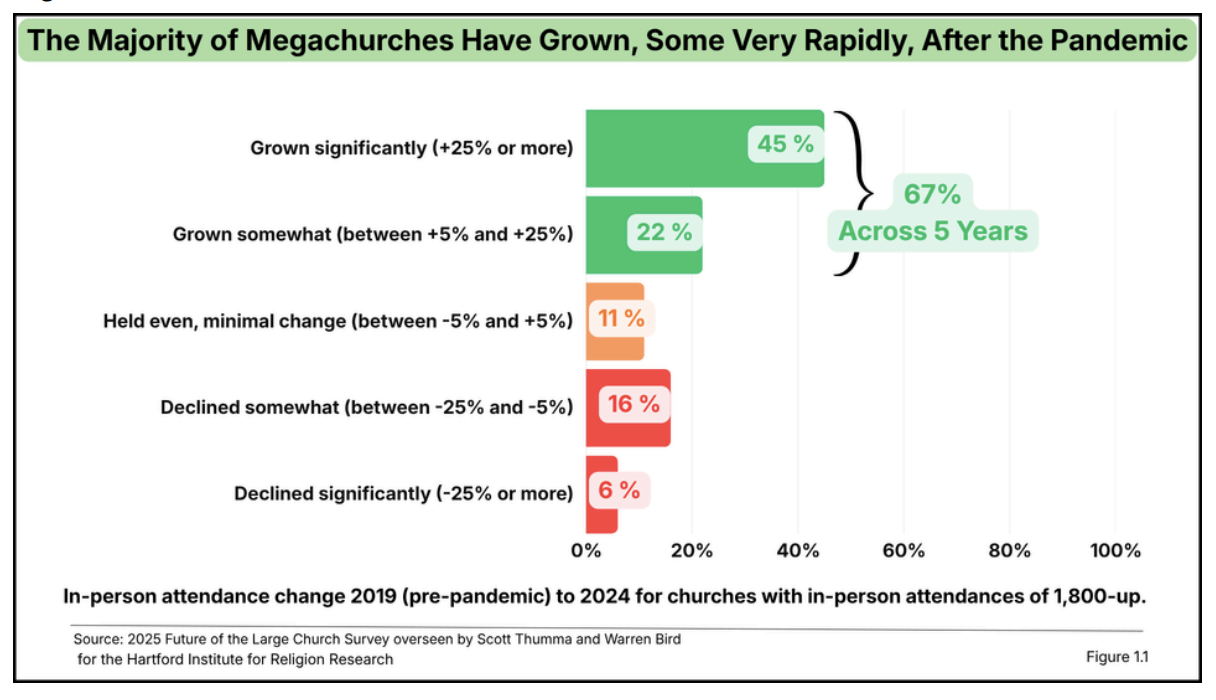
Researchers also found a correlation between large growing churches and those likely to describe themselves as innovative in worship, spiritually vital, increasingly evangelistic, more willing to change, improving discipleship and more attractive to 18– to 35-year-olds.
One of the strategies fueling the rebound for some megachurches is the “attractional model” in which members are encouraged to invite friends. Congregations that grew by 25% or more since 2025 said 76% of their people had invited someone to church.
“It shows that churches with a high invitation culture tend to be growing and also that larger churches tend to have a much higher percentage of their church’s regular participants involved in recruiting new people,” the report states.
Most megachurches reported that small groups were essential in nurturing spiritual formation: “Almost 19 out of 20 megachurches (94%) affirm the centrality of groups —defined as small groups for fellowship, spiritual nurture, etc., in addition to church school or mission groups.”
One notable data point: Most megachurch attenders (68%) attend worship once a month compared to only 5% who come three or more times a month.
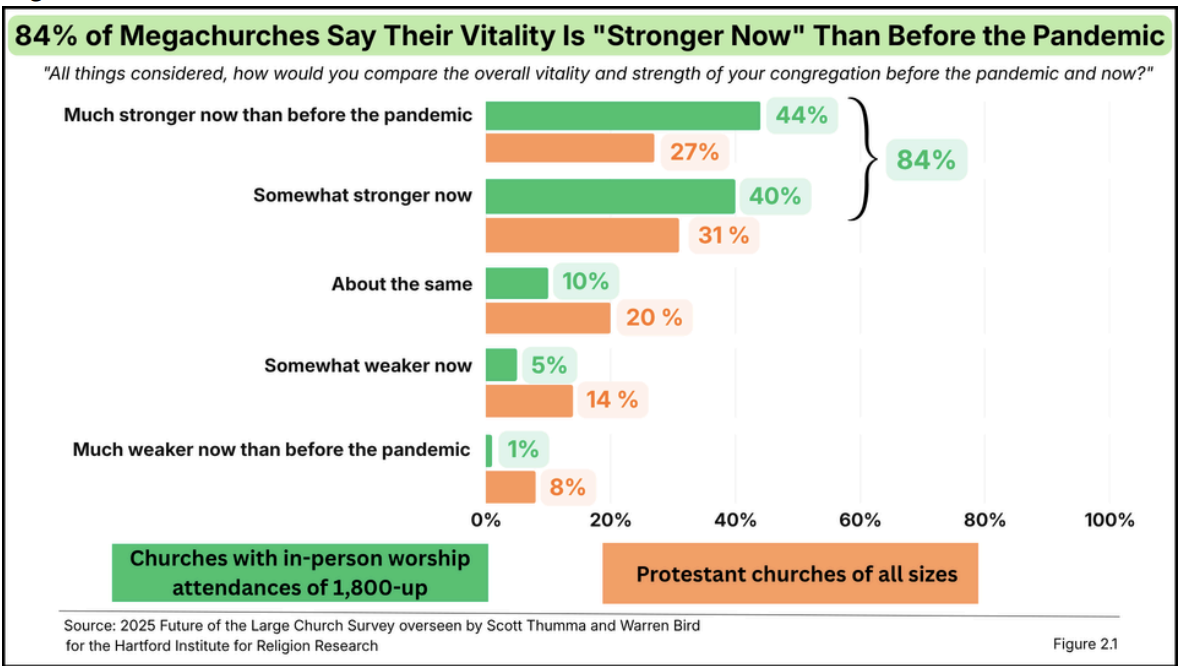
Megachurches also report dramatic increases in congregational vitality, the report says, with stronger “overall vitality and strength” than before COVID. Close to 45% answered the question about vitality with “much stronger,” and 40% said “somewhat stronger.”
By comparison, the percentages dropped markedly when adjusted for Protestant congregations of all sizes, with 27% answering “much stronger” and 31% “somewhat stronger.”
Congregations also were asked about the degree to which they agree with the statement, “Our church is spiritually vital and alive.” In 2025, the megachurch response was the highest ever — 97% either agreed or strongly agreed.
In addition, 86% of megachurches expressed “a strong sense that they are thriving and will continue to thrive going forward,” compared to just 36% of all Protestant churches.
“It is striking that when given five levels of response options — from struggling to thriving — big churches overwhelmingly selected this top option, where the comparison group — churches of all sizes — had a decidedly less optimistic view of their congregation’s future,” researchers said.
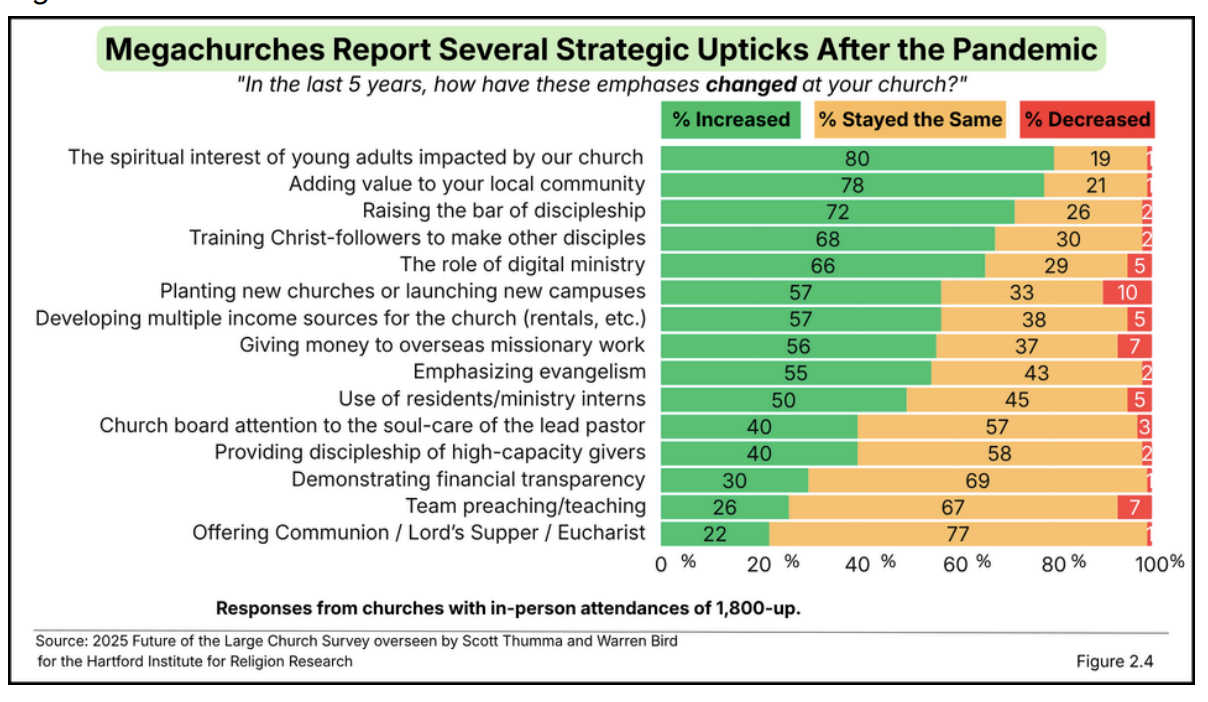
When asked to describe “upticks” in congregational priorities since the pandemic, 80% of megachurches identified the spiritual interest of young adults, 78% said adding value to local communities and 72% said improving discipleship.
A significant majority (92%) of megachurches also rejected the notion that they struggle to build connections between members of their congregations.