

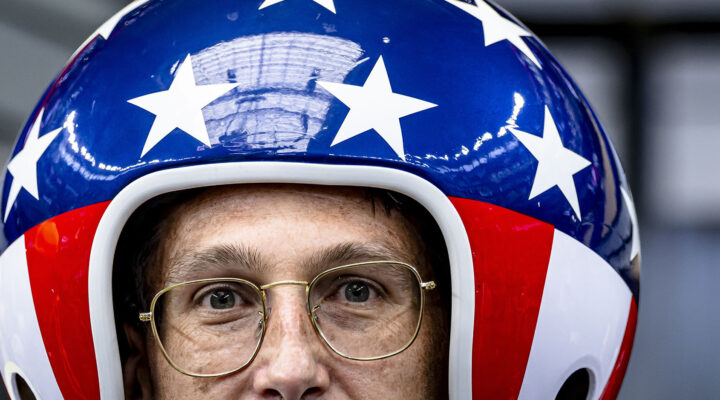
Through recent World Cup fervor, American patriotism has reigned — even more so it seems than on the Fourth of July.
A New York Times article says it well: “At a moment when national pride is at a quarter-century low, according to Gallup, Americans, even for a fleeting moment, have something to unite around.”
Soccer brought us together and provided connection.

Cara Meredith
Yet I understand what Gallup found in its survey. My American pride has fallen to a 25-year national low and I, too, was desperate for a little bit of unity in an already-divided country.
Had Gallup interviewed me, they would have found me intrigued by this sports-related unity, by the tears that well up when it seems like something bigger than myself is at play. But they also would have found me wondering about the obvious, seemingly inevitable intersection of hyped patriotism, military fetishization and sports that also seems to be a part of these moments.
In Grace Over Guns, Presbyterian pastor Ben Daniel argues that “patriotic actions and military celebrations at U.S. sporting events are evidence of a spiritual pathology in need of healing grace.” Of this, he goes on to say:
From 20th-century European fascism to the rise of communism in various places around the world, history tells us that people turn to excessive displays of jingoistic patriotism and military demonstrations when they lack spiritual roots, feel impotent and threatened by new ideas and social progress, and are disconnected from communities and religious institutions. When such spiritual weakness is present in a country, populations become vulnerable, and those who promise transcendence, meaning, and belonging through patriotism, and pledge protection through military strength, are able to wield increasing power.
Daniel, who embraces pacifism, encourages becoming a conscientious objector. In 2018, he , voted with his congregation to become a “peace church”: Those of us who “consume sports-based entertainment are being led — manipulated, perhaps even brainwashed — into believing there is an inherent connection between loving a sport and loving one’s country and supporting its military.”
Daniel learned the Pentagon paid sporting teams “millions of dollars each year for patriotic displays at professional sporting events” and, as of 2022, “the Department of Defense was considering a proposal to offer scholarships for college athletes who play sports other than football and basketball — scholarships that would be contingent upon a commitment to post-collegiate active military service.”
With that in kind, we can’t help but wonder if something’s gone awry.
Further, when fans and players both have been punished for not showing patriotism at public sporting events, nonparticipation is seen as a challenge to the political order, prompting, at least for Daniel, “uncomfortable questions about why so much patriotism happens at sporting events in the first place.”
As for me, a casual fan of professional sports at best, like Daniel, I can only hope to err on the side of grace. After all, he says, this grace “makes us strong, and because we are strengthened by grace, we need not fear or be threatened by ideas or expressions that we find disagreeable.” Instead, and always, by and in grace, we live alongside those who hold a wide variety of opinions, including opinions quite different from our own.
Cara Meredith was raised in the American Baptist Churches in the USA but currently worships as an Episcopalian and recently was ordained there as a deacon. She is a freelance author based in the San Francisco Bay Area. She is the author of Church Camp: Bad Skits, Cry Night, and How White Evangelicalism Betrayed a Generation.