

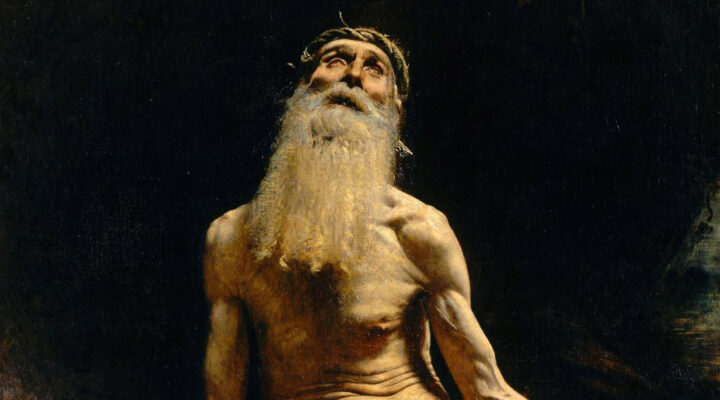
For about a decade, I have had a book brewing that takes on the book of Job. It is now about to come out Sept. 1. It will be called Job in Exile: A Guide for Spiritual Refugees.
There are a lot of reasons why I decided to tackle Job. A lifetime fascination, for one thing. The role of Job in Holocaust theology. The courage of Job to ask his questions and make his protests. The way Job speaks to post-evangelicals and other spiritual refugees.

David Gushee
I realized while writing the book that perhaps one draw was this: Job asks whether the world is governed by a just God — or at least whether God acts so that justice prevails on earth. Sure. Obvious.
But then it struck me: We are living in the middle of a great big object lesson about the very same question. That object lesson exists in the person of one Donald J. Trump.
“His continued power and success itself is an example of the problem of evil in the world.”
At least for the tens of millions of us who oppose him from the very core of our being, his continued power and success itself is an example of the problem of evil in the world. It raises questions about the involvement of God in our world and about the existence of a moral order, as promised by so much of the Bible, in which the good are rewarded and the wicked punished.
I think a great amount of the angst, anger and anguish one finds in the heart of Trump critics, at least those of religious belief, is located right there. People are morally and religiously disoriented by Trump. They are wrestling to restore religious and moral order.
What follows draws on a section of my forthcoming book while extending its argument into our current political and theological moment.
Point-counterpoint
Zophar:
Heaven will expose his iniquity;
Earth will rise up against him.
His household will be cast forth by a flood,
Spilled out on the day of his wrath.
This is the wicked man’s portion from God,
The lot God has ordained for him.
— Job 20:27-29
The rejoinder of Job:
Why do the wicked live on,
Prosper and grow wealthy?
Their children are with them always,
And they see their children’s children.
Their homes are secure, without fear;
They do not feel the rod of God.
— Job 21:7-9
In Job 20, Zophar claims in a long and picturesque soliloquy that the wicked are punished in this life, in the end coming to complete ruin.
But in Job 21, Job claims the wicked are not punished in this life but instead prosper and live at ease until their peaceful deaths.
Close study of these two chapters yields the conclusion that they are a matched set, an intentional contradictory pair, a point-counterpoint debate. Everything Zophar claims in Job 20 is rebutted by Job in Job 21.
Five examples
Here are five crucial examples:
- Zophar claims that “since man was set on earth, the joy of the wicked has been brief” (20:4-5)
Job rebuts by saying if one had “consulted the wayfarers” (21:29-30) they could offer plenty of “evidence” to the contrary. Experienced observers can easily report that instead of being punished, “the evil man is spared on the day of calamity.”
- Zophar claims that while the wicked man “grows as high as the sky,” soon enough he perishes so completely that he disappears like a dream (20:6-9).
Job rebuts by saying “the wicked live on” (and on and on), and you can easily find them at their homes enjoying their enviable prosperity (21:7-9).
- Zophar claims the children of the wicked also are ruined, as their fathers’ loss of prosperity falls on them as well (20:10, 19-21, 26, 28).
Job rebuts by saying the children and children’s children of the wicked are with him, the little ones frolicking and playing on the family estate, enjoying the good life the wicked patriarch has made available to them (21:8, 11-12).
- Zophar uses an extended food metaphor — “though evil is sweet to his taste” — to suggest the ill-gotten happy lifestyle of eating and drinking and merrymaking of the wicked soon enough will turn to poison in their bellies (20:12-17, 23).
Job rebuts with a similar metaphor but entirely different meaning: “His pails are full of milk. The marrow of his bones is juicy” (21:24). The wicked die fat and sassy. The poison never comes.
- Zophar claims “because he crushed and tortured the poor,” the wicked will have to “give back the goods unswallowed” (20:19).
Job rebuts by lamenting “how seldom does the lamp of the wicked fail” (21:17) and how “they spend their days in happiness and go down to Sheol in peace” (21:13). Not only that, but they also mock at God and refuse to learn God’s ways, without anything bad happening to them (21:14-15).
Who is right, Zophar or Job?
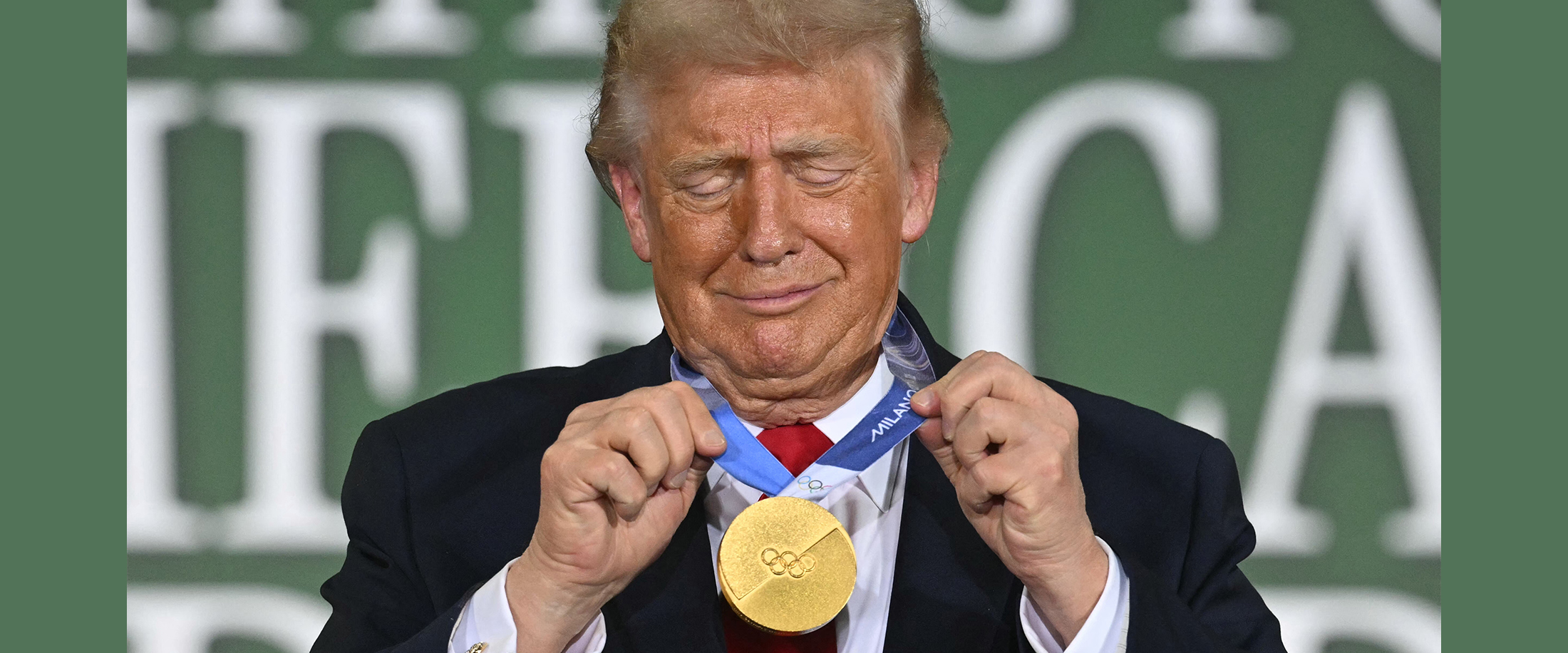
President Donald Trump wears the Olympic gold medal of US speedskater Jordan Stolz as he takes part in a roundtable on “American Agriculture” at Custer Farms in Chippewa Falls, Wisconsin, on June 5, 2026. (Photo by SAUL LOEB / AFP via Getty Images)
The case of Donald J. Trump
A very substantial portion of the U.S. population, along with billions abroad, has for the last decade been struggling morally and even theologically with the continual triumphs of a man named Donald Trump.
The point-counterpoint of Job 20-21 resonates deeply in this unfortunate Age of Trump. President Trump is in the second year of his second term and is the dominant figure both in global and U.S. politics. He is 80 years old, born to money and fabulously wealthy.
He has lived long enough to see children and children’s children enjoy his several grand estates. His various joys have not been brief; he grows to the sky and remains there; he has not disappeared; his children have not been brought low; evil has not turned to poison in his mouth; he eats whenever and whatever he wants (contra Job 20:5-17).
With a few court-ordered exceptions, he has not given back the goods he has taken from those unfortunates he has harmed; he has plenty of survivors to enjoy his growing financial legacy when he dies; some of his iniquity may have been exposed, but earth has not risen up against him (contra Job 20:18-27).
“Job is much more accurate in this particular case when he says, ‘The wicked live on, prosper and grow wealthy.’”
Job is much more accurate in this particular case when he says, “The wicked live on, prosper and grow wealthy” (Job 21:7). Mar-a-Lago and every other estate Trump owns is well-guarded, secure and unpunished either by humans or by the “rod of God” (Job 21:9).
Trump has abundant children and grandchildren who at this writing are growing wealthier, in part through dubious schemes trading on the global power of the U.S. presidency.
While Trump refers to God or religion sometimes, many of us see no evidence of a man who seeks to learn or live in God’s ways (Job 21:14-16). The “calamity” many believe is fully deserved by this man, he continually eludes or, better, outmuscles (Job 21:17).
Through his actions, many an unfortunate suffers greatly, and yet “his pails are full of milk,” his estates full of guests, his bank accounts full of money (Job 21:20-25).
Anyone who has ever dared to “upbraid him to his face” now has reason to fear retribution (21:31).
Every room he enters he is met with honor. With his security detail, his donors and his fans, “everyone follows behind him, innumerable are those who precede him” (Job 21:33). Presumably, he will die one day as an honored man and be given a grand presidential funeral.
Maybe we cannot agree on who is wicked
Have I made a devastating case from the single most visible human example in our time that Job rather than Zophar is correct about bad people not being reliably punished in this life? Many millions of like-minded observers in the U.S. and around the world might rush to agree.
But many other millions would not agree, not in the slightest. Routine news accounts of the U.S. citizens who approve of Trump include interviews with people who decidedly do not agree that he is a bad man. Instead, they believe it is his enemies who are wicked, who are rightly being thwarted, who in some cases are being legally attacked.
Moreover, a religious subset of Trump fans is decidedly convinced that God is specially with him, that he has been spared by God as evidence of God’s hand on him, and that his triumph is wonderful evidence of a just God ruling a just world.
Zophar says the wicked are brought low. Job says they are not. This might seem like an empirically solvable argument. In theory, all one must do is undertake a count of wicked people and look what happens to them.
But that would require being able to agree not just on what is wickedness (and what is goodness) but also on an assessment of where specific current people fall within those categories. In our morally divided societies today, we are experiencing very great difficulty doing precisely this. One group’s hero is another group’s villain.
“The question for Job is not what he and his community believe is virtuous but whether he has been virtuous.”
Later in the book of Job, our hero will conclude his defense of his life with three chapters (Job 29-31) describing in magnificent detail the virtuous life he sought to live prior to the unjust ruin that fell upon him. Surely, he will not offer such a defense without believing his community will agree on what qualifies as virtuous behavior.
The question for Job is not what he and his community believe is virtuous but whether he has been virtuous.
That, I think, is what is going on with Job and his grand book. But I am not sure it is true of us today. Here in the 21st century, in the U.S. at least, we do not agree on what is virtuous and perhaps this is why we cannot agree on who is virtuous. In terms of social cohesion over the long term, we may be far worse off than the community that surrounds the unfortunate man named Job.
Job’s community needs to interpret Job as wicked to make moral sense of his ruination. We don’t know how to make moral sense at all. This leaves terrifyingly open the question of whether we can survive as a community.
David P. Gushee serves as Distinguished University Professor of Christian Ethics at Mercer University, chair in Christian social ethics at Vrije Universiteit Amsterdam and senior research fellow at International Baptist Theological Study Centre. He is past president of the American Academy of Religion and Society of Christian Ethics. He also is author of 30 books, including Righteous Gentiles of the Holocaust; Kingdom Ethics; Defending Democracy from Its Christian Enemies; Changing Our Mind; and The Moral Teachings of Jesus.
Related:
3 views on Donald Trump held by American Christians | Opinion by Mark Wingfield
The contemptible case of Clarence Thomas | Opinion by Joel Bowman