



Back then it was Beverly LaHaye and Phylis Schlafly. Now it’s Alex Clark and Allie Beth Stuckey. To be a female conservative Christian leader is to navigate the contradictions in making careers of saying women shouldn’t have careers but “should be barefoot and pregnant and in the kitchen,” as Clark tells her followers.
These leaders “praise intensive stay-at-home motherhood, yet frequently prioritize their political careers over their kids,” writes Katie Gaddini, an exvangelical Baptist minister’s daughter, in her concise but deep-diving book, Esther’s Army: The Christian Women Who Power the American Right.

Katie Gaddini (Photo by Lily Bungay)
Campaigns for sexual purity and traditional family values “disavow feminism yet borrow from feminist rhetoric and strategy to make political claims,” she writes.
Today’s in-your-face “cuteservatives” — Clark, Stuckey and anti-trans activist Riley Gaines — “frame their aggressiveness as necessary in the face of perceived attacks from the Left,” writes Gaddini. But they soften the blows with “their conventional beauty” and a sometimes exaggerated and “hyperfeminine style of dress.”
Esther’s Army shows that for half a century, conservative women have used their hard-earned freedom to limit women’s freedom.
Schlafly led a successful nationwide campaign to halt the Equal Rights Amendment while playing the submissive wife. “I’d like to thank my husband for allowing me to speak here tonight,” she would say.
“I’m doing this work because my husband wants me to do it,” said Connie Marshner, a pioneering anti-feminist who worked with the Heritage Foundation and Free Congress Foundation.
Gaddini’s pastor-father taught her to pair evangelicalism with right-wing ideology. She later left both conservative faith and politics.
“I know rightwing Christian women not only because I’ve studied them as a sociologist since 2015, but because I used to be one,” she writes, estimating there are 30 to 35 million of them in the U.S.
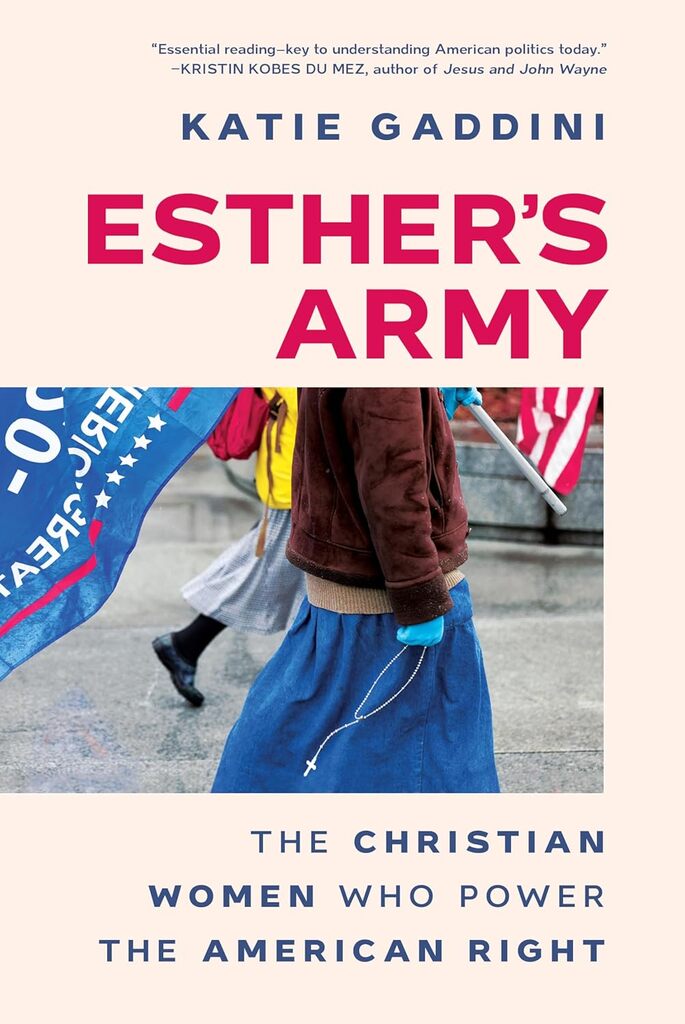 She spent a decade researching, attending events, interviewing dozens of ordinary women and crafting three-dimensional portraits of women you’ve never heard of who are on the front lines of the culture war.
There’s Alyssa, the Liberty University student who’s involved with the late Charlie Kirk’s Turning Point USA and Young Women for America, the youth division of LaHaye’s Concerned Women for America.
For Alyssa, activism began early. She was 12 when she testified against a bill granting transgender people bathroom access. She recently testified against transgender sports participation and is all-in on support for Donald Trump.
There’s Pearl, a Black Christian activist dynamo who’s trying to convert fellow Blacks from blue to red when not “volunteering with groups like Moms for Liberty, Blexit, Alabama Women for Trump, and Gays Against Groomers.”
Pearl is convinced 2024 presidential candidate Kamala Harris is not Black; that President Barack Obama is a “gay Muslim”’ that First Lady Michelle Obama is transgender; and that Haitian immigrants in Springfield, Ohio, really do eat their neighbors’ pets. Pearl organized a meeting in her own town to make sure Haitians didn’t eat pets there.
Esther’s Army shows that for half a century, conservative women have used their hard-earned freedom to limit women’s freedom.
Gaddini’s book clocks in at just under 150 pages of text, but she weaves stories like Pearl’s into broader narratives highlighting movement leaders, including Candace Owens, the foul-mouthed conspiracist Blexiteer who spreads antisemitism and claimed the French first lady is a man.
Pioneers like LaHaye, Schlafly and Marshner worked decades to develop national platforms. Social media has changed that game, as Gaddini shows in tracing Alex Clark’s unlikely rise since 2016, when she engaged in “marathon make-out sessions” on the Fox reality dating show Coupled.

Alex Clark (Photo: Wikipedia)
Clark was co-hosting a morning radio show in Indianapolis when she landed on the radar of TPUSA. The pro-MAGA group trained her, “ultimately transforming her from a Midwestern radio host to one of the most popular conservative influencers.”
Clark is just one of the hundreds of popular young conservative influencers TPUSA has developed, claims Esther’s Army.
Gaddini’s history remains confident until the book’s three-page epilogue, where she wrestles with the question people have asked her countless times: “How could the religious group I’d grown up in, which I knew so intimately, and still loved despite having left, throw their weight behind … such an anti-woman candidate as the current president?”
It’s a question she can’t answer.
“I have spent years studying right-wing Christian women and yet I still don’t fully understand them,” she writes.