

“Today, I can finally say the words I’ve been fighting to say for years: Provo Canyon School is officially shut down,” said Paris Hilton last Friday in response to a decision to revoke the institution’s residential treatment license.
The private boarding school she attended in the 1990s must end all services to boys and girls by Aug. 16.
Hilton alleges enduring physical and sexual abuse at the hands of staff. Provo Canyon School was a residential center for troubled teens, advertised on its website as an institution for children who needed help with “behavioral and mental development.”
In recent years, the star has publicly called out the troubled teen industry, calling for Provo Canyon School to be shut down and lobbying for stronger laws to protect children from similar programs. Since her public advocacy began, she has participated in the passage of 16 state laws, a federal law and a federal bill.
And while she may have been the loudest voice against Provo Canyon School, she is not the only known survivor.
Meg Applegate, founder and CEO of the child abuse survivor advocacy nonprofit Unsilenced, spoke about the institution at a recent press conference addressing two new abuse lawsuits against it. In addition to publicly known stories, there are numerous allegations of child abuse “spanning the last 50 years of Provo Canyon School’s operation,” she said.
“The facts are clear. Children are not safe at Provo Canyon School,” Hilton alleged at the same press conference. “Until you shut this facility down, I will keep showing up. I will keep shining a light, and I will not stop, not until every child walks out of Provo Canyon School alive, and not until Provo Canyon School is permanently closed.”
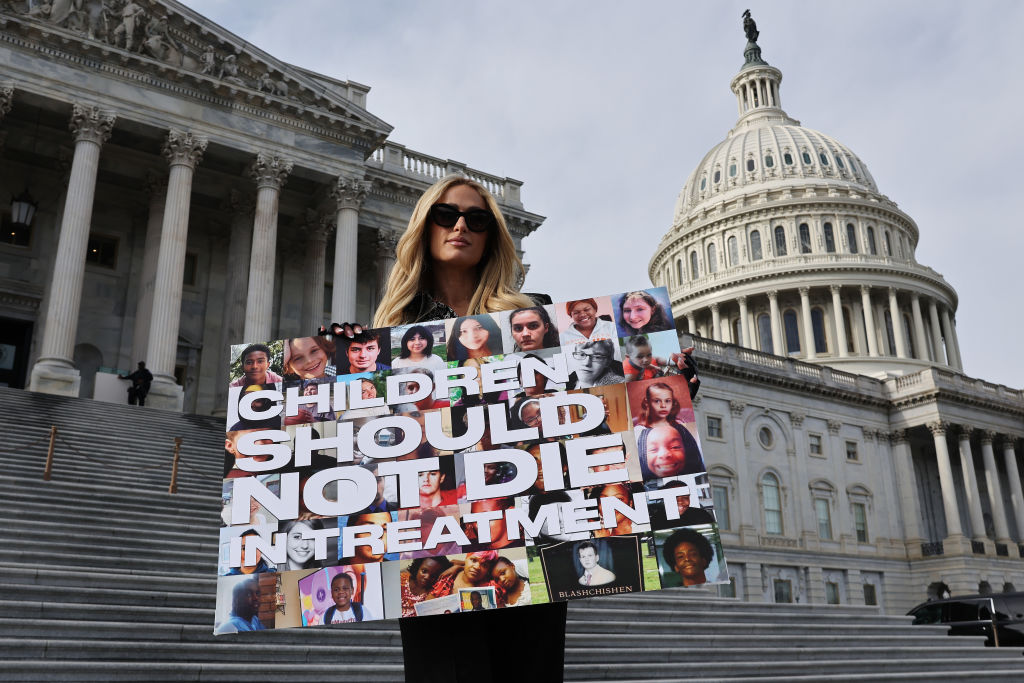
Celebrity hotel heiress Paris Hilton poses for photographs outside the U.S. Capitol on the day the House of Representatives is set to vote on The Stop Institutional Child Abuse Act on December 17, 2024 in Washington, DC. Citing her own traumatizing experience at Provo Canyon School in Utah when she was a teenager, Hilton has lobbied for three years for the legislations that would place greater federal safeguards on institutional youth treatment programs. (Photo by Chip Somodevilla/Getty Images)
The two recent incidents involved children who were injured or sick and improperly cared for by school staff. In both cases, staff chose not to seek professional intervention for serious conditions in a timely manner, instead attempting to handle the incidents in-house.
One teen was a 13-year-old anonymously referred to as AC who “suffered a fractured jaw and intracranial bleeding” in a May 14 incident involving a fight with another student, which staff allowed to escalate into a physical altercation. According to court filings, AC lost consciousness, and neither law enforcement nor emergency medical services were contacted immediately.
The school also failed to promptly inform the child’s mother, who said the most hurtful part of the situation is that she felt “manipulated into believing that this was a place of healing and safety.” But rather than helping her teen, she says his experience at Provo Canyon School “left him completely more hurt and more angry and more traumatized than before.”
As a result of this lawsuit, the Utah Division of Professional Licensing issued the school a conditional license, placing strict conditions on the portion of the institution responsible for the care of boys. That conditional license expired last Saturday.
The other lawsuit involves a female student known as BH who, after vomiting profusely for two days, was only given ibuprofen once daily by staff. Again, no ambulances were summoned, nor was she taken to an emergency room. Once BH finally was given treatment, physicians identified the ibuprofen as a “nephrotoxic agent” that contributed to her acute kidney injury.
“By the time she got medical care, she was in kidney failure and will have lifelong treatment and care,” said Alan Mortensen, a lawyer representing the family. BH must now travel four hours round-trip to Omaha for dialysis three times a week.
The day before the conditional license expired, the Utah Department of Health and Human Services completely revoked the school’s residential treatment license.
“No child should be hurt in a program that is meant to protect them; particularly programs that require the authorization of the state to operate,” said Shannon Thoman-Black, the state’s licensing and background checks director. “It is our job to make sure that programs comply with administrative rules and regulations designed to provide a healthy and safe environment for those in care. These rules and regulations are fundamental safeguards to protect vulnerable people being served in facilities or programs.”
Hilton and other survivors are pleased with the decision, and hope this will lead to safer conditions for all children in residential treatment programs. She said the institution “messed with the wrong girl.”
“When I stood outside Provo Canyon School in 2020, they covered the windows so the children inside couldn’t see that survivors were outside fighting for them. They could block the children’s view of us, but they couldn’t stop what was coming,” she said.
Related:
The Troubled Teen Industry, often linked to religion, is dangerous and deadly | Analysis by Mallory Challis
Paris Hilton’s ‘Stop Institutional Child Abuse Act’ passes with bipartisan vote