

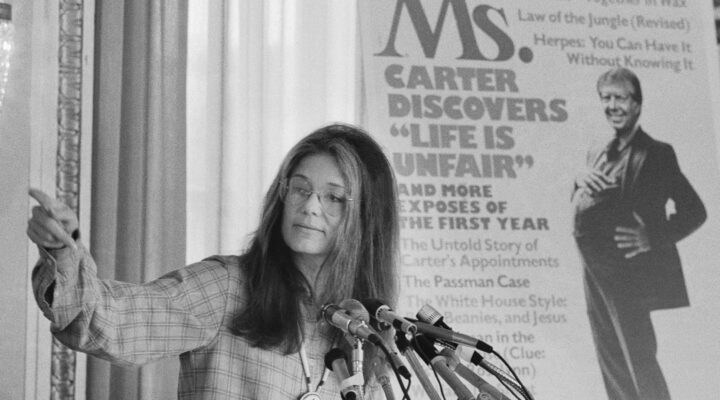
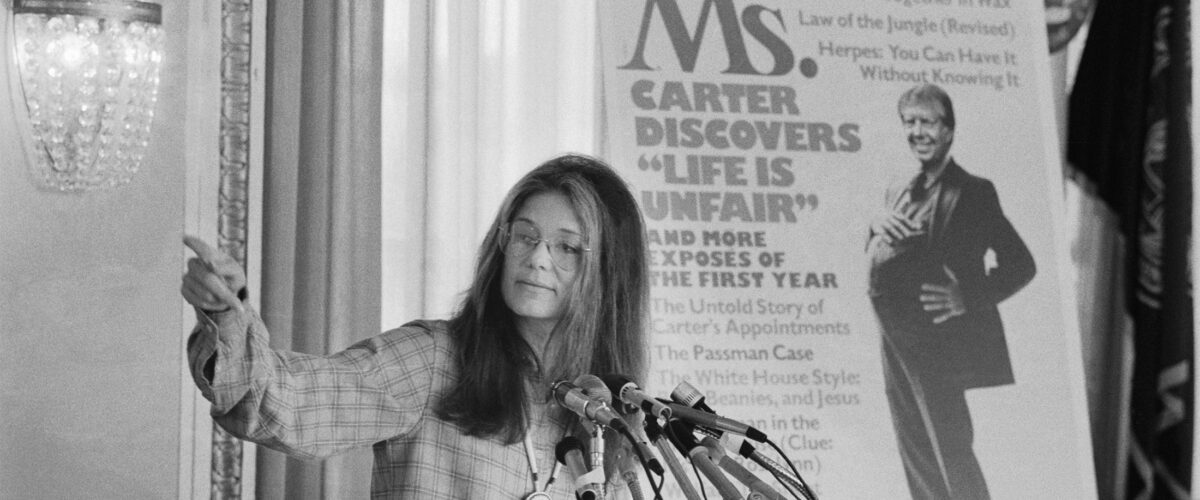
Gloria Steinem, a feminist journalist and women’s rights activist, died on Wednesday at 92 years of age.
Born in Toledo, Ohio, in 1934, Steinem was raised in an interfaith family — her father Jewish and mother Protestant. And while she generally did not describe herself as religious, antisemitism was a justice issue she fought against unequivocally. Steinem once remarked, “Never in my life have I identified as Christian, but wherever there is antisemitism, I identify as a Jew.”
And although it was her father who was Jewish, her mother and paternal grandmother were the ones who taught her most to embrace her Jewishness, especially as it related to social justice. Her grandmother, Pauline Steinem, was an active suffragist in the Ohio Woman Suffrage Association and served as one of two U.S. delegates to the 1908 International Council of Women. She and her colleagues organized and empowered groups of women to show up at the polls, although they faced intense ridicule for doing so from male community members.
Her mother and paternal grandmother were the ones who taught her most to embrace her Jewishness, especially as it related to social justice.
Later in her career, Gloria Steinem started a female-centered publication, Ms. Magazine, named after the title given to single, unmarried women. This was the first national magazine run and written by women who were free to address a variety of topics otherwise off-limits to women in journalism — such as abortion, lesbianism and domestic violence.
The journal brought to light the term “sexual harassment” and its reality for women all over the world. Steinem noted that because of this work, we now can plainly call out the ridicule her grandmother and so many other women were facing in the suffragette movement.
Bringing this to light opened doors for both national and international conversations about the risks women face while navigating daily life in a patriarchal world. A 1977 piece from the magazine on the topic even inspired the 1980 movie 9 to 5, starring Dolly Parton, which addresses sexual harassment in the workplace.
Steinem held a bachelor’s degree in government studies from Smith College and graduated in 1956, when women still faced numerous barriers in their career paths due to lack of government protections. Post-graduation, Steinem spent two years traveling India working with locals to organize against violence between castes and writing about this work as a journalist for Indian news outlets.
In a 2015 NPR interview, Steinem described this experience as liberating, empowering her to begin the rest of her work in the women’s movement.
After moving back to the U.S., Steinem became a freelance journalist, although she struggled to find the same freedom to write about the topics she was truly passionate about.
Women often were relegated to writing stories on “food, makeup, babies and celebrities,” and were barred from writing about politics, she said in 2020. Even stories about feminism were pushed down by editors in the late 1960s and early ’70s who rarely published pieces on the matter, let alone stories showing the women’s movement in a positive light.
In 1963, however, Steinem gained national attention when Show Magazine published “A Bunny’s Tale.” Steinem had gone undercover in one of Hugh Hefner’s nightclubs, aiming to examine how the so-called sexual revolution he was promoting was liberating for men but oppressive to women. The expose revealed the sexism and unfair wages female employees faced.
Along with her work in journalism, Steinem was a lifelong political activist, having helped form the National Women’s Political Caucus, which pushed for more women to hold political offices. She also spoke boldly about reproductive freedom, having had an abortion at 22, long before the procedure was legal.
Having been part of so many leaps forward in women’s rights, Steinem is an icon among feminists today. Awarded the Presidential Medal of Freedom in 2013, her career advanced the practical opportunities for women to work and live.
She also empowered women everywhere in their personal lives. Steinem wanted women to view themselves as important, capable and worthy of dreaming just as big as their male colleagues. One way she did this was by participating in a feminist Seder meal every Passover.
Steinem and other New York City women held the Seder annually on the third night of Passover with the intention of teaching Jewish women they matter. Together, they would examine the roles of female characters in the Exodus story, share personal testimonies and worship through song and prayer.
Steinem described this as a “spiritually centered occasion in my feminist life,” which addressed “the politics of here and now.” Engaging in this ritual helped her navigate the intersections of her religious and political life with meaning.
She explained, “When I feel most drawn to Judaism, it’s not the law part that attracts me, it’s the mystical part, the Kabbalah, the Shechinah (female aspect of God).”