
Baptist News Global
Sections
  • News
  • Analysis
  • Opinion
  • Curated
  • Podcasts
    • Stuck in the Middle With You ↗
    • Madang with Grace Ji-Sun Kim ↗
    • Highest Power: Church + State ↗
    • Non-Disclosure: The Silenced Stories of Kanakuk Kamps Survivors ↗
    • Change-making Conversations ↗
  • Storytelling
    • Faith & Justice >
      • Charleston: Metanoia with Bill Stanfield
      • Charlotte: QC Family Tree with Greg and Helms Jarrell
      • Little Rock: Judge Wendell Griffen
      • North Carolina: Conetoe
    • Welcoming the Stranger >
      • Lost Boys of Sudan: St. John’s Baptist Charlotte
      • Awakening to Immigrant Justice: Myers Park Baptist Church
      • Hospitality on the corner: Gaston Christian Center
    • Signature Ministries >
      • Jake Hall: Gospel Gothic, Music and Radio
    • Singing Our Faith >
      • Hymns for a Lifetime: Ken Wilson and Knollwood Baptist Church
      • Norfolk Street Choir
    • Resilient Rural America >
      • Alabama: Perry County
      • Texas: Hidalgo County
      • Arkansas Delta
      • Southeast Kentucky
  • More
    • Contact
    • About
    • Donate
    • Associated Baptist Press Foundation
    • Planned Giving
    • Advertising
    • Ministry Jobs
    • Subscribe
    • Submissions and Permissions
Donate Subscribe
Search Search this site

Church uses vandalism as social media message

OpinionAlan Rudnick  |  June 3, 2013

What do church leaders usually do when someone vandalizes the side of a church with graffiti? Cover it up, repaint, or remove the vandalism. A church in Randolph, New York was recently vandalized with the words, “Can I still get into heaven if I kill myself?” The church responded in a remarkable and unconventional way.

Grace Episcopal Church allowed the vandalism to stay, but the church added their own reply:
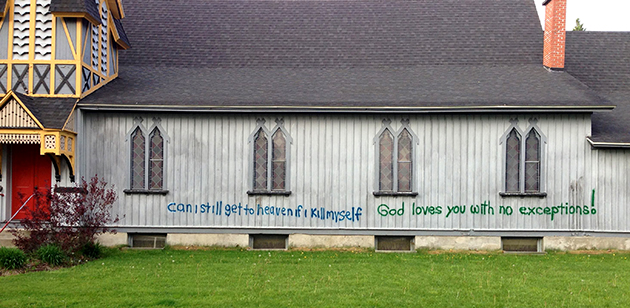
churchheaven

The above picture circulated around Facebook and Twitter with folks generating a conversation about spirituality and community.

Elizabeth Drescher at Religion Dispatches covered the story and found out why the church responded in this way and how it relates to modern religious expression:

Rather than approaching the tagging as a criminal act, however, church leaders decided to take the graffiti seriously as an expression of something spiritually meaningful—a cry for help.. They approached it relationally, using the church building itself as a social media platform, and responding with their own message of hope.

It’s the story of a fairly traditional church actively recognizing that religious doubt, religious critique, and all manner of theological questioning that once would have been seen as belonging squarely within the clapboard walls of a village church unfold in a much wider, much more broadly networked universe.

What started as a process to respond to church vandalism turned into a broader conversation on social media. With hundreds of shares, likes, and comments on Facebook and Twitter, this church’s vandalism response sparked mostly positive reaction. Some of the replies on the church’s Facebook post tell of the conversation around suicide, religion, and young people:

“As a pastor who has lost a young adult son to suicide, let me add that the forum is 100% appropriate and the response is as well. Song lyrics or no, any indication that an individual might be contemplating suicide needs to be taken with the utmost seriousness.”

“I’m not of this faith, but I really respect and admire this response. It goes beyond religion for me. It comes down to basic, good old-fashioned human kindness, which, sometimes, is the one thing a desperate person needs.”

“This is what I got from this message (go ahead and kill yourself God loves you) should have been worded differently indeed! And so as long as I ask for forgives before I kill myself its all good right.”

“I think the response was great — people in that much pain need to know that not only does the Church love them, but that God loves them. Who knows, this might be just the turning point that this person needs to know that people and God cares”

“my experience working with suicidal people is that the thing that might encourage someone to get help is the sense that someone has heard them. We also don’t know if the person who painted the original message is suicidal or whether the are in profound grief after someone else’s suicide… or if something completely different is going on. You can’t really counsel an anonymous message written on a wall – sounds like the parish is doing the best they could have done under the circumstances”

This story is a lesson in leadership. Rather than react with, “Who would dare do this!?!” The church was proactive and asked, “Why is this person hurting so much to do this? What can we do to reach out in an equal response?” Many Christians and churches are quick to judge, but we must find creative responses to brokenness — as Jesus did.

Share this:

  • Share on X (Opens in new window) X
  • Share on Threads (Opens in new window) Threads
  • Share on Facebook (Opens in new window) Facebook
  • Print (Opens in new window) Print
  • Email a link to a friend (Opens in new window) Email
  • Share on Bluesky (Opens in new window) Bluesky
  • More
  • Share on LinkedIn (Opens in new window) LinkedIn
  • Share on Reddit (Opens in new window) Reddit
  • Share on Tumblr (Opens in new window) Tumblr
  • Share on Pinterest (Opens in new window) Pinterest
  • Share on Telegram (Opens in new window) Telegram
  • Share on WhatsApp (Opens in new window) WhatsApp

OPINION: Views expressed in Baptist News Global columns and commentaries are solely those of the authors.
Tags:Alan RudnickcongregationleadershipTechnology & ChurchreligionchurchesSocial Issuessocial media churchesCommunitySocial MediaCongregationsSpiritualitySpiritual FormationJesusMinistryChurch
More by
Alan Rudnick
  • Get BNG headlines in your inbox

  • Check out our podcasts


    Stuck in the Middle
    With You


    Madang
    With Grace Ji-Sun Kim


    Highest Power
    Church+State


    Non-Disclosure:
    The Silenced Stories
    of Kanakuk Kamps Survivors


    Change-making
    Conversations


  • Politics • Faith • Resistance: by Greg Garrett

    BNG interview series on the state of faith, politics and resistance in our nation.

    See also Greg’s series on Politics, Faith and Mission


  • Featured

    • Islamophobia is the next bogeyman

      Opinion

    • The Black Church cannot remain America’s emergency moral infrastructure

      Opinion

    • We are manna

      Opinion

    • Webinar explores religious context of America’s Founders

      News


    Curated

    • Staunch Israel critic and Gaza trauma surgeon Adam Hamawy wins NJ-12 primary

      Staunch Israel critic and Gaza trauma surgeon Adam Hamawy wins NJ-12 primary

    • Elderly Christian Among 31 Sentenced In China Church Crackdown

      Elderly Christian Among 31 Sentenced In China Church Crackdown

    • In U.F.O. Files, Some Christians See Vexing Questions — and Demons

      In U.F.O. Files, Some Christians See Vexing Questions — and Demons

    • Christian theologians react to the pope’s ai warning

      Christian theologians react to the pope’s ai warning

    Conversations that Matter.

    © 2026 Baptist News Global. All rights reserved.

    Want to share a story? We hope you will! Read our republishing, terms of use and privacy policies here.

    • Facebook
    • Twitter
    • Instagram
    • LinkedIn
    • RSS
    • 129