

By Jeff Brumley and Bethany Harper
There’s a lot about the Internet and social media that’s good for humankind and religion, says Rabbi Joshua Stanton.
“It demonstrates the creative potential of human beings and provides evidence that human beings are sacred,” said Stanton, assistant rabbi at Congregation B’Nai Jeshurun, a Reform congregation in Short Hills, N.J.
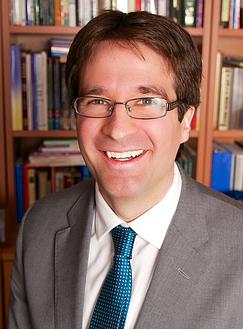
It’s the ability to create meaning and hope among often disconnected people and draw them together in faith, said Stanton, also an expert on the impact of Internet technology on society and religion.
“It’s evidence that we can make human life better,” he said.
And that’s how a group of Texas college students see it, too.
‘The people side of technology’
They are participants in Baylor University’s Computing with Compassion, a student-led campus outreach devoted to solving the technology challenges of ministries and nonprofits in Central Texas.
It’s already had a palpable effect on Baylor senior James Payne’s spiritual and professional future. That happened after he saw children at a church mentoring program reading books and engaging with the mentors.
“My work with Computing for Compassion has helped me realize I want to be on the people side of technology,” Payne said.
By meeting organizations’ technology needs, Computing for Compassion gives ministries, churches and nonprofits space to focus more on ministry and less on logistics, said Jeff Donahoo, a professor of computer science at Baylor. He and Bill Booth, senior lecturer in computer science, launched the group in 2013.
“Ministries in Waco and beyond should be able to focus on their mission, not get bogged down with technical challenges,” Donahoo said. Computing for Compassion “allows students with skills in computer science and information technology to use their gifts to magnify the capabilities of compassion-based ministries. Our goal is simply to help enhance the great work of these programs.”
Their projects have included improving website and donor communication for Global Banjara Baptist Ministries International, creating a mobile app for children with attention-deficit disorders and developing a church notes website for St. Luke Catholic Church in Temple, Texas.
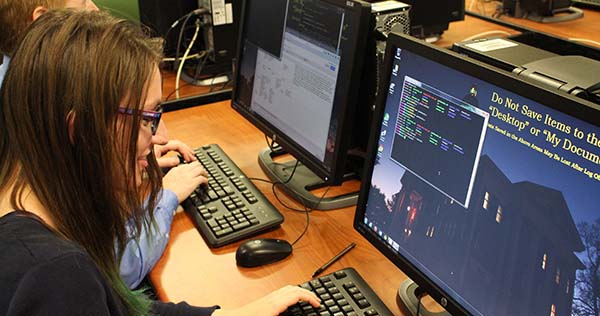
More than 20 students are working on projects through Computing for Compassion. The group mostly consists of computer science majors, along with students in electrical and computer engineering, bioinformatics, mathematics and University Scholars. The organization is open to all students interested in using their technological skills to better the community.
The program is a win-win for both the community and the students, Donahoo said. As students address problem-solving techniques and infrastructure improvements, they gain valuable real-world experience that does significant good for the community.
‘Gifted uniquely for service’
Students work in teams, interact with clients and develop strategies to further the mission of organizations. Nonprofits, in turn, implement and learn to work with new technologies, allowing more time to be spent focusing on their organizations’ ministry needs.
Through their work with the STARS Mentoring Project in Waco, Computing for Compassion students augmented the organization’s volunteer base by making it easier to bring in more mentors and service more students in need by improving their information technology.
“Their creative solutions, hard work and collaboration have helped us significantly streamline our administrative tasks,” said Michael Jeter, assistant director of STARS.
One Baylor student said it’s all about service.
“I believe we are all gifted uniquely for service, and Computing for Compassion provides a way for people who are good at computer programming to use their skills to serve God and others,” said Matt Arnold, a junior computer science major and vice president of the organization.
Arnold has spent many hours working on the STARS project.
“It was cool to hear reports from STARS about how our work was enabling them to work better and positively impact kids’ lives,” he said.
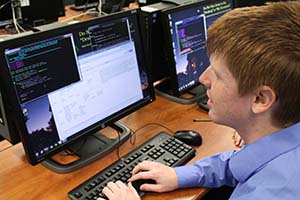
The work goes far beyond a degree requirement, Donahoo explained. His hope from the beginning was to see students’ lives transformed through investing in others.
“We hope our students’ dedication will be ongoing,” he said. “We hope that as students leave the university, they will carry forward a desire to plug in and support compassion-based ministries in their communities.”
Contributing to communities
Stanton said the Baylor computing students represent what’s good — the creativity evoked — about technology and the web.
“In many ways it has improved our lives and provided a tangible sense of what human beings are capable of,” said Stanton, who co-authored a recent Huffington Post article on technology and religion.
But there also are some down sides, as well.
“What’s painful for people is seeing the negative and the hurt in the world,” he said. “I don’t think we realized how much pain was out there until it showed up on our Facebook newsfeeds.”
It’s also threatening the role of authority and leadership in religion, largely because many individuals no longer feel they need religious bodies to provide prayer books and liturgies.
Stanton said that’s the ongoing debate in American Judaism.
“We are trending more to spontaneity in our prayer, but we need a certain common denominator of things that keep us together,” he said. “We are struggling to hold on to those common threads, even in worship itself.”
But there is also visible an urge to not allow technology to dismantle faith, Stanton said. He said it is visible in actions of the Texas computing students.
“People want to find ways to contribute to their communities,” he said.