

By Jeff Brumley
Few were surprised by a Pew Research Center survey finding that Republicans hold more negative views about Muslims than Democrats do.
But the poll — along with recent anti-Muslim protests in Texas — reconfirmed for some observers that it’s not easy being a member of that faith since 9-11.
“It must be a terribly painful time to be a Muslim in America,” said Matthew Baldwin, a biblical scholar and professor in the department of religion, history and philosophy at Mars Hill (N.C.) University.
But Baldwin and other scholars at Baptist, or historically Baptist, universities say the Pew survey reveals more astonishing and disturbing attitudes toward religion than it would seem.

Among them, Baldwin said, is how coldly Republicans view members of the Islamic tradition. Likewise, Democrats’ negativity toward Mormons is puzzling.
And it’s strange how they fit into the picture, he said.
“It’s better to be an atheist than a Mormon on the left, and better to be an atheist than a Muslim on the right,” he said.
Lukewarm feelings
Pew presents its findings as “feeling thermometer” ratings, with zero to 100 the coldest to the warmest feelings Americans have for various faiths.
Republicans and those who identify with them ranked Muslims at a chilly 33 degrees — just below atheists at 34 degrees.
Democrats and those who lean Democratic gave Muslims a warmer 47 — just ahead of Atheists at 46 degrees.
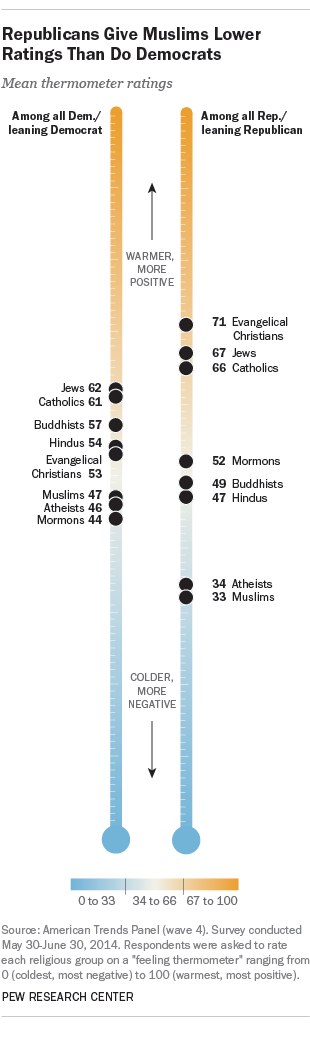
Respondents from the two parties also had divergent views about other faiths and the way they ranked them.
Democrats lumped all the religions between 62 degrees at the top (Jews) to Mormons at 42. In descending order were Catholics, Buddhists, Hindus, evangelical Christians, Muslims, Atheists and the Church of Jesus Christ of Latter-day Saints.
Republicans spread their feelings over a wider range of the scale. Evangelicals were at the top with 71 degrees, followed closely by Jews and Catholics. There’s a significant drop to Mormons at 52 degrees, followed by Buddhists and Hindus. Further down still are atheists and Muslims.
Muslim affinity with Republicans
All the negativity among Republicans toward Islam reveals a lack of basic understanding on the right about many Muslims, said Rob Nash, professor of missions and world religions at Mercer University’s McAfee School of Theology.
“Here’s the interesting thing that most people don’t fully understand about Islam,” Nash said: the tensions that Islam feels toward the West are not tensions that emerge from hostility toward Christianity.

Rather, it’s the secularization and perceived hostility toward religion in Western nations that many Muslims oppose, he said.
Many of the Muslims Nash knows have told him they would rather live in a country where Islam is only partially accepted than a secular, free state where religion isn’t taken seriously.
“Muslims respect people who take their faith seriously,” he said.
And that’s why the Pew survey is so interesting: Republicans and Muslims both generally connect their political and social movements to religious impulses.
“Muslims have far more affinity for Republicans because they view Republicans as being far more religiously motivated toward their political positions than are Democrats,” Nash said.
Appeal of the mysterious
The survey also uncovers the raw nerves that are driving much of the political, social and religious discourse, said Glenn Jonus, professor and chairman of the department of religion at the Campbell University Divinity School in Buies Creek, N.C.
“A lot of what we are doing as a nation right now is fear motivated — there is a culture of fear that has taken hold in our society since 9-11,” he said.
It’s also interesting that Buddhism and Hinduism received such high esteem from Democrats, feeling warmer about them than evangelicals, Jonas said.
“Because they are from the Far East, there’s a kind of mysterious element that might have an appeal to people,” Jonas said.

It may also suggest an openness on the left for faiths that are perceived as more tolerant. But the tolerance needed all the way around is for Muslims, since they, along with Jews and Christians, share a spiritual heritage, Jonas said.
“I say to my classes all the time about Muslims, Christians and Jews — if we could sit at a table we would realize we have more in common than we don’t have in common,” he said.
Painful integration
But that’s a tough sell in a nation where media polarization has created flashpoints and barriers among Americans over various political and social issues — and especially around Islam, Baldwin said.
Complicating matters further is that the Pew survey is expressed in terms of feelings, which he described as “squishy” because respondents may not know much at all about the faiths they were asked to rate.
“Where are people getting their images of religions — from the media, from around the community?”
Baldwin said he found it interesting that Republicans clustered Mormons together with Hindus and Buddhists. Does that mean they see them as another foreign, world religion of sorts, or does it reflect evangelicals’ traditional disdain of Mormonism?
“That may be the story here: the ‘othering’ of minority groups,” Baldwin said.
Given the continuing war on terrorism and the way Islam is portrayed in it, it’s unlikely many Americans of any political perspective are going to feel warmer about Muslims any time soon, he added.
They are undergoing a stage of integration “even though they are monotheists and embrace some traditional values and could be seen as allies to those on the right,” Baldwin said.