

The United States Supreme Court heard oral arguments Jan. 22 in a case described as a major test of the balance between religious freedom and the separation of church and state.
Two-and-a-half years ago the Supreme Court ruled that a church could not be excluded from a Missouri program providing grants to improve playground safety. The 7-2 majority in the landmark decision in Trinity Lutheran v. Comer, however, did not hold that states are required to fund religious activities conducted through religious schools.
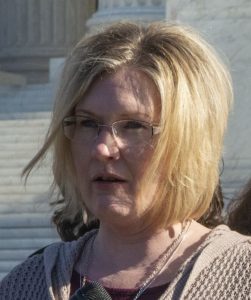
Kendra Espinoza, one of three Montana women filing a lawsuit seeking access to funds controlled by the state to pay tuition at a Christian school, talks to reporters after today’s oral arguments before the U.S. Supreme Court. (Photo by Cherilyn Crowe)
The case argued today, Espinoza v. Montana Dept. of Revenue, asks the justices to decide whether it is constitutional to deny generally available student aid to parents who choose to enroll their children in religious schools.
“States should not have to fund religious schools,” Holly Hollman, general counsel of the Baptist Joint Committee for Religious Liberty said after oral arguments at the Supreme Court.
“Religion is treated in a unique way in constitutional law, both to avoid its establishment by government and to avoid government interference in its free exercise,” Hollman said. “This special treatment of religion stems from our country’s deep and abiding commitment to religious liberty for all.”
In 2015 Montana created a scholarship program providing dollar-for-dollar tax credits for individuals and businesses who donate money to provide scholarships allowing children to attend private schools.
After the law was enacted, the Montana Department of Revenue issued a rule barring the use of scholarships at religious schools, in line with the state constitution’s prohibition against “direct or indirect” aid to schools that are “controlled in whole or in part by any church, sect or denomination.”
Three low-income mothers who count on the scholarships to keep their children at Stillwater Christian School, a nondenominational school in Kalispell, Montana, sued, claiming religious discrimination.
A trial court sided with the women, finding that the tax credits involved private gifts, not taxpayer dollars, and that excluding religious schools might violate the U.S. Constitution. The Montana Supreme Court reversed that decision in 2018, finding that by providing the $150 tax credit to donors of the program, the legislature “indirectly” paid tuition at religious schools, thus violating the state constitution.
The Baptist Joint Committee for Religious Liberty – a church/state watchdog group supported by 16 Baptist groups including the Alliance of Baptists, American Baptist Churches USA and Cooperative Baptist Fellowship – filed a brief last November saying that avoiding government funding of religion is a key protection for religious liberty.
“While states do not have to provide protection equivalent to that provided by the federal government, they can, and often do, offer greater protection,” the brief said in part. “Montana’s constitution reflects the state’s interests in respecting the distinctive nature of religious education, avoiding interference in religious schools, and protecting its state funding resources for public education. It ensures public accountability for education and avoids entanglement with religion.”
Other groups asking the Supreme Court to find the Montana aid program unconstitutional include the National School Boards Association, American Federation of Teachers, Americans United for Separation of Church and State and the Interfaith Alliance.
Groups asking the court to uphold the scholarship program include the American Center for Law and Justice, Becket Fund for Religious Liberty, Billy Graham Evangelistic Association and Christian Legal Society.
The Trump administration filed a brief claiming that “no-aid” clauses like Montana’s violate the U.S. Constitution by “imposing special disabilities on religious adherents on the basis of their religious status.”
“It prohibits religious schools, simply because of their religious character, from receiving funds available to the rest of the community,” argued the Justice Department brief.
The government brief cited a constitutional amendment proposed in 1875 by Congressman James Blaine to bar states from placing tax dollars “under the control of any religious sect.”
“Congress considered that proposal during an era of widespread hostility to Catholicism in general and to Catholic schools in particular,” the Justice Department argued.

Baptist Joint Committee General Counsel Holly Hollman discusses oral arguments on the steps in front of the Supreme Court. (Photo by Cherilyn Crowe )
The Blaine amendment received a necessary two-thirds passage in the House of Representatives but fell four votes short in the Senate. Efforts continued at the state level, however, and by the 1890s about 30 states had incorporated bans on religious schools in their constitutions intended to prevent public funding of Catholic schools.
The Baptist Joint Committee brief, on the other hand, said the history of no-aid provisions is more complex than anti-Catholic animus. Today, 38 state constitutions contain provisions that prohibit public monies being spent in aid of religious institutions or religious education. Of those, 19 originated before the vote on the 1876 Blaine Amendment.
“Even though some of these constitutional provisions and statutes were enacted during a time of growing nativist reaction to Catholic immigration, there is a lack of evidence that religious animus or dissention was a leading factor in the enactment of these provisions,” the brief contended.
When Montana began drafting its constitution, it was the most religiously diverse territory in the West. Catholic missionaries were among the first Christian settlers in Montana, and the discovery of gold, silver and copper attracted many mine workers who were either Irish or Irish-Americans. Later large numbers of Catholics arrived from Italy, Germany and elsewhere. By the early 20th century, 77 percent of all Montanans who considered themselves members of any church denomination identified as Catholic.
Rather than religious animus, the BJC brief said, Montana’s founders likely were motivated by a desire to support public schools and avoid competition between religious groups seeking public funds. A common practice at the time, delegates to the 1884 Montana convention borrowed language from constitutions in other states, including the no-funding provision.
“The Supreme Court has long recognized that government may not directly fund religious exercise,” Hollman said Jan. 22. “So it is neither surprising nor discriminatory that Montana’s constitution, like those in other states, protects religious liberty by avoiding even the indirect funding of religion. No-aid provisions ensure that state funds are preserved for state purposes and not used to advance religion.”
Hollman said the Supreme Court should “reject blanket attacks on no-aid provisions and uphold Montana’s law that preserves public funding for its public schools.”
Previous story:
BJC, others, urge Supreme Court to allow states to bolster religious-liberty protections
Related commentary:
Holly Hollman | Supreme Court should protect religious liberty by guarding against government funding of religion