

 In 1893, Atticus G. Haygood, white supremacist and Georgia Methodist bishop, observed, “Now-a-days, it seems the killing of Negroes is not so extraordinary an occurrence as to need explanation; it has become so common that it no longer surprises. We read such things as we read of fires that burn a cabin or a town.”
Haygood’s words, cited in James Cone’s masterwork, The Cross and the Lynching Tree, could describe the American nation in 2020, personified in the murders of Ahmaud Aubery and Rayshard Brooks in Georgia, Breonna Taylor in Kentucky, and George Floyd in Minnesota, each perpetuated by individuals claiming to act in law enforcement.
“Perhaps no other church coalition in America has personified Roger Williams’ insight into shelter and conscience as profoundly as the black church.”
Three of the four atrocities were recorded on video, a visual barbarism that stung the nation, evidenced in continuing multiracial protests in municipalities large and small. Rightly compared to the lynching era, the deaths brought the country face to face with systemic racism, a ravaging pandemic plaguing the Republic since the 1619 arrival of the first slave ship in Jamestown, Virginia. In those incidences, the evils of chattel slavery, Lost Cause-contrived history, Jim Crow’s cruel laws and white supremacy, white supremacy, white supremacy converged in what many have called a sea of American racism.
Enter the Black Lives Matter (BLM) movement, formed July 13, 2013, in response to the Florida shooting of the young African American Trayvon Martin and the acquittal of his shooter, who pled the state’s “stand your ground” law. Founded by three community organizers, Alicia Garza, Patrisse Cullors and Opal Tometi, BLM’s first public protest occurred August 17, 2014, in a “Freedom Ride” to Ferguson, Missouri, after the police shooting of Michael Brown, another young black man.
While BLM’s earliest intent “was to build local power and to intervene when violence was inflicted on Black communities by the state and vigilantes,” over time that mission expanded “to struggling together and to imagining and creating a world free of anti-Blackness, where every Black person has the social, economic, and political power to thrive.”
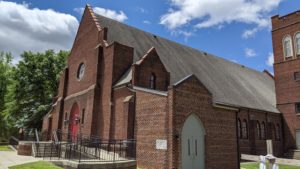
First Baptist Church, Highland Avenue, in Winston-Salem, North Carolina. Used by permission.
Long criticized and attacked, suddenly Black Lives Matter has become something of a national mantra, uniting individuals across racial, economic and regional lines. Public protests, even amid the COVID-19 pandemic, have been large and unrelenting. Politicians, both Democrat and Republican, are pledging new legislation on policing practices; Lost Cause-era Confederate statues are being taken down; NASCAR has banned the presence of rebel flags from its races; professional sports executives have apologized for their opposition to players taking the knee during the national anthem; and “Aunt Jemima,” an enduring public symbol of slavery, will vanish from pancake mix.
Are recent actions such as these the early stages of awakened sensitivity to the legacy of American racism and a new commitment to long delayed reform? Or are they (yet again) a mere quick fix without continuing substance? Time will tell.
Within Christian communions, new multiracial alliances are taking shape and older ones are being strengthened in response to BLM initiatives and the heinous deaths of African Americans, often in the name of law and order. At this somewhat hopeful moment, let us affirm that Black Churches Matter too – those historic enclaves of safety and spirituality for African Americans and seedbeds of prophetic witness for gospel justice in church and public square. From slavery time to Trump time, African American churches have provided what Roger Williams called “a shelter for persons distressed of conscience,” an ever-important witness for all churches at this American moment.
“Shelter itself is hazardous in a nation awash in a sea of racism. Conscience too is perilous, especially in a land where justice can be elusive.”
Reflecting on his founding of the Providence, Rhode Island, colony, Williams, the quintessential dissenter and erstwhile Baptist, wrote, “I desired it might be for a shelter for persons distressed of conscience. I communicated my said purpose to loving friends who desired to take shelter here with me.” Perhaps no other church coalition in America has personified Williams’ insight into shelter and conscience as profoundly as the black church.
It began with slavery. In his classic text, Trabelin’ On: The Slave Journey to an Afro-Baptist Faith, Mechal Sobel writes:
“The black Baptist faith gave coherence to prewar slave society. It provided the possibility for meaningful lives with meaningful goals. It was a black creation, made in contact with the white Baptist faith and affecting that faith, but it remained the very special Sacred Cosmos of blacks, filled with spirit and joy and mourning and time past, all used to understand time present.”
Writing in 1964, in The Negro Church in America, African American scholar E. Franklin Frazier noted that blacks were never “completely insulated from the white world,” forced to conform to continuing [white] ways. Yet blacks could “always find an escape from such, often painful, experiences within the shelter” of the church.
Black churches matter for innumerable reasons, but at this moment American Christians (and anyone else who’ll listen) need to learn from and cling to black churches’ sense of shelter as safe places of spirituality and community – and as conscience as witnesses and advocates for justice inside and outside the church. This connection of shelter and conscience must not be spiritualized, since the black church itself illustrates the danger and struggle of those forces, past and present.
United Church of Christ minister Waltrina Middleton articulated that vulnerability in a recent essay in the Christian Century on the fifth anniversary of the murders at Mother Emanuel AME Church in Charleston, South Carolina. Entitled “I don’t forgive the man who murdered my cousin DePayne at Mother Emanuel,” her article describes the “shelter” that the participants gave the shooter on that fateful night:
“They did not judge him or presume he was a threat because of his race. The stranger was welcomed to join in worship, prayer, and fellowship…. My cousin reportedly shared a Bible with him and as a result was one of the first to fall to his murderous act.”
Five years later, Middleton asserts that the spiritualized rush to forgiveness denied families the right and need to lament. She writes:
“My family did not offer forgiveness in the courtroom. The words of a few became the headline for all, which became in turn a marketable narrative made for television and for profit, for pulpits and for politics, in order to ease the guilt of white supremacy and remove accountability. In the rush to force this false narrative, our society failed to truly engage dialogue on race, racism, and racialized violence that targets black and brown bodies.”
And that is why the black church matters as much now as when it began. Shelter itself is hazardous in a nation awash in a sea of racism. Conscience too is perilous, especially in a land where justice can be elusive.
Given our social and ecclesiastical location, we white Christians still have a lot to learn and a reprehensible past to lament. After 400 years, we’d better pray that black churches are still willing to teach us. And that we’ve got conscience enough to act on what we learn.
Related opinion:
Chris Caldwell | Beyond ‘contact without fellowship’: How can white people move toward black people?
Emmitt Drumgoole | Tower of Babel or Pentecost? The Church must not turn a deaf ear to cries for justice.
Kris Aaron | Will we white Christians continue to ignore the pleas of our black brothers and sisters?
From BNG’s opinion archives:
Bill Leonard | American racism, 1619-2019: Exorcism of this demon is needed – now (December 2018)
Bill Leonard | ‘The Cross and the Lynching Tree’: A broken gospel (July 2017)