

 Recently I posted about re-encountering my white privilege on Facebook. I told a story about a meeting with a fellow dad from my daughter’s school and about my recognition that our lives were similar yet markedly different because of the respective color of our skin.
I closed my piece, as I often do, with a benediction. This one read: “May that Holy One of Blessing give us the strength and courage to change.”
A friend of a friend responded to my post in a telling way. “This is a lovely story,” he said. “And you seem like a decent human. But I know full well that Christians don’t care about justice.”
Because this Christian does, I asked him to tell me more. I’m always interested when people have strong feelings about something.
His arguments were familiar: “Christians care about a lot of things that don’t matter. And they care a lot about the next life, but not about this one.”
Anyone in the church or who thinks about the church should recognize where this comes from. David Kinnaman told us what many outside the church think about us over a decade ago in unChristian: What a New Generation Really Thinks about Christianity … and Why It Matters. According to his research, a vast and growing number of Americans equate Christianity with narrow moralism, hypocrisy, homophobia and a lack of concern for the everyday lives of those in need.
Wherever we turn in America’s past, we find some white Christians standing up not for justice, but against it.
Like some of you, I recognize this as the faith tradition in which I grew up. Our primary concern was with where we would spend eternity, and when our pastor spoke about this life at all, when he spoke of sin, it was purely to address personal moral failings: gambling, drinking, dancing, adultery.
Never a word about the poor, despite the thousands of verses in the Bible about the least of these.
Never a word about justice.
Those outside a faith tradition think that we don’t care about racial justice because the most visible Christians in our culture often reflect that concern with salvation or offer an ethos of life that doesn’t encompass all lives. It’s easy enough for us to say, “I’m not that kind of Christian” and distance ourselves. But we also have to deal with our long common history of Christianity being not just disinterested in justice, but claiming God’s warrant to actively enslave or persecute others.
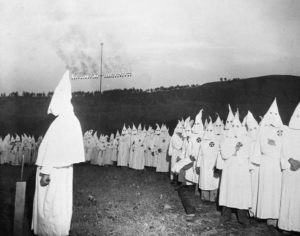
A huge cross burns on top of of Stone Mountain, in Atlanta, Georgia, July 23, 1948, during a massive initiation ceremony of the Ku Klux Klan. (AP Photo)
One example of many: On Nov. 25, 1915, W.J. Simmons — a former soldier, traveling salesman and itinerant preacher — led a group of 15 men to the top of Stone Mountain, just outside Atlanta. They were inspired to make that climb by the recent Atlanta premiere of D.W. Griffith’s Civil War and Reconstruction epic The Birth of a Nation, which climaxed with the stirring rescue of beleaguered whites from bestial blacks by the Ku Klux Klan. They also were reliving the recent lynching of Leo Frank, a Jew wrongfully convicted of killing a 13-year-old Christian girl, a lynching in which some of them had participated.
When they reached the summit of Stone Mountain, these good Christian men set up a flag-draped altar, opened a Bible, laid out the Constitution of the United States, the Declaration of Independence and the historical orders of the Ku Klux Klan, and they burned a 16-foot cross as part of the initiation ceremony reinstituting the Klan. The burning cross could probably be seen for miles that night from atop Stone Mountain.
Thomas Dixon, author of the novel The Klansman that D. W. Griffith turned into The Birth of a Nation, also was an itinerant preacher, as well as a classmate of Woodrow Wilson, who screened The Birth of a Nation at the White House, praised it because he shared its racial sensibilities and is nonetheless buried in America’s House of Prayer, Washington National Cathedral.
Wherever we turn in America’s past, we find some white Christians standing up not for justice but against it, find them using Scripture not as a liberating tool but as a device for holding people in their places — beneath White Christian America.
So why should we be surprised that the American public doesn’t automatically think of the church — especially the white church — as a force for what is good and right and just?
And now, here we are in America in 2020, when for the first time, a majority of white Americans approve of the aims of Black Lives Matter, agree that racism is still a serious national issue, and are living into the realization that white privilege is not just a ruse to extort guilty and good-hearted white people but a recognition of the myriad ways, official and informal, legal and popular, that white Americans have conspired to hold people of color in thrall.
We must own our history, repent of it and enter into painful but necessary conversations about how white Christians can be at the forefront of the movement going forward.
A common response of good-hearted whites is to say, “I didn’t do that.” As Robin DiAngelo points out in one of America’s best-selling books White Fragility: Why It’s So Hard for White People to Talk About Racism, we now equate racism only with active hatred. Only evil people are racist. Only skinheads and Neo-Nazis. Not me.
And yet.
James Baldwin often said that white people were enslaved by our history, afraid to name it and claim it, afraid to move forward. “People are trapped in history,” he wrote, “and history is trapped in them.”
The white church is no different.
The friend of my friend regarded me as guilty because I follow the Way of Jesus, and while he was willing to listen to me, he was skeptical. We have a great deal of ground to make up — perhaps too much — but those of us who believe that only the peace of God can speak into a world full of division have work to do.
We must own our history, repent of it and enter into painful but necessary conversations about how white Christians can be at the forefront of the movement going forward.
For 401 years, White Christian America built and inhabited a system where we benefited and others suffered, but the tide of history has turned, and unless we turn with it, God help us, our witness and our relevance will disappear entirely.
May that Holy One of Blessing give us the strength and courage to change.