

“He who attempts to act and do things for others or for the world without deepening his own self-understanding, freedom, integrity and capacity to love, will not have anything to give others.” ~ Thomas Merton
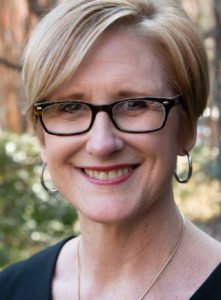
Julie Pennington-Russell
It’s an understandable declaration: “Praying about injustice isn’t enough. God is calling me to do something.” This is a fair claim on the part of Christ-followers as the tidal wave of racial, social, economic and environmental injustices continue to engulf our nation and world. Ours is an active faith: “I was hungry and you fed me …, I was a stranger and you took me in,” said Jesus. “Faith, if not accompanied by action, is dead,” said James.
And yet, just as faith without action is useless, so peace and justice work, if not connected to the life-affirming presence of the Holy One, must find its energy elsewhere and often winds up operating from the realm of the ego, with its need to win, convince and/or differentiate itself from the “other.”
As the U.S. reckons in this moment with disproportionate deaths of African Americans from COVID-19, police brutality against Black lives on display, daunting unemployment numbers and bitter divisions along political and religious lines, our nation and world are in desperate need of prophetic people who transcend the categories of “liberal” and “conservative” as they integrate activism with contemplative minds and hearts.
One common misconception about contemplative Christianity is that it avoids real engagement with the pain of the world while remaining cloistered in the prayer closet. But contemplation is not the absence of action. Contemplation is a reflective way of acting upon God’s call. Contemplative prayer inevitably leads to action grounded in the love and way of God, who is anything but passive about suffering.
“Contemplation is not the absence of action.”
Contemplation. From the Latin contemplari. It means to gaze; behold; observe; pay attention. A “contemplative” is simply one who is learning to pay attention to Divine Presence in each moment. Someone who’s learning to see beneath the surface and listen beneath the noise. Contemplatives are those who are discovering what it means to be present to Presence, whether praying in a secluded hermitage or marching in a protest.
If we want to live as people who lead, serve and advocate from a grounded place with God at the center, I invite us toward three particular areas of heightened awareness:
First, notice when the speed at which we are moving and thinking exceeds our ability to be fully present in each moment. While we live in a rocket-speed society, we have wagon-train souls. If we want to be present to the tasks and issues and people around us, we must tap into what the 20th century contemplative Gerald May called “the power of the slowing.”
“Becoming still seems counterintuitive when there is so much around us that needs doing.”
The Holy One invites us to ease back the throttle, not just with our bodies but also with our minds, which are constantly in motion as we plan, anticipate, strategize, compensate. Becoming still seems counterintuitive when there is so much around us that needs doing. And yet, as we allow ourselves to be led beside still waters, we are best able to discern what is ours to do, trusting that we can make a difference in our own gifted ways.
Second, notice when we are operating primarily from our ego self. The ego is not our enemy. Our sense of self is a gift from God that helps us function in the world. And yet, when we identify with our ego self as our ultimate identity, more than our grounded-in-God identity, then we filter what we see, hear, say and do through that narrow self-centeredness: How is this going to affect me? What opinion will people form of me if I do this, say this, post this?
When we see and listen and live from our deepest, truest identity, beneath the ego, then the work we do, the leadership we give, the conversations we have and the prophetic actions we undertake will be grounded in the animating presence of the Beloved.
Third, notice when we are operating primarily from our analytical minds. As with the ego, the mind is not our enemy. Our minds are a gift from God. And the rational mind is relentlessly dualistic. It knows by comparing, opposing, judging, differentiating. Our minds also assign binary labels: good/evil; beautiful/ugly; black/white; right/wrong.
As long as we’re aware of this, we can receive and appreciate the analytical mind for what it is: helpful in many ways, and yet wholly inadequate for dealing with the deep mysteries of God, grace, pain, sexuality, suffering, death, love. If we want to be fully present with God in each moment, the rational, analytical mind can’t get us there on its own.
Contemplative people have much to offer our ruptured world. The contemplative Dorothy Day co-founded the Catholic Worker movement and championed the plight of the poor. The contemplative Howard Thurman was a principal architect of the nonviolent Civil Rights movement in America. The contemplative Desmond Tutu stood up for peace and justice during and after the darkness of apartheid in South Africa.
The presence of the Beloved is constant, infinite and everywhere. We cannot not be in the presence of God. As we grow in our capacity for prayerful listening, we can notice and join the movements of the Spirit that bring healing, liberation and life.
Julie Pennington-Russell is pastor of the First Baptist Church of the City of Washington, D.C.
This column is part of an election year series being published by Central Baptist Theological Seminary on the seminary’s website. It is shared by permission with BNG.