

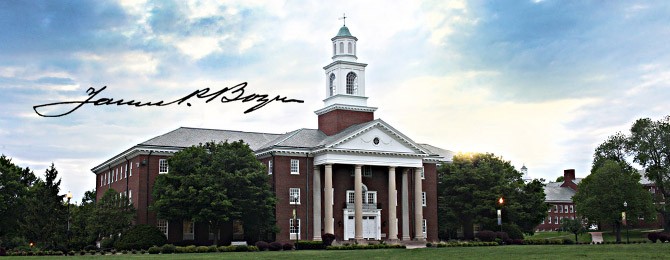
As some Black Southern Baptists urge their denomination’s flagship seminary to remove honors to enslavers, prominent white Calvinists associated with the school are defending not only the founders but even slavery.
Dwight McKissic, pastor of Cornerstone Baptist Church in Arlington, Texas, is leading the push for changing campus building names at Southern Baptist Theological Seminary in Louisville, Ky.
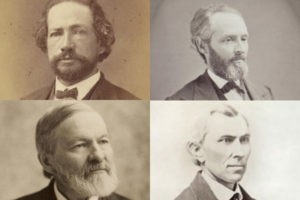
Southern Seminary founders, clockwise from top left: Boyce, Manly, Williams, Broadus.
In 2018, SBTS released a 71-page report detailing how its four founders — James Boyce, John Broadus, Basil Manly Jr. and William Williams — together enslaved more than 50 persons. Additionally, Boyce served in the Confederate Army, and Broadus was a Confederate chaplain. Each are still honored today on campus with building names and even on memorabilia like coffee mugs.
But amid calls for removing the names of the enslaver founders from buildings, some white Calvinists are pushing back.
Nettles: Wrong to remove names of founders
Tom Nettles, a longtime professor at SBTS before retiring in 2014, penned a column Aug. 26 on the website of Founders Ministries — a group devoted to promoting Calvinism within the Southern Baptist Convention — in which he defended the seminary’s honors to its enslaver founders.
Nettles characterized McKissic’s call for removing from buildings the names of the enslaver founders “wrong, undesirable and impossible.” Nettles is the author of several books, including James Petigru Boyce: A Southern Baptist Statesman.
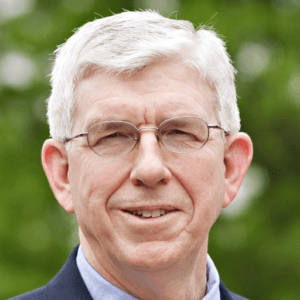
Tom Nettles
Nettles insisted in his Founders Ministries column that being “antebellum slave owners” and even “post-bellum white supremacists” doesn’t mean men like Boyce were “necessarily heretical.”
Finding support for slavery in the Bible
Like the enslavers he defends, Nettles sees support for slavery in the Bible and suggested it was immoral for enslaved persons to challenge or escape the institution of slavery. And he grounds his justification for slavery “in biblical infallibility and in the revelatory ministry of the apostles.”
“Slaves were to do their service gladly to their masters, even to those who were harsh, embracing the opportunity for sanctification and for emulation of Christ,” Nettles wrote. “They were to consider that their work transcended a merely earthly task and was done as unto the Lord. In their faithful service, considering their master as worthy of ‘all honor,’ they would adorn gospel doctrine.”
Believing the Bible allowed slavery and required submission by the enslaved, Nettles even suggests freedom from slavery should only be achieved by lawful means.
“Freedom is superior as a temporal condition to slavery and should be achieved when a lawful opportunity arises,” he wrote.
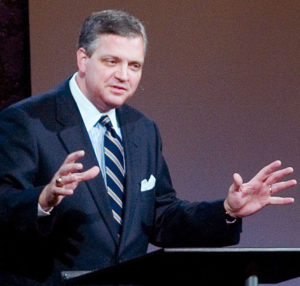
Albert Mohler
SBTS President Albert Mohler, a Calvinist who insists the SBTS founders should be honored as champions of “Baptist orthodoxy,” has similarly argued that enslaved Black people were wrong to seek to escape slavery by unlawful means. Earlier this year, he apologized for comments on Larry King Live in 1998 in which he criticized Harriet Tubman and others for running away from slavery, since Mohler believed the Bible condemned that behavior by the enslaved.
Nettles also argues that Christians biblically could enslave fellow Christians.
“Masters, like slaves, will be judged according to an absolute standard of justice,” Nettles wrote. “They were to consider one another, even in this relationship of slave and master, as beloved because graciously and eternally loved by God and as brothers because of having received the Spirit of adoption whereby both cry ‘Abba, Father.’”
Thus, Nettles insists that as long as an enslaver was not an abusive enslaver and fought against abuses in the system — even while literally fighting to preserve that abusive system in the Confederacy — then it is “disturbing” to call such an enslaver “a heretic” or view “his character and doctrine” with “suspicion.”
Ultimately, however, Nettles urges people to simply overlook the slavery legacies of Boyce and the other SBTS founders.
Desire to separate the founders from slavery
As Mohler has tried, Nettles attempts to separate being an enslaver and preaching support for slavery from the theology of the seminary’s founders. This perspective says that viewing Black people as lesser than white people is not a theological issue and therefore cannot be held against the teachings of the enslaver founders.
“The elimination of slavery by the Emancipation Proclamation and the South’s defeat in the Civil War did not change the theology of Boyce and the seminary cohort in any of these truths of revelation,” Nettles insists.

Boyce College at Southern Seminary.
Nettles also argues that if the names had to come off the buildings, then everything the founders taught or believed would also have to be removed — even though McKissic had previously explained that he still thought the men should be taught, just not so honored. For Nettles, however, if the founders are rejected in any area for heresy, then apparently all their theology and writings must be removed.
“One must realize how deeply entwined is the very soul of the founders in the ongoing ministry of the school,” Nettles wrote. “In order not to be tainted by the impact of Boyce, should we raze (SBTS) like Jericho and warn against restoring its gates?”
A Black pastor responds
On Aug. 28, McKissic responded to Nettles, insisting he is “fully supportive of the educational mission” of SBTS and was instead “merely arguing for the removal from their current place of honor the names of Boyce and others who bought, sold or continued to hold kidnapped human beings.”
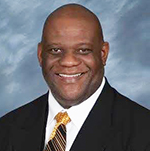
Dwight McKissic
“I am arguing for this so that Southern’s mission can be maintained with integrity,” McKissic added. “As long as our seminary makes heroes of those who were ‘men-stealers,’ she elevates those who taught ‘contrary to the sound teaching’ (1 Timothy 1:10).”
“Let’s keep Boyce in our studies. But let’s not exalt him as a hero,” McKissic added.
Insisting that “racist chattel slavery is not biblical and not humane,” McKissic said Southern Seminary’s founders should not be honored on buildings. And he rejected arguments by Nettles that attempts by enslavers to evangelize the enslaved means the enslavers should be honored.
 “I appreciate the founders’ concern for the souls of my ancestors, but there was a better way to bring them the gospel than by kidnapping them, chaining them, abusing them, selling them, buying them and holding them as property,” McKissic wrote. “Evangelism is very, very important, but the human beings we evangelize are important, too. The founders could have followed Jesus’s Great Commission by ‘going’ to my ancestors with the biblical message of freedom rather than by forcing them to come in chains to the ‘masters’ who bought them like things.”
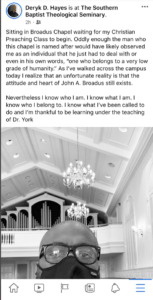
And McKissic isn’t alone. As Southern Seminary’s fall term started last week, one Black student publicly wrote about his uneasiness of attending a preaching class in a chapel named for Broadus, an enslaver.
“Oddly enough the man who this chapel is named after would have likely observed me as an individual that he just had to deal with or even in his own words, ‘one who belongs to a very low grade of humanity,’” Deryk Hayes wrote on Aug. 25, along with a selfie of himself wearing a mask in the chapel. “As I’ve walked across the campus today, I realize that an unfortunate reality is that the attitude and heart of John A. Broadus still exists.”

Brian Kaylor serves as editor of Word & Way in Jefferson City, Mo.