

White conservative evangelicalism had just survived its perceived nightmare of the Obama presidency. They were certain that contraception mandates, cake-baking mandates, transgender people being free to use the restroom for their gender identity, and ultimately the legalization of same-sex-marriage were threats to their religious freedom.
So on the evening of Donald Trump’s inaugural concert in front of the Lincoln Memorial, they found themselves experiencing a taste of their heaven as Toby Keith sang, “Take all the rope in Texas. Find a tall oak tree. Round up all of them bad boys. Hang them high in the street for all the people to see.”
Little did we know that within four years, a mob of white evangelical Trump supporters would storm the Capitol with weapons and build a gallows and a cross just outside while chanting, “Hang Mike Pence!”
Leaving Babylon
Travel back now to 1980 as Bob Jones University graduate David Peters is finishing his master’s degree in cinema arts. Being from California himself, he was ecstatic as California’s own “cowboy,” Ronald Reagan, rode into his campus to campaign. Peters remembers: “We were all electrified. I can still remember parts of what he said. He knew how to move an audience. And, of course, we were all putty in his hands.”
Peters spent his first decade out of school as a film editor for the Air Force, and then the following 18 years as a pastor before he began to question his theology and politics of war. Of the War on Terror, he said: “I kept reading about it and was horrified. Daniel Ellsberg also helped radicalize me against war as I realized how the American people were lied to flagrantly during the Vietnam War. And how much carnage there was to the civilian population in Vietnam, Cambodia and Laos.”

David and Kathi Peters
After reading Brian Zahnd’s 2019 book Postcards from Babylon: The Church in American Exile, Peters was taken by a statement Zahnd wrote toward the end of the book: “I write so my grandchildren will know that during the Trump era I wasn’t duped, I wasn’t silent, and I didn’t go along for the ride. I spoke out.” This resonated with Peters as he reflected on his relationships with his own grandkids. So Peters and his wife, Kathi, began the process of co-producing their second independent film together to confront the Babylon of white Christian nationalism.
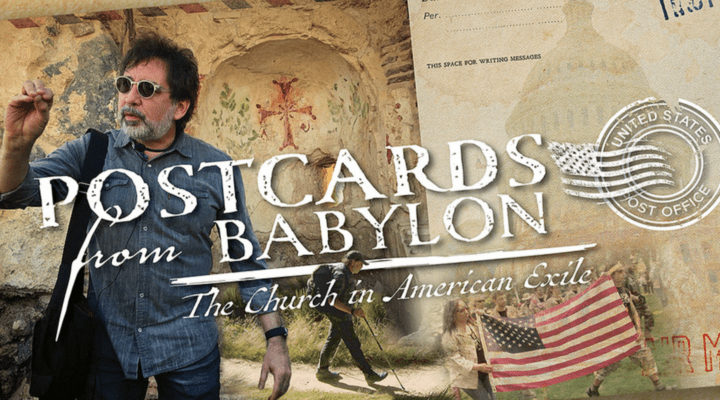
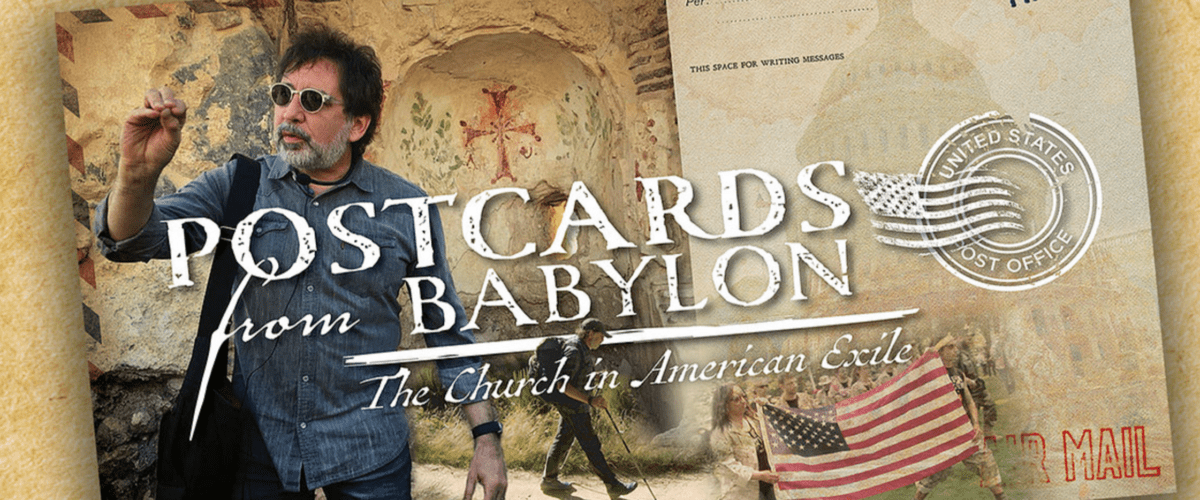
Their documentary, Postcards from Babylon, premiers online Jan. 21 at 7 p.m. and features such contributors as Brian Zahnd, Walter Brueggemann, Lisa Sharon Harper, Kristin Kobes Du Mez, Scott Hancock, Pete Wehner, and Jonathan Merritt.
A clash of kingdoms
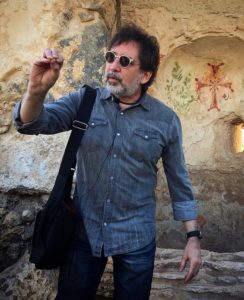
Pastor and author Zahnd opens the documentary by confronting Americans with the reality that “America is not a kind of biblical Israel, but a kind of biblical Babylon.”
He acknowledges that “America is deeply reactionary at the moment,” and says, “I’m not a Democrat. I’m not a Republican. I’m a Christian… . I follow the Lamb.”
Brian Zahnd
For Zahnd and the other contributors, following Jesus as the Lamb of God is the way of love, peace and grace as a reflection of the vision of God for the world revealed in Jesus on the Cross. As Zahnd says: “The best news of all is that God is like Jesus. God has always been like Jesus. There’s never been a time when God was not like Jesus.”
The good news described in Postcards from Babylon is a reversal of traditional power hierarchies. Jonathan Merritt observes how the temptation of Jesus in the desert to compromise everything for power is a temptation humans still face today.
Rather than everything being controlled from the top down, Jon Huckins of The Global Immersion Project, says, “The community of God … is a community on the underside of power … . It’s those that are being occupied and oppressed and crushed. And their relationship to God is one of seeking liberation from the empires that were crushing them.”
Clashing with this Kingdom of Restoration in the church today is the Kingdom of Retribution that I recently talked about from the American Gospel: Christ Alone and Christ Crucified documentaries that have been heavily promoted by The Gospel Coalition, an ironically politically and militaristic branded group of mostly white conservative evangelicals who are trying to pretend now that they haven’t theologically formed this militant masculinity. As we will see throughout this review, Postcards from Babylon sets up a vision of the kingdom of God that is fundamentally different than the vision of the American Gospel documentaries.
Feeling our wonders and wounds
The American Gospel documentaries repeatedly dismiss our feelings as irrelevant compared to “giving God glory.” In fact, we are repeatedly warned that our feelings are the seeds of sin that lead us away from the gospel.
Walter Brueggemann
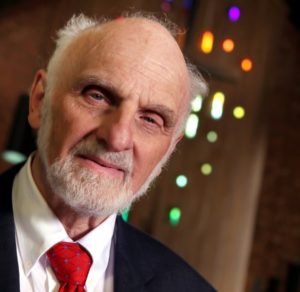
In Postcards from Babylon, however, we can be present with our feelings. I found myself laughing hard as Walter Brueggemann looked at a recording device like it was a piece of alien technology and then had to sit on a concordance to frame his face right. My face tightened at the awkwardness of a Zoom call filled with Republican and Democrat Christians being direct with one another about their desires and differences. I almost had to stop watching as a young Black woman spoke the final words of George Floyd: “Please. I can’t breathe. My face hurts. Just get up. My neck. My stomach. It hurts. Everything hurts. Mama. Mama.” My anger burned as racists raged with middle fingers raised against a Black man standing before a Confederate statue because he was simply asking for the entire story to be told. And my own shame from my retributive theological past resurfaced through the wounds of a soldier’s regret as he tossed his medals into the wind.
For Postcards from Babylon, our wonders and wounds are felt not simply in isolation, but together. Evangelical men feel the wounds of decades worth of being theologically formed into a vision of biblical and American manhood that cuts them off from self, neighbor and God.

Kristin Kobes Du Mez
Author Kristin Kobes Du Mez reflects: “I was paying very close attention to the language they were using. ‘We need strong leadership. We need a strong man.’ A strongman. ‘He’s our ultimate fighting champion.’ And this was the rhetoric that was so familiar to me because I had been reading hundreds of books on Christian manhood. And this was the same language that they were using to say, ‘This is God’s will for masculinity. This is God’s will. The church needs strong men to step up.’ They’re trying to fight against the wussification of America. That feminism had destroyed real pure rugged tough masculinity. And men needed to reassert that power. And it was for the sake of leadership in their families, and in their churches, and in this nation.”
She continues, “This puzzled me at first how frequently John Wayne was held up as the icon, not just of American manhood, but also of Christian manhood.”
It’s as if evangelical pastors felt that Jesus wasn’t enough, that they needed John Wayne to give their men something to try to measure up to, although knowing they never could. And so, through the wounds of their disconnection from self, they lived their fantasies by projecting their insecurities into their politics.
Naming our shame-fueled violence
Continuing this theme of evangelicals’ John Wayne masculinity, Du Mez says, “He was this kind of rugged masculine ideal who knew how to use violence when necessary to achieve good, to bring about order.”
“This militant masculinity had, in fact, reshaped Christianity itself. It had reshaped the ideal of Jesus Christ.”
The evangelical embrace of violence shaped the world during the War on Terror perhaps far more than any other force on the earth. Du Mez remembers: “We saw white evangelicals as real outliers when it came to enthusiastic support for the war, enthusiastic support for pre-emptive war … . White evangelicals, more than any other demographic, were more likely to condone the use of torture. This militant masculinity had, in fact, reshaped Christianity itself. It had reshaped the ideal of Jesus Christ. So you can see the history of this particularly militant conception of Christianity, of Christian masculinity as well, somebody who would fight to defend your family, your church and your nation because America was a Christian nation, they said. And that defense needed to be through ideas, culture wars, but it also needed to be through the military because we needed to protect God’s nation and God’s truth.”
Carrying our cross
Ultimately this clashing of kingdoms is about two different visions of the cross.
For the retributive justice of conservative evangelicalism’s American Gospel, the cross is the place where the Father vented all his wrath against Jesus, violently killing him and turning his face away until he was satisfied enough to forgive a few humans. Retributive justice is a driving out, a beating down, a turning away. It’s the Father vs. his Image Bearers solved through the Father vs. the Son. This vision takes our us-vs.-them dualism, projects it onto the Infinite, and calls it “good news.” And it has theologically formed generations of white evangelicals to see their world through the same us-vs.-them dualism that enthusiastically embraces pre-emptive war, torture and militant manhood in the home, the church and the nation.
“The Cross is where Christ abolishes war and the myth of redemptive violence and calls us into a new world formed in peace.”
Zahnd reveals a very different cross. He says: “At the cross we find a lot of things, including we discover a God who would rather die than kill his enemies … . At the cross … we see a world formed in violence reaching a hideous apex. And with great violence, the world sinned its sins into the body of Jesus Christ. The wounds on Christ’s body, on his hands, his feet, his side, these are the entry wounds as sin is being violently injected into Jesus. But what happens when sin enters the body of Jesus? Sin itself dies. Jesus goes down into death, leaves sin and death there conquered and defeated. He’s raised on the third day. He comes back preaching the first word of the new world, ‘Peace be with you.’ The Cross is where Christ abolishes war and the myth of redemptive violence and calls us into a new world formed in peace.”
The way of restorative justice
The way of the Cross, when seen through the lens of a God who would rather die than kill God’s enemies, is the way of restoration. For evangelicalism to participate in the making of all things new, it must set aside the sword of retributive justice and carry the cross of restoration.
Unfortunately, evangelicalism does not seem willing to do so. Jonathan Merritt observes: “When you really get down to the things that actual Black people will tell you they want and need in order to embrace their full humanity in order to achieve equality, evangelicals will almost always oppose them.”

Liz Sharon Harper
And so we have a credibility problem. Lisa Sharon Harper notes: “I don’t think that the church has integrity to speak any good news at all until the church actually understands the reality that it is living and has crafted bad news in public policy. It has established theological foundations for oppression that have lived throughout the times and only changed shape over the generations but has not been repented of.”
For restorative justice, the path of facing how we’ve wounded the oppressed is the beginning of coming together again. Brenda Mitchell says: “I just call this bridge building at the basic level, creating that place where people know that they can actually become the bridge when we walk toward each other as opposed to away from each other.”
Making evangelicalism new
As I prepared to write this review, David Peters told me: “I think God is trying to communicate that she doesn’t fit comfortably in the institutional and political boxes we’ve forced her into. God is doing something fresh, and it seems to be happening out on the margins, which always seems to be the case. Prophets are speaking. The church is reforming. A more generous orthodoxy is emerging that is drawing people toward the truth that the gospel is far more inclusive than we ever imagined.”
Noting how many people like myself are feeling increasingly exiled from evangelicalism, he said: “This fact compels me to create films that help these religious refugees know that they are not alone. There are many of us out there. We need to find each other, listen to each other’s stories and collectively hold on to the hope that the Jesus Way will always be a path worth walking.”
The Jesus Way as envisioned in Postcards from Babylon is a path worth walking. Unlike the American Gospel path that has cut us off from ourselves, our neighbors and our God and theologically formed us into a cowboy Christianity that storms the Capitol with crosses and gallows, the path of restorative justice feels the wonders we share and the wounds we bear; it names and lays aside the sword of violence; it follows Jesus onto the cross of peace; and it gently turns our faces back toward one another.
 Rick Pidcock is a stay-at-home father of five kids. He and his wife, Ruth Ellen, have started Provoke Wonder, a collaboration of artists that exists to foster child-like worship through story and song. Provoke Wonder’s first album, Consider the Stars, was released in March 2020. Their first children’s book, What If, will be released soon. Rick is pursuing a master of arts degree in worship from Northern Seminary.
Related articles: