

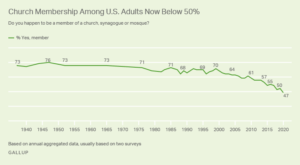
The exodus from formal affiliation with U.S. houses of worship continued its relentless pace in 2020 as congregational membership hit an all-time low in the 80 years Gallup has tracked it.
The practice of “belonging” to a church, mosque or synagogue declined from 50% of Americans in 2018 to 47% last year, the research organization said in a survey released March 29. Congregational membership was at 70% as recently as 1999.
“U.S. church membership was 73% when Gallup first measured it in 1937 and remained near 70% for the next six decades, before beginning a steady decline around the turn of the 21st century,” according to the report.
 The trend was illuminated during a 20-year stretch of polling in which Americans were asked to share attitudes about religious beliefs and practices. Gallup found declines in congregational membership from 1998 to 2000, when membership rates averaged 69%, from 2008 to 2010, which averaged 62%, and 2018 to 2020, with an average of 49%.
“The decline in church membership is primarily a function of the increasing number of Americans who express no religious preference,” Gallup reported. “Over the past two decades, the percentage of Americans who do not identify with any religion has grown from 8% in 1998-2000 to 13% in 2008-2010 and 21% over the past three years.”
Among those who claim no religious affiliation, only 4% said they belonged to a religious organization from 2018 to 2020, which was down from 10% in the period 1998 to 2000. “Given the nearly perfect alignment between not having a religious preference and not belonging to a church, the 13-percentage-point increase in no religious affiliation since 1998-2000 appears to account for more than half of the 20-point decline in church membership over the same time,” Gallup noted.
Much of the rest of the drop is attributed to Americans who do identity with a faith but no longer choose to belong formally to a congregation. “Between 1998 and 2000, an average of 73% of religious Americans belonged to a church, synagogue or mosque. Over the past three years, the average has fallen to 60%.”
Much of the rest of the drop is attributed to Americans who do identity with a faith but no longer choose not to belong formally to a congregation.
The increase in Americans claiming no religious affiliation can be traced to generational differences, Gallup added.
“The decline in church membership, then, appears largely tied to population change, with those in older generations who were likely to be church members being replaced in the U.S. adult population with people in younger generations who are less likely to belong.”
This point has been reinforced by other religion researchers, particularly those who study the “nones,” Americans with no religious affiliation. One of those researchers is Ryan Burge of Eastern Illinois University.
Burge is the author of a new book titled The Nones that explores this demographic group in-depth. Presented with the new Gallup data, he tweeted: “It asks ‘be a member’ not ‘current religion.’ Lots of non-denominationals don’t have membership. They just don’t care about it. And the % of Americans who ID as non-denom. has tripled since 1996.”
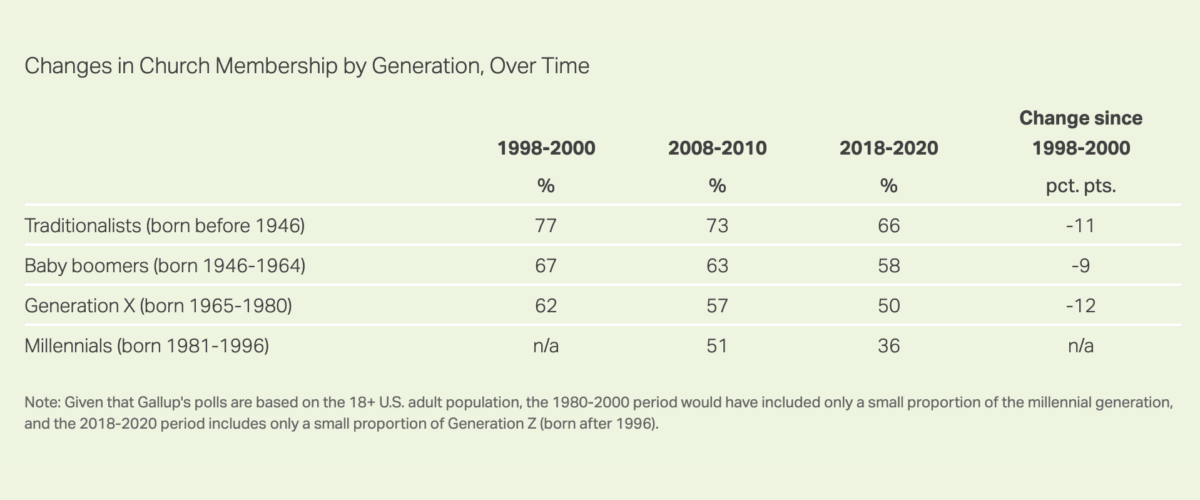
Gallup found that 66% of Traditionalists — those born before 1946 — continue their memberships in houses of worship, with Baby Boomers next in line at 58%. They are followed by Generation X at 50%, Millennials at 36% and Generation Z close behind.
“The change has become increasingly apparent in recent decades because Millennials and Gen Z are further apart from Traditionalists in their church membership rates (about 30 points lower) than Baby Boomers and Generation X are (eight and 16 points, respectively). Also, each year the younger generations are making up an increasingly larger part of the entire U.S. adult population.”
“Each year the younger generations are making up an increasingly larger part of the entire U.S. adult population.”
Another contributing factor is that the number of religiously unaffiliated adults has risen among older generations, with the share of non-member Traditionalists increasing from 4% to 7%, Boomers from 7% to 13% and Gen Xers from 11% to 20% since 2000.
“Currently, 31% of Millennials have no religious affiliation, which is up from 22% a decade ago,” Gallup reported. “Similarly, 33% of the portion of Generation Z that has reached adulthood have no religious preference.”
The trend also was documented across race and religious denomination, the research organization reported. Catholic membership dropped 18 points from 76% to 58% during the 20-year span, while Protestant membership fell from 73% to 64%.
Religious memberships among non-Hispanic Blacks fell from 78% to 59% from 2000 to 2020, a 19-point decline, according to Gallup. “Church membership among Hispanic Americans in 2018-2020 was 37%, among the lowest for any major subgroup.”
The survey concluded that while it is too early to declare religion dead in America, its downward spiral will likely continue.
“The U.S. remains a religious nation, with more than seven in 10 affiliating with some type of organized religion. However, far fewer, now less than half, have a formal membership with a specific house of worship,” Gallup concluded. “While it is possible that part of the decline seen in 2020 was temporary and related to the coronavirus pandemic, continued decline in future decades seems inevitable, given the much lower levels of religiosity and church membership among younger versus older generations of adults.”