

The role of women in the Southern Baptist Convention historically has been much more complex than narratives about female submission to a male-controlled denomination.
“There were spaces in Southern Baptist life in which women sought and found agency, supported one another, cultivated a sense of call, did some remarkable things and pushed against boundaries,” said Elizabeth Flowers, a Baylor University associate religion professor and co-editor of the 2020 book, A Marginal Majority: Women, Gender, and a Reimagining of Southern Baptists.
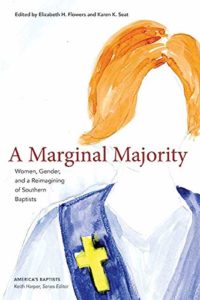 Flowers and co-editor Karen Seat, director of religion and classics at the University of Arizona, also contributed to the collection of essays, which trace the roles and challenges of women from the 19th century onward. The integral role women played in fundraising and missions, their push to attend SBC seminaries and the development of women’s and teaching ministries also are some of the subjects covered. The interplay of gender, class, race and politics are treated throughout.
The all-female team of writer-scholars, many of whom have some personal connection to Baptist life, “applies a women’s studies lens to SBC history” that makes the text especially relevant in the age of third-wave feminism and the #MeToo and Black Lives Matter movements, said Flowers, who grew up Southern Baptist, taught Sunday school at Broadway Baptist Church in Fort Worth, Texas, and now attends a Disciples of Christ church.
Another major context for the writing and publication of A Marginal Majority was the SBC’s all-out support of Donald Trump, a development that created and widened divisions in the denomination along gender lines and set the stage for the high-profile departure of teacher and evangelist Beth Moore earlier this year.

Karen Seat
“For Beth Moore, certainly the Trump era was a turning point” as it was for many other SBC women who previously supported the doctrine of complementarianism, said Seat, who was raised by Baptist missionary parents in Japan. “The idea behind complementarianism is that women should have something to gain from patriarchy, and when men start supporting something like Trump or turn a blind eye to sexual harassment, for Beth Moore that was a breach of the agreement.”
As a whole, the essays reveal the central and complex life of Southern Baptist women, she said. “The book shows that you can’t fully understand SBC history without women.”
Flowers added that the history is “a very mixed and complicated bag.”
The founding of Woman’s Missionary Union in 1888 illustrates how complicated women’s status could be in the convention. Its auxiliary status gave its members a measure of independence but also required they support SBC missions boards, all controlled by men.
But the WMU did find other ways to wield influence through the requirement that it raise its own funds and keep its own budget, according the forward of A Marginal Majority.

Elizabeth Flowers
“The SBC’s male leadership later came to regret this decision, as women found avenues for autonomy in this structure, especially in the years before World War II. For example, social progressivism … most often found expression in the SBC through the national leadership of the WMU, which succeeded in raising and managing its own funds along with selecting its own officers and publishing its own literature.”
But even that history is layered, Flowers said, because just as Southern Baptist women struggled to gain agency, they often took it from others.
“When you look at the development of personal service programs and the social gospel and the way WMU women were progressive in their social reforms, you see that in their reforms they often perpetuated racial hierarchies,” she said. “And you see how they wielded power over the women to whom they were ministering and that they were less apt to help them find agency.”
Whatever weight women carried during that era began to diminish in the latter half of the 20th century, Seat said. “The story is that as the Southern Baptist Convention became more powerful after World War II, women got less and less powerful.”
The advent of feminism added more downward trajectory to the status of women in the denomination.
The advent of feminism added more downward trajectory to the status of women in the denomination, the editors explain in their foreword: “Experiencing a backlash against feminism’s gains, Southern Baptist women were increasingly marginalized in a denomination that resisted their entrance into arenas of power and authority other than missions, particularly those that involved ordained ministerial status.”
The dominance of ultraconservatives during the last two decades of the 20th century further marginalized women, in part by more explicitly demanding obedience to husbands in revised versions of the Baptist Faith and Message doctrinal statement, the forward continues.
“Conservatives then drew on the revised document to determine those who did not tow the party line, thereby purging the SBC’s seminaries, agencies and mission fields of dissenters who supported women’s ordination and other forms of women’s leadership.”
The female-led teaching ministries that developed in the 20th century created “a parallel universe” of personalities and groups that gave agency and voice to women, Flowers said. “You see this with Beth Moore, and for these women church might not be the sanctuary or the pulpit at 11 o’clock but it’s these teaching spaces that became quite powerful for women.”
And although the Trump era has hardened SBC doctrines against women’s leadership, it also has revealed the difficulty of painting all women in the denomination with one brush, Flowers said.
“Conservatives don’t speak with one voice. There are complementarians but now there are soft complementarians. It’s a mixed and very complicated bag,” she said. “And I think the whole Beth Moore controversy indicates there are a lot of internal tensions in the SBC that the resurgence didn’t settle.”
Related articles:
How the male-centered image of God marginalizes women and disabled persons | Opinion by Mallory Challis
I knew the truth about women in the Bible, and I stayed silent | Opinion by Beth Allison Barr
Now Beth Moore is taking on patriarchy in the church
Why Beth Moore’s departure from the SBC really matters
Beth Moore and a lost Southern Baptist Convention | Opinion by David Gushee
Is the Beth Moore Effect a feminist awakening? | Analysis by Courtney Pace
Debate over women in Southern Baptist pulpits flares on social media
Jesus and John Wayne exposes militant masculinity in the age of Trump | Analysis by Alan Bean