

By Norman Jameson
Forty-two years ago Milton Brasher-Cunningham first heard the words that rescued him, like a strong arm lifting a drowning person to safety.
He was 16 and the new missionary kid from Africa in a big Houston school, plopped into the middle of his junior year. His family came to Houston to lead a Baptist church, but details had not been finalized so Brasher-Cunningham — ordinarily an extrovert — could not connect in school with youth from that church.
He didn’t talk to a single other student outside of a classroom for two weeks, dreading every lunch hour sitting alone in a boisterous cafeteria, a stone in the river of laughter flowing around him.
Until one day he heard, “Here’s the guy I’ve been looking for.” A missionary-kid friend from Africa, whom he hadn’t seen for years, scooped up Brasher-Cunningham’s tray and set it down in the midst of others from his home church.
“That changed my whole world. Someone knew my name. I started being greeted in the halls. It changed everything.”
Compelling image
The day-night difference between a grinding, solitary lunch and a convivial meal shared with friends is now the compelling image that drives Brasher-Cunningham’s daily life as a minister, chef, writer and community energizer.
His blog — www.donteatalone.com — reflects his theology of the table and in it he offers the occasional recipe and poem. His book Keeping the Feast, is a long and loving metaphor about the interweaving of food, faith and relationships around the table. A second book due in 2015 is about home.
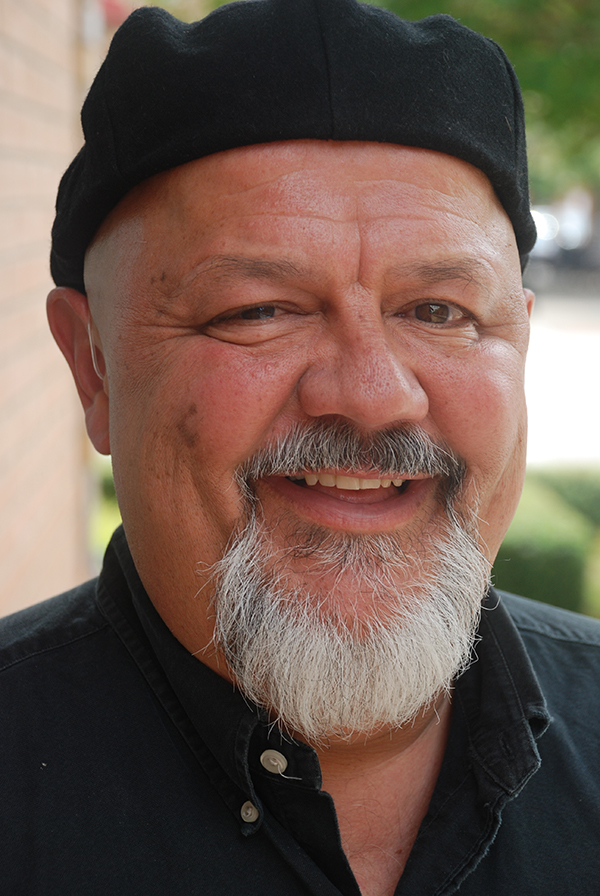 Brasher-Cunningham grew up Milton Cunningham Jr., son of missionaries who eventually returned to Texas, where the late Milton Cunningham Sr. became a prominent Baptist leader. The younger Cunningham attended Baylor University and Southwestern Baptist Theological Seminary, and led youth at University Baptist Church in Fort Worth, Texas.
He and Ginger Brasher, a Samford University and Southern Baptist Theological Seminary graduate, were newlyweds when they went to Boston to plant a church as emissaries from University Baptist. Then-pastor Randel Everett, who later became executive director of the Baptist General Convention of Texas, realized changes in Baptist governance and funding for missions agencies could put more responsibility for missions directly on churches. Everett wanted University Baptist to get directly involved and asked Milton and Ginger to be first.
After just six months they realized they needed additional jobs to pay the Boston rent. A dozen blizzards that winter blew up their weekly Bible studies and by the time spring came, the group they’d gathered melted away with the snow.
When Ginger was invited to be youth minister at a nearby United Church of Christ congregation, they resigned as church planters to walk through that open door. The UCC has been home church for them since. Today Ginger is pastor of Pilgrim United Church of Christ in Durham, N.C.
With a theology grown in a Baptist garden and seasoned with flavors of examination and experience, Brasher-Cunningham is also ordained in the United Church of Christ.
Not just a church ritual
He believes Jesus’ last supper with his disciples could have been less about instituting a church ritual than simply admonishing his followers literally to remember him “anytime we sit together around a meal.”
The opposite of “remember” is not “forget,” Brasher-Cunningham says. “The opposite of remember is dismember.” When the centripetal forces of life “throw us all to the edges, we come back to the table to put ourselves together again around Christ.”
Such “reassembly” is important to Brasher-Cunningham, who endured the rootlessness typical of missionary families, attending 12 schools in 10 cities through the 10th grade.
He learned to establish relationships quickly and came to see life and faith in the context of team sports, rather than individual events.
“We live and grow and die together,” he says. ”No one lasts long in solitary.”
Thus, one characteristic of his faith is “invitational theology,” which is “a lot more about being faithful and together than it is about being right.”
A counter-cultural act
American society is so polarized that “most of what we know to do is run to the extremes and scream at each other,” Brasher-Cunningham says. That means one of the most counter-cultural actions American Christians can take is to learn how to come to the table together.
Quoting Frederick Buechner, he says “it’s hard to act superior when you have catsup on your chin.”
“We do lots of things differently,” but “every Christian since that first supper, comes to the table.”
It’s what goes on the table that helped pull Brasher-Cunningham from eight years of soul-crushing depression. Shortly after his wife was called to her first pastorate, “the floor opened up,” he said. For a year his greatest daily achievement was to get out of bed.
He felt as alone as sitting at the high school lunch table. Eventually Ginger said they needed him to get a job because they were getting buried financially.
Maybe because cooking requires concentration and focus, and has a clear end result, “the kitchen was always a depression free zone for me,” he says. He hounded a local restaurant into hiring him and the art of cooking helped to pull him out.
The “table,” whether in practical or theological terms, is a “relational invitation,” Brasher-Cunningham says. His favorite thing to cook is “whatever makes you sit down at the table and talk for two hours. “
The table, he notes, is about relationships and in a culture of individualists, screaming at each other from the edges, food may be just the magnet that draws others to faith.