

Decades-long declines in faith affiliation coupled with the pandemic-inspired evolution of online church services are contributing to a huge downturn in religious facility construction in the United States.
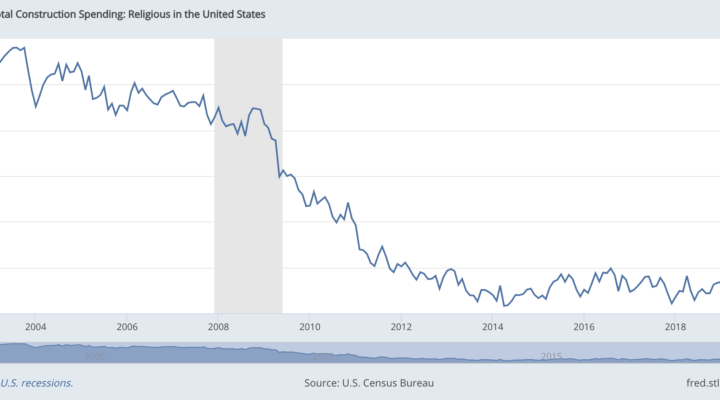
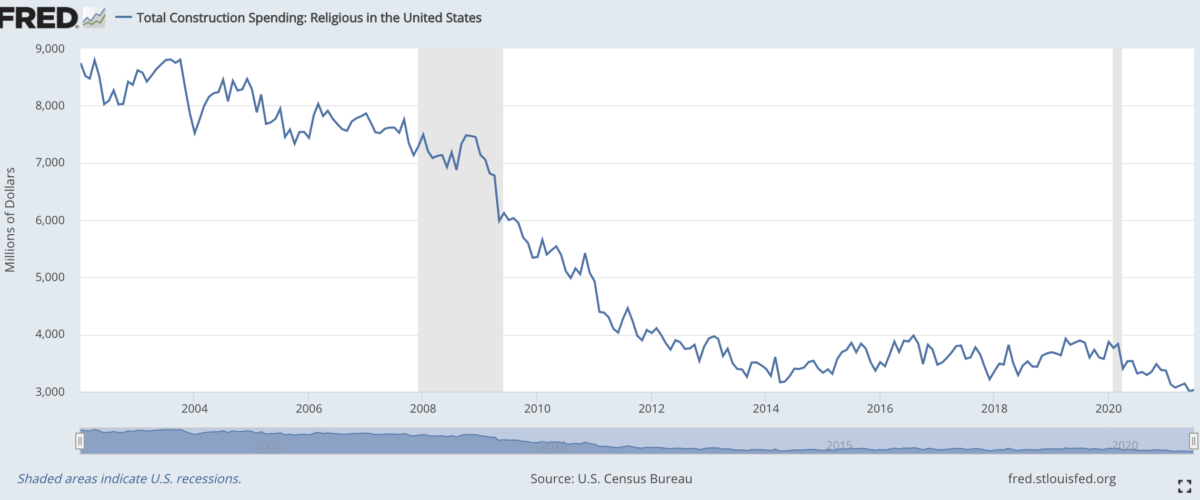
According to the U.S. Census Bureau, total spending on the construction of churches, mosques and temples — already on a downward trajectory — plummeted from close to $9 billion in 2003 to a record-low $3 billion this year. Viewed on a monthly basis, construction of houses of worship has dropped from a seasonally adjusted annual rate of $3.9 billion in January 2020 to $3 billion this summer.
By comparison, total construction spending in the U.S. rose from $900 billion to $1.5 trillion from 2003 to 2021, with educational, amusement and office space among the categories seeing notable increases.
Total spending on the construction of churches, mosques and temples — already on a downward trajectory — plummeted from close to $9 billion in 2003 to a record-low $3 billion this year.
But the drop in new religious construction could be much more precipitous than the federal statistics show, said Bill Wilson, director of the Center for Healthy Churches: “If you take away construction of megachurches and church plants, the 66% decline probably goes to 95%.”
Wilson said it’s been years since he’s had a client congregation embark on a new construction project, and that most of the recent plans he’s aware of are funded by major donors or by selling off parking lots and other parcels to finance new facilities or renovations.

Bill Wilson
“Churches that used to be viable are not looking good in the future, and of course they are no longer building,” he said.
The all-too-familiar decline in religious identification, the continued success of megachurches and the popularity of virtual religious programing throughout the COVID-19 pandemic are conspiring to keep pews and buildings increasingly empty, Wilson explained.
An April 2021 Gallup survey reported that less than half of Americans belong to a church or other house of worship.
“Americans’ membership in houses of worship continued to decline last year, dropping below 50% for the first time in Gallup’s eight-decade trend. In 2020, 47% of Americans said they belonged to a church, synagogue or mosque, down from 50% in 2018 and 70% in 1999,” according to the survey.
“U.S. church membership was 73% when Gallup first measured it in 1937 and remained near 70% for the next six decades, before beginning a steady decline around the turn of the 21st century,” Gallup added.
Megachurches also are a factor because the quality of music, ministries and other programs attract many Christians away from smaller congregations.
A study by the Hartford Institute for Religion Research found that 72% of megachurch members came from other congregations, 44% of them locally and 28% as transplants from other areas.
Wilson calls this the “Walmart effect” because the larger congregations “put mom-and-pop churches out of business. As megachurches grow, they siphon off the growth of other congregations.”
“As megachurches grow, they siphon off the growth of other congregations.”
A number of studies conducted in 2020 demonstrated that in-person attendance declined significantly during the first year of the pandemic. Barna found that only one in three Christians attended in-person services during 2020 while more than half streamed their church’s services and another 34% worshiped online with groups other than their own.
While the temporary decline in coronavirus infections earlier this year reopened most congregations, Wilson said there is a sizeable group of Christians that won’t be returning to physical programs. That puts more force behind declining church construction as pews and buildings continue to empty.
“A third of your people are going to opt for a hybrid model and a third are not coming back at all, so you will need even less building space than you did before,” he said.
Yet, many congregations remain blind to the causes of their increasingly empty spaces. “The denial is that, somehow, this is our local church’s problem rather than a systemic, nationwide challenge. They will say they just need a pastor who can turn this thing around.”
What they need is to look at new ways of being the church that may, or may not, involve having properties built for another age, Wilson believes. “The churches that are thriving went from an attractional model toward a missional model.”
The others, he noted, are selling off buildings and parcels or just going out of business while church buildings are turned into other kinds of facilities. Estimates are that churches nationwide have an average of 80% more facilities than they need.
“If you Google ‘architectural firms that repurpose church buildings,’ get ready for a long day at the computer,” Wilson said. “It is now a very significant industry, especially in urban centers around the country where churches have excesses of buildings and other properties.”
Related articles:
Unconventional project combines church, apartments
Let’s reimagine how your church property might serve the community