

Christians needn’t fear reading Black literature that bears painful witness to the historic and ongoing brutality of racism in America, author Claude Atcho said during a webinar hosted by the Equal Justice USA network for evangelicals.
After all, congregations that study Scripture together already have developed the discipline needed to process hard-hitting Black writings, said Atcho, author of Reading Black Books: How African American Literature Can Make Our Faith More Whole and Just.
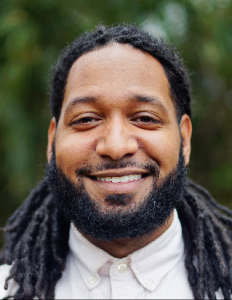 “Because the Bible is not only God-breathed but is … God’s revelation through literature, it makes sense that it should prepare Christians who are reading Scripture in community to then read other literature,” said Atcho, pastor of Church of the Resurrection in Charlottesville, Va., and a contributor to Christ & Pop Culture, Think Christian and The Gospel Coalition.
He appeared July 6 on “In the Movement,” an EJUSA webinar series hosted by Evangelical Network Manager Sam Heath.
Reading Black Books is not intended only for white audiences seeking to understand structural racism, but to give the church insight into the history and experiences of Black Americans, he said. “The lessons that come from this sort of reading of African American literature are for the whole body of Christ, and I think we need that. We can learn together.”
Atcho examines 10 classic African American writings from the 20th century, including Ralph Ellison’s Invisible Man, James Baldwin’s Go Tell It on the Mountain, Zora Neal Hurston’s Moses, Man of the Mountain, W.E.B. Du Bois’s poem “The Litany of Atlanta,” and Toni Morrison’s Beloved.
The texts were chosen in part for the powerful ways in which they communicate the pain and hope of Black Americans, he said. “I wanted to build on the empathetic side of literature. The value of literature is that it puts us in somebody else’s shoes to generate empathy and understanding and experience that is outside our own.”
“The value of literature is that it puts us in somebody else’s shoes to generate empathy and understanding and experience that is outside our own.”
The books and poems also were selected for the messages they convey about God, sin, salvation, healing, lament and hope, he explained. The goal “was to not just stop at empathy, but to make the connection to theology and what it says about God, the world, other human beings, the gospel and living as a disciple of Jesus.”
Atcho said he was experiencing that literary and theological connection when he started the writing process in March 2020. “There was so much happening in our country with the deaths of Ahmaud Arbery and George Floyd, and the beginning of the pandemic. The world was just upside down. It felt like it was on fire.”
An upsurge in demand for Black literature emerged from those and other events, he said. “We all saw an upswell in interest and awareness of inequality, racism and an upswell in ‘What do we read? What do we do? How do we have these conversations?’”
Reading Black Books is an attempt to meet that demand with a survey of literature that provides unique avenues for insight into others’ lives. The approached worked in the 19th century with slave narratives that helped fuel the abolitionist movement, he said.
“The discipline of reading itself puts us in an environment, in a story, that we haven’t crafted on our own and that produces an empathetic impulse that very few other things really do.”
Church-based groups, including book clubs, that read Black authors can be similarly inspired to act against systemic racism, he said. “That’s where communities can really be formed to grow in faithful response, practice, reflection — not just from the reading individually, but processing together.”
Any feelings of resistance can be dispelled by recalling that the Bible itself deals with difficult topics. “If the Scriptures were all peaches and cream and rosy, we would dismiss it immediately knowing that it actually bears no resemblance to reality. Think about the Gospels: Jesus dies.”
But there also is hope in the Bible, just as there is in Black literature, Atcho said. “At its core, there is a direct line between Scripture — its truth, its beauty, its honesty — and other literature that we can read in light of it. I’m not saying it’s easy, but hopefully we can cultivate a willingness to draw out some of those connections.”
Related articles:
The end of the status quo: Why white people must overthrow white racism | Opinion by Greg Garrett
A conservative case for why the church should lead the way in being ‘woke’ | Opinion by Steve Baldwin
Reading good literature can develop skills in empathy and compassion, professor says
What Toni Morrison taught me about my people, the Quakers | Opinion by Becky Ankeny