

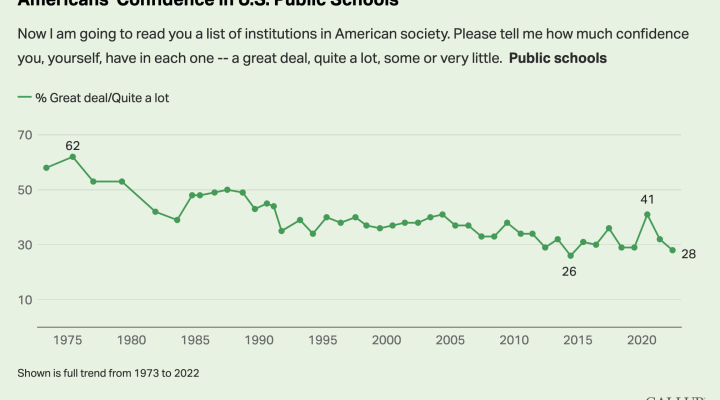
American confidence in public schools spiked with the arrival of COVID-19 in 2020, but it has dropped to nearly an all-time low, according to a new Gallup poll.
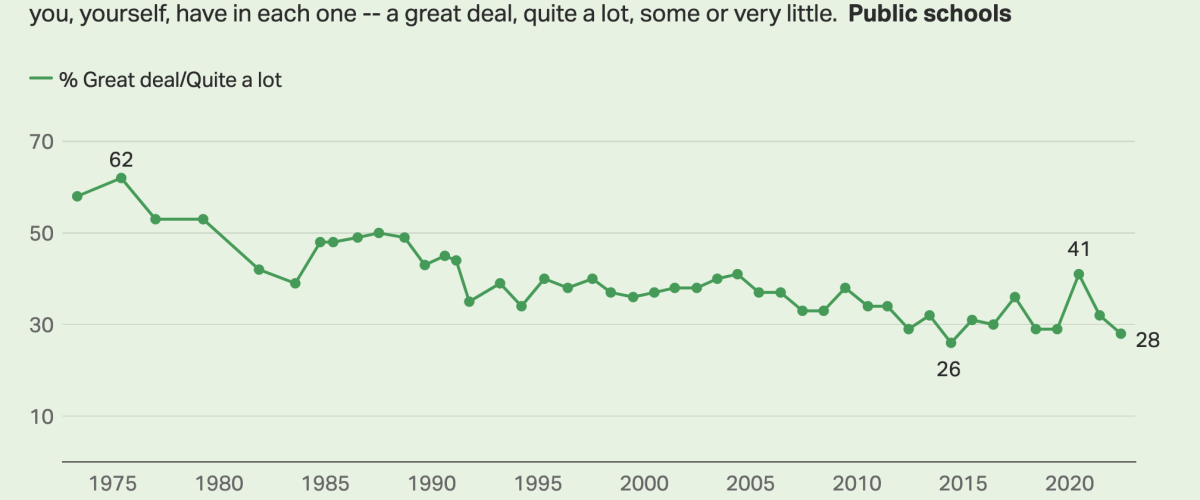
The survey reported 28% of U.S. adults expressed “a great deal” or “quite a lot” of trust in public education, compared to 32% last year and 41% the year before that. In 2019, however, 29% shared that level of assurance.
“While today’s 28% is below the average 31% seen since 2012, it is slightly above the all-time low of 26% measured in 2014,” Gallup reported.
But public education was by no means the only institution to decline in popularity during the previous year, the June poll revealed.
“Americans are less confident in major U.S. institutions than they were a year ago, with significant declines for 11 of the 16 institutions tested and no improvements for any,” Gallup said.
Institutions covered in the survey ranged from all three branches of government, to the military, police and health care, as well as media, the criminal justice system, and big and small business.
The presidency endured the most significant decline in public confidence, dropping 15 points to 23%. The U.S. Supreme Court, which fell 11 points to 25%, trailed right behind.
Small business received the highest level of esteem but still dipped from 70% in 2021 to 68% this year. The military ranked second but dropped five points to 64%, while police, enjoying the third-highest level of confidence, shrunk from 51% to 45%.
Institutions with the lowest confidence ratings were Congress, at 7%; television news, at 11%; and big business, at 14%.
Gallup noted churches and other forms of organized religion fell to their lowest points in three decades. Confidence in religious institutions dropped from 37% to 31% over the past year.
Gallup noted churches and other forms of organized religion fell to their lowest points in three decades. Confidence in religious institutions dropped from 37% to 31% over the past year. Those numbers represented a bigger decline, at 6 points, than schools, at 4 points.
Overall, confidence in institutions has been down this year, Gallup said.
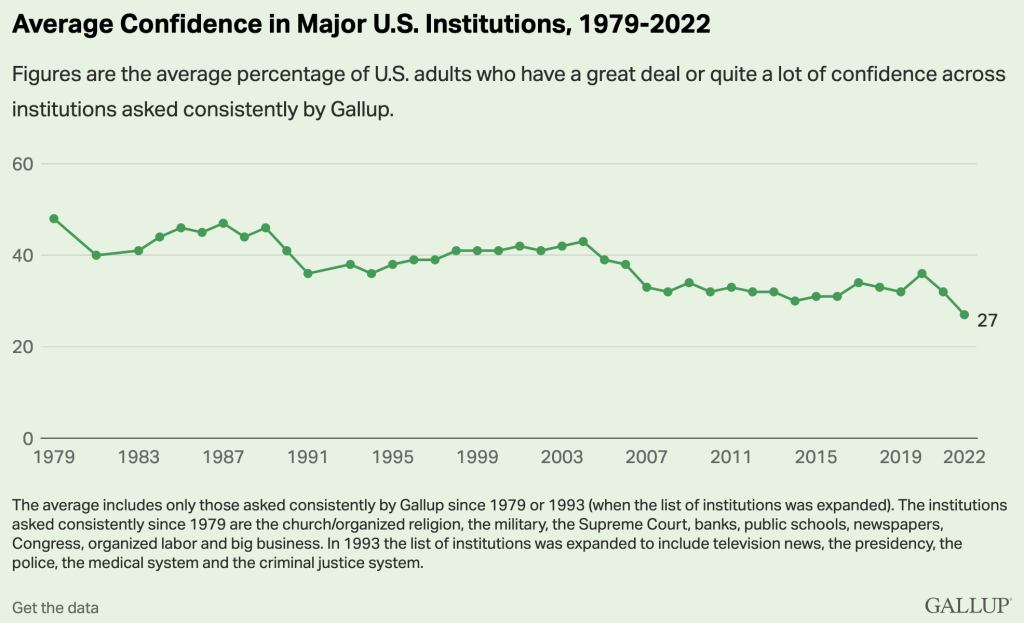
“This year’s 27% average of U.S. adults expressing ‘a great deal’ or ‘quite a lot’ of confidence in … 14 institutions is three points below the prior low from 2014,” the polling organization explained. “The confidence average is also down nine points from 2020, when Americans rallied around some of the institutions most affected by the COVID-19 pandemic, expressing greater confidence in the medical system, public schools and organized religion.”
But even the bump induced by the pandemic fell short of previous measurements.
“Average confidence was at least 40% from 1979 to 1990 and from 1998 to 2004,” Gallup said. “Those latter years spanned the dot-com economic boom and the rally in support of government leaders after the 9/11 terrorist attacks.
“Since 2004, a number of factors have conspired to keep confidence down, including the Iraq War, the Great Recession and financial crisis, increasing partisan gridlock in Washington, a resurgence of populism, the COVID-19 pandemic and inflation rates not seen for four decades.”
Sharp spikes in partisan ideology comprised one of those factors for public schools, “with Republicans more opposed than Democrats to distance learning and student face mask requirements during the COVID-19 pandemic,” Gallup said.
By keeping public education in a negative political spotlight, the ongoing local, state and national arguments over curriculum — involving systemic racism, gender and sexual orientation — also have contributed to the decline in school confidence.
“The percentage of Republicans having a great deal or quite a lot of confidence in public schools fell from 34% in 2020 to 20% in 2021 and 14% today,” the survey found. “Since 2020, independents’ confidence has declined nine percentage points to 29%, and Democrats’ has remained fairly high — currently 43%, versus 48% in 2020.
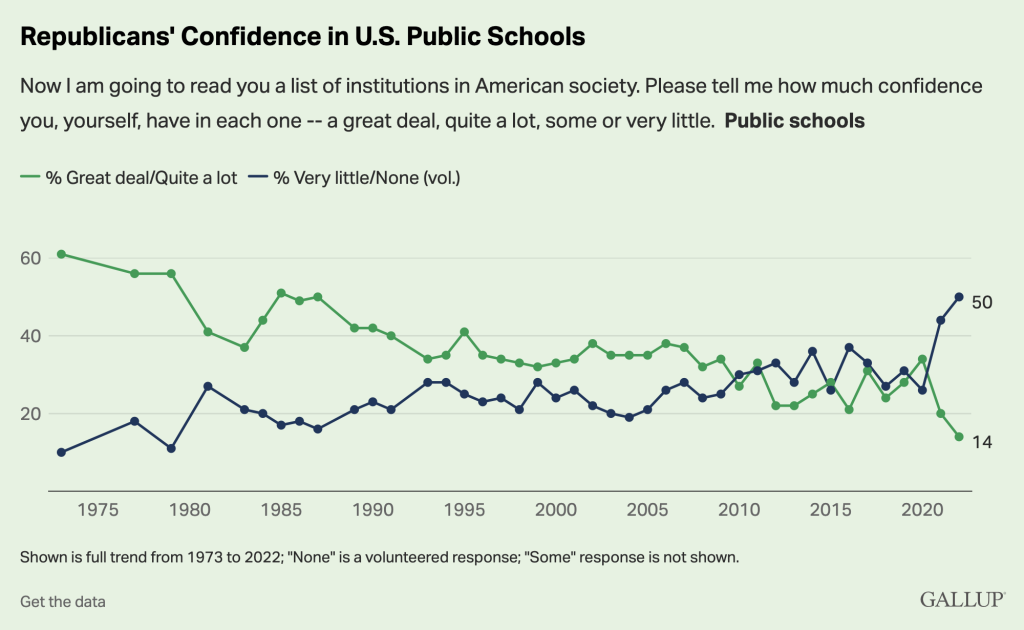
“The extent of Republicans’ displeasure with education today is further evident in the sharp increase in those expressing very little or no confidence in public schools. Half of Republicans are now this critical, up 19 points from 31% in 2019.”
Republican confidence in public education usually declines when Democrats hold the White House, Gallup added. “However, the 12-point drop in Republicans’ average level of confidence in public schools between Donald Trump’s presidency (29%) and under President Joe Biden’s (17%) is greater than would be predicted by those factors alone,” it said.
But when asked to identify the nation’s top challenge, “only 1% of Republicans in June named education in answer to this open-ended question,” Gallup said. “Thus, it remains to be seen if concerns about education spur Republicans to the polls in November – or if other issues, from inflation to abortion to guns, are more prominent in influencing whether and how people vote.”
Related articles:
Gallup finds a sharp political divide on American views of moral values
American support for abortion rights at highest level since 1995, Gallup says
Belief in a literal interpretation of the Bible at all-time low among Americans, Gallup reports