



Theological education has been my life’s work, and it has been a joyful and traumatic pursuit at three schools: Southern Seminary, Central Seminary, and now United Theological Seminary of the Twin Cities.
I would consider myself blessed to have labored alongside students, faculty and administrators in each of these contexts, and each has included provocation.
Coming from a conservative theological background, Southern forced me to ask questions that my home church and my college preferred to sidestep. I had not really integrated my reading of Scripture with my clear sense of calling to ministry, one of the reasons I had felt compelled to enter seminary. Not many wanted to talk about what role women should play, even though the “mother seminary” was thought to be a bastion of progressive theological thinking.
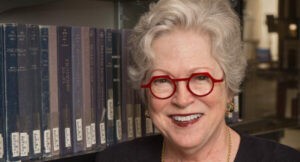
Molly Marshall
In the spring of 1973, Billy Graham held a town hall meeting with students in the chapel. I had been there only a short time, so perhaps the protocols of the place eluded me. Anyway, I ventured to ask the renowned evangelist a question. I simply asked, “What do you believe the Bible teaches about the ordination of women?”
He responded, “This is not really the place to discuss that.”
If not here, where? I wondered. Some students clapped and some booed. I was branded as a provocateur. Such a label was both terrifying and encouraging.
“I was branded as a provocateur. Such a label was both terrifying and encouraging.”
In those days, there were few women pursuing the master of divinity degree. It was assumed that they would automatically enroll in the master of religious education program, and that is where I landed — for one semester only. After signing up for classes that were core to the School of Theology curriculum, I asked to transfer into the M.Div. degree. The dean of the School of Religious Education was less than pleased, provoked really, contending that I had not given his school a try. I wore him down, respectfully, of course, and he relented.
Professors offered the provocation of deep learning that challenged imbedded convictions. I did not know that the Baptist theological heresy of Landmarkism had deeply infected me until sitting in Glenn Hinson’s church history class. His description of the “trail of blood” was exactly what I had imbibed in the teachings of my church in northeastern Oklahoma.
Dale Moody, who had a double major in Bible and geology at Baylor, brought his desire to integrate science and Scripture into his theology classes. When he attempted to correlate the Eden story with the Neolithic Age, my worldview shifted considerably. While I would argue with that attempted exactitude now, his venturing example shaped students’ thinking.
Moody’s own view of women in ministry began to shift as his daughter (enrolled at Southeastern Baptist Seminary) began to explore ordination. When St. Matthews Baptist Church convened an ordination council for me in the spring of 1983, Moody was front and center, asking hard questions and affixing his signature to the Certificate of Ordination. He, too, had been provoked and changed his mind. He encouraged me to accept the call of a rural Kentucky church to serve as pastor.
My years of teaching at Southern and Central coincided with the rise of intersectional theology. The claims of race, gender, sexual identity and geographical context, all ingredients to theological construction, provoked fresh readings of Scripture, new forms of theological reflection, and renewed attentiveness to ethical perceptions. Most provocative was revisiting the language used for the divine. “What language shall we borrow?” indeed.
“The language we use for God has powerful authorization for human linguistic conventions.”
The language we use for God has powerful authorization for human linguistic conventions. If God is always referred to as “he,” it is not hard to think of God as literally male and conclude that men are more like God than women, justifying the patriarchal complementarian construal.
The provocative writing of theologian Elizabeth Johnson, She Who Is, propelled the conversation in scholarly circles and highlighted how our mode of speaking of the divine is always the play of analogy, to usurp Aquinas’ approach, which always spoke of God in masculine language and turn it on its head. Her provoking rhetoric opens a door to more careful language when speaking of the divine, including trinitarian identity. The church and the academy are in her debt.
In 1993, she came to Louisville to receive the Grawemeyer Award for her perceptive work. She offered a public lecture at Louisville Presbyterian Seminary to an overflowing chapel. Early the next morning, under cover of darkness, she came to Southern to meet with doctoral students and hear our concerns about the encroaching fundamentalism and patriarchal enervation we were experiencing. I remember her compassion as she reflected on her own experience in her Roman Catholic structure. She had to change schools from Catholic University to Fordham University for the sake of conscience; she knew the cost of provocation.
Another key issue that students — more than faculty — brought to the fore was justice for LGBTQ persons. I remember the quiet conversations between students and trusted faculty and then the courage of a student representative to the board, Tyler Tankersley, to speak to the need to change the admission and employment policies at Central. The board showed courage also, as the provocation was offered in love and hope. Persons who would not have come to Central prior to the nondiscrimination policy began to arrive, and they found a place that had made room for them.
And now at United Theological Seminary of the Twin Cities, the blessing of provocation comes in the form of our school’s commitment to interreligious engagement. Many of our students practice “multiple belonging” as a part of their spiritual ques; others are firmly planted in other than the Christian tradition.
As a trinitarian theologian, the ethical commitments and spiritual identity of these adherents challenge easy certitude as their contextual and historicist perspectives interrogate my commitments and beckon humility. Yet, in my judgment, respectful engagement with other ways of faith is a key charism of progressive Christianity.
I am blessed because I keep encountering persons who will not rest while injustice prevails, especially in the name of Christ’s church. These have encouraged me to risk provocation as a means of reformation for Christian witness in our time.
Molly Marshall serves as president of United Theological Seminary of the Twin Cities. She previously led Central Baptist Theological Seminary.
Other articles in this series:
‘We’re so blessed!’ | Opinion by Mark Wingfield
Blessing is not about good fortune; it is akin to God’s love | Opinion by Ann Bell Worley
Original blessing, the #blessed hashtag, and what it really means to be blessed | Opinion by Andrew Daugherty
When being a ‘blessing’ comes with some baggage | Opinion by Amber Cantorna
Seeing mortality as a blessing | Opinion by Cynthia Astle
Blessed by life’s diversions | Opinion by Jeff Hampton
Blessing is naming what is true | Opinion by Erin Robinson Hall