


During most trips down the interstate, drivers mindlessly zoom past billboards bombarding them with a blur of messages on their way to wherever they’re going. But every once in a while, travelers are confronted with a message about a different destination — their eternal destination.
The “Billboard Evangelism Program” is run by Christian Aid Ministries, a ministry founded in 1981 by Amish, Mennonite and Anabaptist individuals and groups with the purpose “to glorify God and help enlarge his kingdom.”
According to their website, they have 1,295 billboards throughout all 50 states, which are seen by more than 20 million people per day and result in 304 phone calls per day. Their 2020 in review report claims 72% of callers are either curious or seekers, while 9% are “mocking/foolish” and 5% are from the LGBTQ community.
Because they believe in young earth creationism, some of their signs include messages against evolution.
They also believe “God has established unique roles of authority for man and woman” and that “the woman’s head is to be veiled, and her hair uncut, signifying their acceptance of God’s order.”
Because of their views of creation and gender roles, they believe “adultery, fornication, homosexuality, pornography, lesbianism and any other sexual involvement is condemned by God.” So they often strategically place billboards about lust within proximity to adult stores or strip clubs.
And for those who do not accept their theology, “eternal damnation in hell” awaits them.
Billboards with actual ‘good news’

Zack Hunt
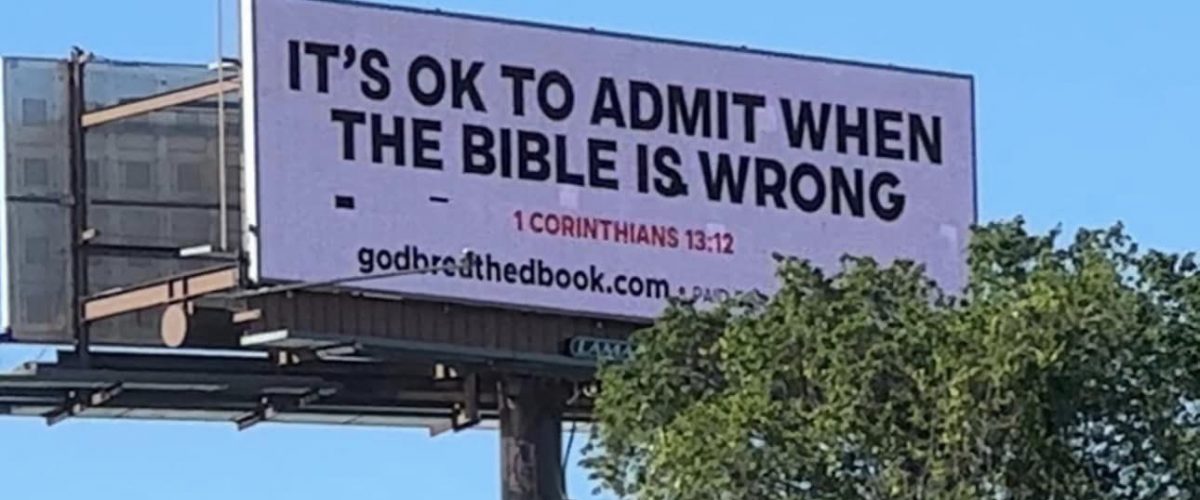
Zack Hunt, author of the newly released book Godbreathed: What It Really Means for the Bible to Be Divinely Inspired, believes billboards such as these are not presenting a message that is good news. So he decided to rent three billboards along Interstate 65 near Nashville with a quite different message.
Hunt’s three billboards say:
- “You are not going to hell. — John 3:17”
- “It’s OK to admit when the Bible is wrong. — 1 Corinthians 13:12”
- “God didn’t write the Bible. People did. — Romans 1:1”
While his billboards are getting a rise out of evangelicals, Hunt says they’re meant to be an encouraging, uplifting message of good news.
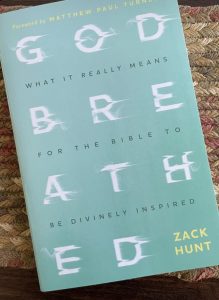 In an interview with Baptist News Global, Hunt shared how he understands biblical inspiration and interpretation, and he explained why he believes his three billboards are good news.
In some of your discussions about inspiration, you mention the Bible should breathe life into the world. Conservative evangelicals would probably agree with that statement on a surface level. But they often also assume that means confronting people in order to convince them to agree with their views of theology and ethics. Why would you disagree with their view of breathing life into the world? And how would you recognize when true life was really being breathed into the world?
If confronting people with theology and ethics that condemns people for loving people for loving the “wrong” people or simply being who they are by virtue of their creation, then yes, I would disagree with that as breathing life into the world. Proselytization is not inherently virtuous or defensible.
If the theology and ethics we hold are used to marginalize and oppress, if they’re not breathing hope, grace and love into the world, then they’re not life giving, no matter how many Bible verses we believe we have to back them up.
You say we should interpret the Bible in a way that is spiritually healthy and intellectually honest. Some conservative evangelical pastors have told me they don’t prioritize interpreting the Bible in spiritually healthy ways because they’re more concerned about interpreting it in biblically accurate ways. Likewise, they aren’t concerned about being intellectually honest because they choose to trust God rather than their own understanding. So why would you be concerned about those two priorities?
I find them both inherently dishonest and deeply idolatrous. We play an inescapable interpretative role whenever reading and applying verses from the Bible. Even simply making a choice to quote one verse rather than another is an interpretive move.
“Any pretense of simply repeating the plain words of Scripture is an intellectually dishonest and lazy deflection of personal responsibility.”
Our role as biblical readers is not to try to excise ourselves from interpretation. That’s impossible. Our role is to recognize our inescapable role and the assumptions, context, biases and presumptions that come with interpretation and then in spite of those things, or in some cases directly because of them, find ways to read and apply the Bible that brings life into the world.
Any pretense of simply repeating the plain words of Scripture is an intellectually dishonest and lazy deflection of personal responsibility and worse, in doing so makes us the mouthpiece of God by framing our interpretative decisions as the unfiltered word of God when they are anything but.
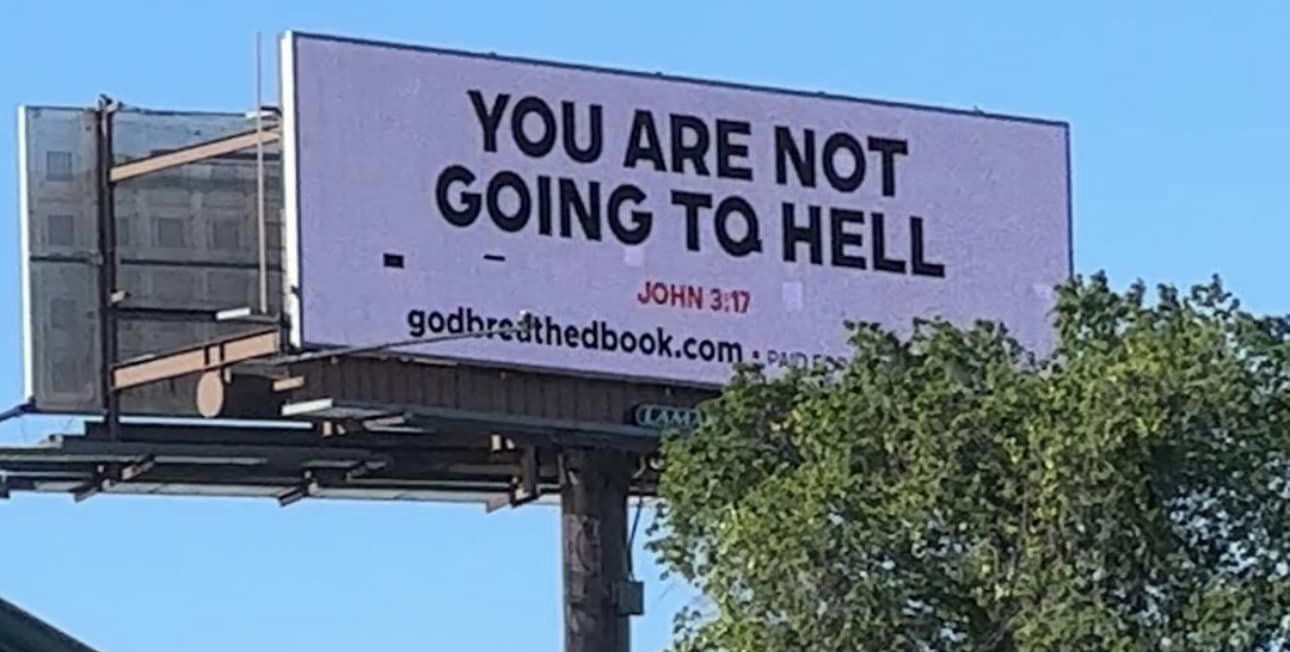
In one billboard, you say, “You are not going to hell.” The billboard also references John 3:17. How would you interpret Jesus’ statement that God sent his Son to save the world rather than to condemn it in light of the apocalyptic teaching of Jesus that seems to include condemnation? Why do you think conservative evangelicals are willing to celebrate a good news that they aren’t going to hell, when they believe their neighbors are? And what sort of justice do you hope for in the afterlife, if any?
I wouldn’t say there is necessarily no condemnation, although Paul does open the door to that if John 3:16 is true and through the death and resurrection of Jesus we are now all caught up in God’s grace. But I think the idea that a rejection of hell is a rejection of eternal justice, a comment I’ve encountered in various forms in response to that particular billboard, is a failure in theological imagination.
I think there will certainly be justice in some form in eternity. Jesus says as much in Matthew 25. But what exactly happens to the goats Jesus turns away, he doesn’t actually say. But I do know that sending people to a place of eternal conscious torment is not a biblical idea.
Conservative evangelicals often argue there has to be an objective standard of morality outside of ourselves or else anything goes. Their conclusion is that this standard is recorded in the Bible. So why would you consider the possibility of the Bible being wrong on issues of morality to be good news?
I find good news in biblical imperfection because I see the Bible as a story we are invited into, not a rule book we must follow in order to avoid hell. Imperfections mean not only are real people telling real stories, but they find no reason to hide their dirty laundry behind hagiography.
“I see the Bible as a story we are invited into, not a rule book we must follow in order to avoid hell.”
I find that hopeful because it means the Bible is full of imperfect people just like me, which means God can use imperfect people just like me, people who screw up sometimes and sometimes even put words in the mouth of God and yet God is there to meet them, meet me with grace every time.
When we reduce faith to nothing more than a list of rules to follow and beliefs to affirm in order to avoid hell, then biblical imperfection can be really scary. But when we see the Bible instead as a story we’re invited into, a story we’re called to continue telling, then the imperfections become a reminder of God’s grace.

Inerrantists often create a dichotomy between trusting man’s words and trusting God’s word. In their theology, their interpretation of the Bible is viewed as an anchor amidst the storm of ever-changing opinions. So why would you consider the idea that people wrote the Bible rather than God to be good news?
I find good news here for the same reason I find good news in other biblical imperfection: It’s another sign of God’s grace and God’s invitation. If our interpretation of the Bible is our anchor in the storms of life, then our anchor isn’t God or even the Bible. Our anchor is us. We’re just holding onto ourselves.
But the Bible is more than that, more than a rule book to be followed or a dogmatic fortress, if it’s a story bigger than ourselves, bigger than our interpretations, bigger than our individualism. And if that story, the story of the people of God, is one that is still being told, then we have the entire body of Christ surrounding us and holding us up through the storms of life, not just our individual understanding of the Bible.
Related article:
Evangelicalism isn’t dying; it’s already dead | Opinion by Zack Hunt