


Linda Livingstone took office as the 15th president of Baylor University in 2017 during one of Baylor’s most challenging times. During her tenure, the university has become one of America’s few faith-based universities to achieve Research 1 status and made major strides in reckoning with our racist and slave-holding history, and she herself has been recognized as a leader in American higher education and in the constantly evolving world of college athletics. I sat down with Livingstone in her office at Baylor for a long interview, from which the following is excerpted, and am so grateful for her thoughtful engagement with these questions.
Greg Garrett: The Baylor board of regents recently adopted an expanded university motto “Pro Ecclesia, Pro Texana, Pro Mundo.” Over the last year, universities and even the idea of the university have become a culture war battleground. Why has the university become this cultural football? What do you hope Baylor speaks into larger conversations about what we are called to do in the church, the nation and the world?
Linda Livingstone: Universities are designed to create knowledge, to share knowledge, to debate knowledge, try to find truth in things. By the nature of what our purpose is, there is certainly the opportunity for divisiveness and disagreement. I don’t know that we should be particularly surprised when the world becomes really divisive or when there are really divisive issues that they become magnified on a college campus because of the nature of what we do, and because we have really young people on our campuses who are trying to figure themselves out and figure out what they believe.
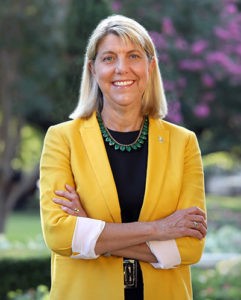
Linda Livingstone (Photo/Baylor)
We have seen that at other points in the history of our country. Baylor Christian higher education offers an opportunity because we’re grounded in our faith beliefs and our values to try to find a way to step into that gap and to find a pathway for thinking about seemingly intractable issues, a way that can be healthier, more productive, trying to find ways to solve problems.
Because typically when people are really angry about something, everybody thinks there’s a problem, they just can’t agree on how to solve it. So the question becomes, can we, from the perspective of our values as a faith-based university, try to help find ways to bridge those disagreements and at least try to find common ground to reach some kinds of solutions as opposed to people just continuing to grow further and further apart?
GG: A week or two ago, I had the opportunity to speak with some of our new faculty on diversity, equity and inclusion. We reside here in Texas where our sister public institutions are being required to step back from some of that institutional work, while my perception is that Baylor continues to lean further into it. Could you talk a little bit about why that work is so important and maybe how it fits with the Christian mission?
LL: One of the things we want for every student on our campus coming from the diverse backgrounds and experiences our students have, particularly some of our students who come from marginalized communities, is we want them to be successful on our campus. We want them to feel seen and heard and engaged and know they’re cared for. And that flows out of our values as a Christian institution. Clearly the Scriptures tell us the second greatest commandment is to love your neighbor as yourself. So how do we do that and live that out in a concrete way?
It’s so important to deal with diversity because of our values as a Christian community. We do believe everybody was created and gifted by God, and so we need to honor that and figure out how to help people be the best that they can be, given what God has gifted them. We have a unique opportunity as a university, but then as a Christian university, to be able to lay those values across it.
“It’s so important to deal with diversity because of our values as a Christian community.”
Our country’s diverse, the world’s diverse, and it’s going to become more and more diverse. And you talked about the motto earlier, we need to be reflective of that. We actually have one of the most diverse student populations in the Big 12, and we have worked really hard to create an environment with faculty and staff, too, that’s more reflective of our student population.
GG: After the George Floyd murder, it felt like there were opportunities to wrestle with the reality of race in America. And then, as is often the case, we saw the pendulum swing back. How would you respond to those who argue race is not an issue a university should be paying attention to given that sort of backlash and the political cultural wars?
LL: If you just think purely from an academic perspective, we should be studying important issues that are influencing and shaping society and the world. We need to have faculty researching these issues to help us understand the causes, how we try to resolve them, how we get to a better place.
Then from an educational perspective, we have a responsibility to educate our students, to engage them around these hard issues and to help them learn to think critically, to find good information and truthful information, to come to terms with what they truly believe. That’s one of our responsibilities as a university, so these are the kinds of issues we need to be talking about.
Finally, from a student, faculty and staff well-being standpoint, these issues affect people on our campus and their ability to be successful academically, their ability to engage with one another in healthy ways, so we need to be able to help work through that and help support them.
GG: This year we’re hearing a lot about the notion that America was founded as a Christian nation, that it should be governed by Christian principles. People sometimes seem surprised to hear somebody like me who is an ardent Christian say that this is not a Christian way to think about how we live our public lives. What can Baylor bring to the conversation about this ideology?
LL: I think of the history of Baylor being a moderate Baptist institution, a “broad middle” institution. What you’re talking about is an extreme view on the continuum. Because we live in the broad middle, how do we work in that space knowing we have people on our campus who are outside those parameters? How do we create a space where we can try, like I said before, to bring people together and have a healthy conversation that really is about solutions?
“We’re Baptist by heritage, by values.”
The other thing I would say: We’re Baptist by heritage, by values. One of the core principles of Baptist faith is separation of church and state. We have to think about — as an institution that has a Baptist heritage — how we live out that deeply held Baptist core belief that there’s a legitimate reason to have separation of church and state while as individual Christians we live out our faith in the civic world. It is a difficult space to inhabit right now.
GG: One of the things I’m asking people is where they’re finding joy and hope. What are you reading? Are there things going on here at Baylor that make you say there are at least this many good things in the world that I can put my trust in?
LL: Well, a few things. As you know, we just were on a trip to Europe and a portion of that trip was visiting students on study abroad. Honestly, being around our students, whether abroad or when we’re on campus, gives me great hope. Our students overseas were so engaged in what they were doing, asking interesting questions, delving deeply into subjects and taking seriously what it means to be a world citizen.
Back on campus, we’ve got our incoming freshmen in orientation, and they are excited about college and what it’s going to mean for them. I can’t help but be hopeful when I see our students. They’re bright, they’re curious, they care about the world. That gives me hope.
At Baylor, our board just approved a new strategic plan that will launch publicly in the fall. It’s built on the great success we had with our last strategic plan, our last philanthropic campaign. I’m very hopeful about the impact it’s going to have, not just on our campus, but in the way it’s going to propel us forward and have impact outside the walls of Baylor. That partly is why we changed our motto to include “Pro Mundo,” for the world. That gives me hope about the future of Baylor and the impact we can have.
This isn’t going to sound hopeful, but I’m reading The Demon of Unrest by Eric Larson. It’s about all the stuff that leads up to the Civil War, a time when things were deeply, deeply divided in this country and what caused it. So you ask, why am I talking about that in a question about hope? I think it’s why you have to study history, right? Because you can go back and say, OK, what caused that? What were the issues? Could something have been done? What do we learn from what happened there? How might we take that learning and apply it in a situation that we see now where we’re seeing a lot of division?
To pull a phrase from Lincoln’s First Inaugural Address, I have to believe our better angels are going to prevail, the better angels of our nature. And part of the reason I believe that is because as Christians, our hope is in the Lord. Ultimately the Lord has his hand in things and gives us the ability and responsibility as Christians to help work through some of these really difficult issues. I view it as a real privilege to be able to do that in my role here at Baylor.
Greg Garrett teaches creative writing, film, literature and theology classes at Baylor University. He is the author of two dozen books of fiction, nonfiction, memoir and translation, including the critically acclaimed novels Free Bird, Cycling, Shame and The Prodigal. His latest novel is Bastille Day. He is one of America’s leading voices on religion and culture. Two of his recent nonfiction books are In Conversation: Rowan Williams and Greg Garrett and A Long, Long Way: Hollywood’s Unfinished Journey from Racism to Reconciliation. He is a seminary-trained lay preacher in the Episcopal Church. He lives in Austin with his wife, Jeanie, and their two daughters.
More from this series:
Politics, faith and mission: A conversation with Charlie Bell
Politics, faith and mission: A conversation with Grace Ji-Sun Kim
Politics, faith and mission: A conversation with Rowan Williams
Politics, faith and mission: A conversation with Nathaniel Jung-Chul Lee
Politics, faith and mission: A conversation with Starlette Thomas
Politics, faith and mission: A conversation with Samuel Perry
Politics, faith and mission: A conversation with Jimi Calhoun
Politics, faith and mission: A conversation with David Dark
Politics, faith and mission: A conversation with Randolph Hollerith
Politics, faith and mission: A conversation with Jillian Mason Shannon
Politics, faith and mission: A conversation with Bishop Mariann Edgar Budde
Politics, faith and mission: A conversation with Vann Newkirk II
Politics, faith and mission: A conversation with Sarah McCammon
Politics, faith and mission: A conversation with Winnie Varghese
Politics, faith and mission: A conversation with Kaitlyn Schiess
Politics, faith and mission: A conversation with Russell Moore
Politics, faith and mission: A BNG interview series on the 2024 election and the Church
Politics, faith and mission: A talk with Tim Alberta on his book and faith journey
Politics, faith and mission: A conversation with Jemar Tisby
Politics, faith and mission: A conversation with Leonard Hamlin Sr.
Politics, faith and mission: A conversation with Ty Seidule
Politics, faith and mission: A conversation with Jessica Wai-Fong Wong
Politics, faith and mission: A conversation with Brian McLaren