

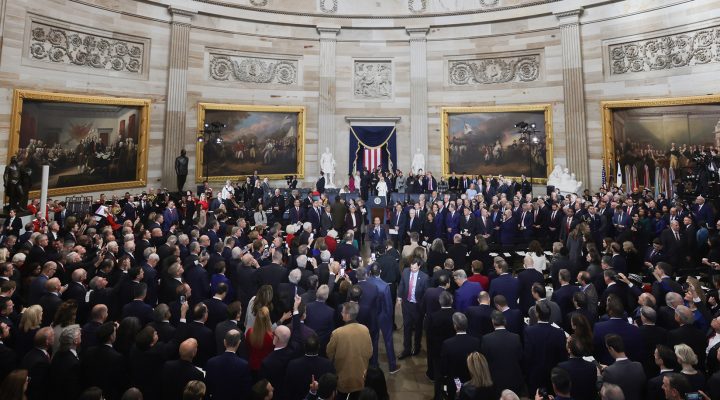
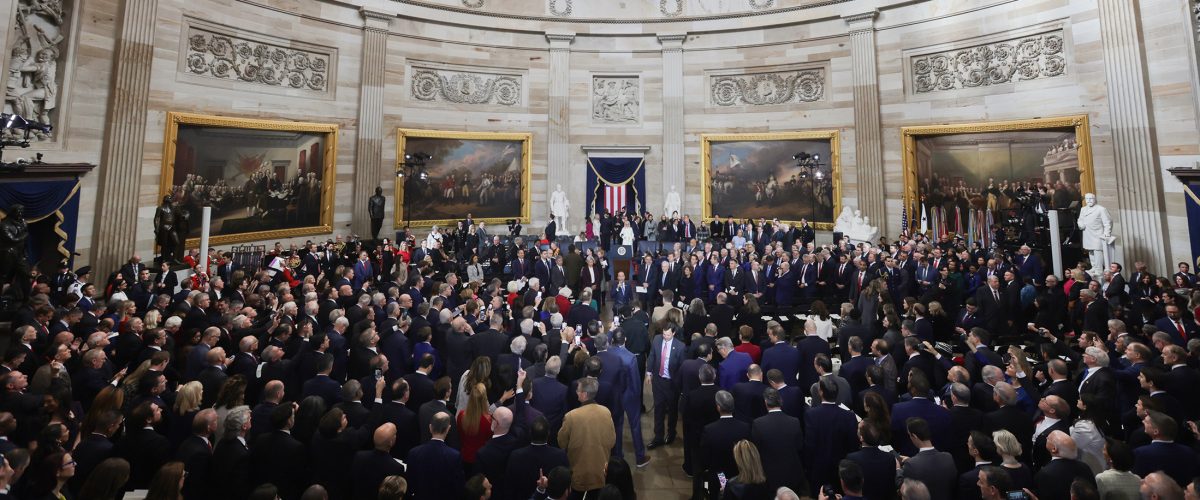
The inauguration of Donald Trump to a second term as president of the United States was another example of how religion and politics are being blended in America today.
This merger challenges the idea that the government should not interfere with religion, favoring one religion over another or establishing an official government religion, the political concept popularly known as the “separation of church and state.”
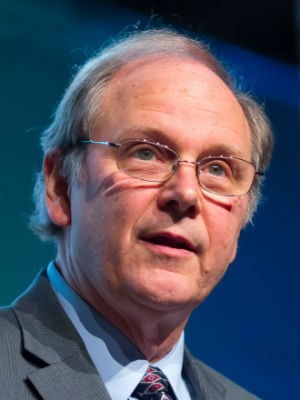
Robert Sellers
As the billionaires, legislative and judicial leaders, cabinet nominees, former presidents and vice presidents, family members and invited guests, and — oh, yes, President Joe Biden and Vice President Kamala Harris — awaited the arrival of Donald and Melania Trump, the pianist played a song as background music I immediately recognized.
I doubt many of the gathered guests paid much attention, but to some of those in the crowd who did hear the music, the signal was very clear. Evangelical Christians in the room, and certainly many who identified themselves as Christian nationalists, might have recognized the song.
“Evangelical Christians in the room might have recognized the song.”
It was the Christian hymn “Great Is Thy Faithfulness.”
Manipulating a Christian hymn
Thomas Chisholm, a schoolteacher, newspaper editor and insurance agent born in a Kentucky log cabin in 1866, wrote the hymn’s lyrics in 1923, as well as 1,200 other poems. The lyrics reflects the writer’s belief that God works in our lives in simple, often unremarkable ways and that God’s faithful provision, pardon, presence and peace are always dependable.
I suspect Chisholm never would have dreamed this hymn would be used to make a political statement.
As a Christian for more than 70 years, I know and love this hymn but believe it was not appropriate to use in a political setting like the inauguration. I recall it often being sung in worship services during the years of my youth as I was experiencing God gradually leading me toward international, cross-cultural ministry. The hymnal my church used during my childhood and adolescence categorized this song under the theme of the “Love and Mercy of God.”
Like many other Baptist youngsters, the frequent singing of this hymn in my church helped me memorize the verses and think of this hymn text as a part of my spiritual formation.
In 1975, my wife, Janie, and I began our journey as career missionaries. Early in our quarter century living and ministering in Indonesia, our sponsoring agency — the Southern Baptist Foreign Mission Board — sent a German film crew to Jakarta to interview and film us to create a 30-minute documentary depicting a young missionary couple.
One brief scene in the film shows us practicing a duet in the Indonesian language which we would sing for our small congregation. It was “Mulia SetiaMu” or “Great Is Thy Faithfulness.” Even though that rehearsal in our Jakarta home was filmed more than 45 years ago, almost every time any congregation or choir sings the hymn my thoughts return to God’s calling on our lives and our wonderful missionary years in Indonesia.
Hymns as political symbols
What I question about this hymn being played at the inauguration is not its instrumental reminder — to those who recognized it — that God is faithful, but rather the association of “God’s love and mercy” with a political event, especially one as consequential as the inauguration of the president and vice president of the nation. It was a bit of contrived emotional manipulation, for the setting was not worship, but rather a partisan political celebration.
“It was a bit of contrived emotional manipulation.”
Almost a year ago — months before the 2024 presidential election — I published an article for the Public Square segment of The Interfaith Observer. It was titled “’On the Border’ — Franklin Graham’s Religious-political Scramble.” The article concerned the announcement of Graham’s “God Loves You Tour” he would take to 10 southern border towns, with the express purpose of bringing a message of personal salvation.
As I wrote then, Graham’s unabashed support of Trump — along with Trump’s repeated condemnation of his political opponents’ “illegal immigrant” fiasco at the southern border — made the location and timing of the Frontera campaign suspect. I wrote:
This religious-political scrambling of motivations behind the tour … underscores (a) characteristic of this odd mixture, which is the inappropriate marriage of religion and politics in a multi-city event devised to gain maximum news coverage. For all who care about the intersection of freedom of religious expression and the role of government, this is an attack on the separation of church and state, which is protected in the First Amendment of the U.S. Constitution. The problem here is the pretense of conducting religious meetings that really have clear political overtones.
Playing a familiar Christian hymn as a lead-in to a formal government observance creates the opposite problem — designing a political ceremony that has clear religious overtones.
Manipulating a Christian prayer
I would not typically criticize a Christian prayer, especially publicly and in writing. But these are not typical times, and I feel I must speak out, although my words may be rejected even by some of my friends. I cannot do otherwise, for if the “special music” at the inauguration “service” seemed manipulative, the “morning prayer” offered by Franklin Graham was doubly so.
He looked so much like a younger version of his famous father, Billy Graham, as he walked to the podium. Standing almost directly in front of Joe Biden — still president at that point in the ceremony — Graham looked at Donald Trump and said: “Mr. President, the last four years, there are times, I’m sure, you thought it was pretty dark. But look what God has done! We praise him and give him glory.” The audience applauded, and Graham smiled, looking especially pleased that his opening remarks had struck the desired note.
Then he continued with his prayer — heard not only by the hundreds of invited guests in the Capitol Rotunda, but by millions throughout America and around the world via television and the internet.
Analyzing the prayer
Graham prayed as a Christian, but in words that communicated he believes the Judeo-Christian heritage of America is every American’s birthright and cultural milieu. Praying to “Our Father and our God” does not represent those millions of citizens who will be governed by this president but who do not worship as Graham does.
“Praying to ‘Our Father and our God’ does not represent those millions of citizens who will be governed by this president but who do not worship as Graham does.”
“Blessed is the nation whose God is the Lord,” he said. That presumes a nation with a secular or pluralistic identity cannot or will not be blessed, a presumption that challenges the establishment of our nation and our government’s defining documents.
Then he quoted the prophet Daniel: “He changes the times and the seasons. He removes kings. He raises up kings.” The changing times and seasons are self-evident. Yet, the divine’s removing “kings” and raising up other “kings” concerns me, especially in the frequently heard hints that Trump would like to be America’s king.
It is understandable that someone will thank God when they, or someone they love or admire, narrowly escapes death. But Graham in his prayer repeated the claim he had made publicly before: “When (Trump) was there in Pennsylvania, and that bullet went through his ear, just missing his brain by a millimeter or so, I believe God turned his head at that precise moment that saved his life. … I think God has saved him and brought him to this position.”
In the prayer, he declared of God: “You and you alone saved his life,” which implies God took sides in the election and seems presumptuous. One might also question why God protected Trump from the bullet but did not protect Corey Comperatore, the spectator who was killed as he sat in the crowd and was trying to protect his family from the attack.
Perhaps a more unassuming entreaty to God, and certainly a less political one, might have been something like, “May this near-death experience be a reminder to President Trump of the fragility of life and of the importance of a new beginning.”
Graham then referenced JD Vance’s role as a biblical Aaron figure supporting and giving strength to Trump, a new Moses figure: “May he be a strength to President Trump, to stand beside him, to hold up his arms like Aaron held up the arms of Moses in the midst of battle.”
When you understand that actor Jim Caviezel — “Jesus” in The Passion of the Christ movie — who has become a conspiracy theorist and MAGA darling, has been spreading the opinion that Trump is the “new Moses” this is more frightening. The allusion to a battle the followers of Moses had to fight and win makes me think this new Moses will expect his followers to be at his side as he engages his political enemies in the battle for the future of the nation.
Graham then drew a reference from 1 Samuel 10:1, where the prophet Samuel anointed Saul to be the first king of Israel — a centralized monarchy. I wonder if this reference was a not-so-veiled suggestion that Trump will end the democratic governance of America as he creates an expanded executive branch and becomes like a king. This is, of course, a very subtle implication, but might Graham have purposefully selected this biblical passage and included it in his prayer because he understood himself to be anointing a new king?
“Connecting this cliché to God’s participation and help was a political leap.”
Graham concluded his prayer with a reference to America becoming “great again,” a repetition of Trump’s MAGA motto. Connecting this cliché to God’s participation and help was a political leap.
Moreover, for Graham to pray “in the name of the King of Kings, the Lord of Lords, your Son, my Savior and our Redeemer” was insensitive in a religiously pluralistic nation where one must be the president of all Americans, not just the Christian ones. The emphasis Graham made when he said “my Savior” might suggest Jesus wasn’t the Savior of all the listeners, or it could be interpreted as the same kind of egotism Trump so frequently displays.
Prayer as manipulation
In the same way playing the hymn “Great Is Thy Faithfulness” at a political ceremony blended religion and politics in a manipulative way, this prayer just moments before Trump was sworn in for a second term can also be construed as manipulation.
Quoting the Prophet Daniel and the Prophet Samuel were unusual choices for an inauguration prayer, yet Graham chose those references intentionally. One might surmise he was not so much voicing a prayer to God as he was making several political points to his listeners around the world: that God is on Trump’s side, that God protected Trump from death in order that he might reenter the White House, that Trump is the “new Moses” who will help his followers win a decisive battle against their political enemies, and that Trump’s presidency will bring about the transition from democratic rule to a kingly reign.
Trump and his marketing did not need, any longer, to persuade people to vote for him. Instead, they needed to convince those on the political fence that he is on God’s side. Or, more importantly, that God is on his side.
That implication that the president and God Almighty are in close relationship makes it even more interesting that Trump did not place his hand on the Bible his wife was holding for him as Chief Justice Roberts swore him in as the nation’s 47th president.
Rob Sellers is professor of theology and missions emeritus at Hardin-Simmons University’s Logsdon Seminary in Abilene, Texas. He is a past chair of the board of the Parliament of the World’s Religions in Chicago. He and his wife, Janie, served a quarter century as missionary teachers in Indonesia. They have two children and five grandchildren.
Related articles:
Franklin Graham equates Trump’s inauguration with God’s blessing
At prayer service, Episcopal bishop calls on Trump to show mercy
A god of their own making | Opinion by Greg Jarrell