

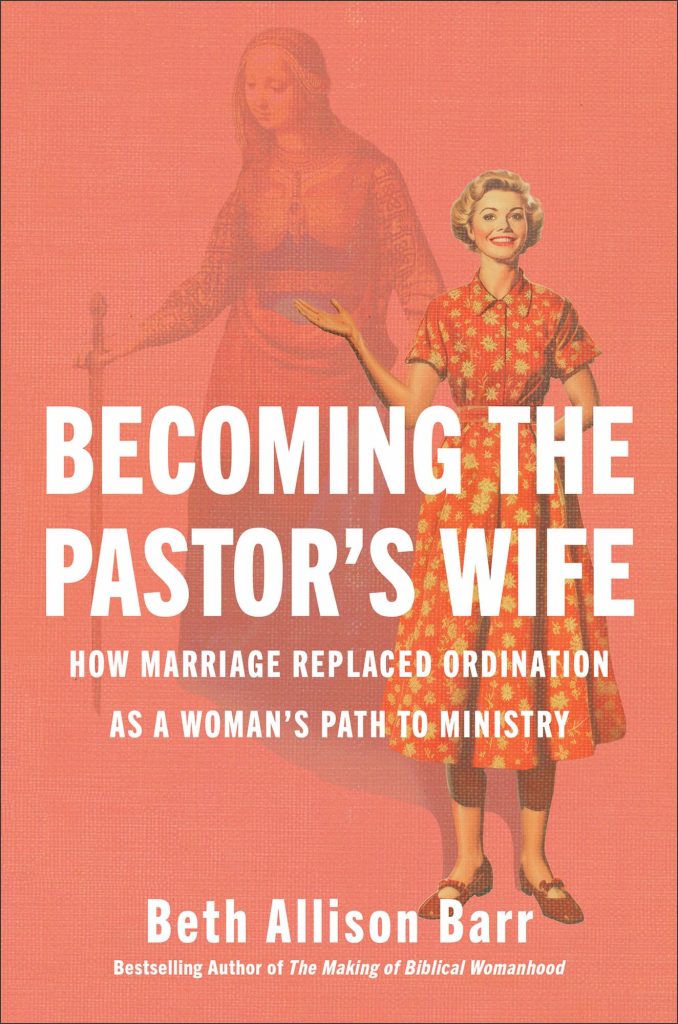
Beth Allison Barr holds the James Vardaman Chair in History at Baylor University. She is the New York Times bestselling author of the new book Becoming the Pastor’s Wife: How Marriage Replaced Ordination as a Woman’s Path to Ministry and the USA Today bestseller The Making of Biblical Womanhood: How the Subjugation of Women Became Gospel Truth, and co-host of the “All the Buried Women” podcast. Beth is married to Jeb, a Baptist pastor, and so is herself a pastor’s wife. I am always grateful for Beth’s work excavating the treatment and mistreatment of women in the church, and her reminder that church history and the Scriptures suggest better possibilities for all of us.
Greg Garrett: So, my dear friend, you have been working on this project for a while. Since Biblical Womanhood landed, what has changed for you in terms of the work you’re doing and the work you’re doing in this book?

Beth Allison Barr
Beth Allison Barr: This book only exists because of The Making of Biblical Womanhood. I never would have thought about writing a book like this investigating the history of the pastor’s wife role. I don’t know if anybody would’ve read a book investigating the history of the pastor’s wife role if I hadn’t written The Making of Biblical Womanhood.
This book really was born in something I didn’t address in that book, the question of women’s ordination. I was reading our colleague Betsy Flowers’ book Into the Pulpit, and she has this section about the rise of the SBC’s “conservative resurgence” and how the women who are fighting on the front lines against women’s ordination are pastor’s wives. That’s actually where I got very interested in this topic: What’s the connection between these very visible pastor’s wives and the fight against women’s ordination?
GG: You and your husband, Jeb, have negotiated these issues personally. You’re very clear you don’t understand yourself as a person called to ordination in a traditional way, but you also have had to live into this space where you begin the book with an older woman in a church who said, “I’m doing the bulletin because our pastor doesn’t have a wife, but when he has a wife, I’ll stop.” Maybe you don’t feel called to ordination in the ways some of the people in the book feel called, but you are well aware of the injustice people who have gifts for ministry get tasked with editing the bulletin or coordinating child care.
BAB: That’s exactly right. In many ways what this book is about is how the options for women in ministry have narrowed, not because of the Bible, not because women aren’t still doing the work and haven’t always been doing the work, but because of this very rigid theology, a relatively new development that has been systematically pushing women out of titled paid professional ministry roles since the 1970s.
And while they’re doing that, they also start raising the visibility of the pastor’s wife, which is something I did not know even though I’ve been a pastor’s wife for more than 25 years. It never occurred to me that the pastor’s wife had been used in this way to limit possibilities for women called to different types of ministry.
“That’s really what this book is about, the narrowing of options for women in conservative spaces that focus on the glorification of the pastor’s wife role.”
That’s really what this book is about, the narrowing of options for women in conservative spaces that focus on the glorification of the pastor’s wife role, which is also just a terrible role. I mean, it’s a really hard role the way it has manifested.
GG: In my James Baldwin class today, we were talking about the concept of intersectionality. I am a white, straight Christian male, and what America has put forth over the last hundreds of years is the idea that anybody who doesn’t look like me is going to have to wrestle to get to the position I hold. I wonder if you could talk a little bit about where intersectionality fits into this, and also about what you discovered when you looked at the Black church.
BAB: So intersectionality, as you know, is actually not a complicated theory at all, or even a controversial one. It just says some people face more challenges in getting to live out their callings than other people do or getting to live out their gifts or having economic security than other people.
When we think about that intersectionality in the North American world, it very much applies to anyone who is not at the top of the patriarchal structure. White women have a better chance of being able to negotiate this power than nonwhite women, but at the same time, in order to negotiate, they make what we call in feminist theory “the patriarchal bargain.” They have to play by the rules of patriarchy.
 In many ways, this is exactly what the pastor’s wife role has become. It is a safe ministry position women who play by the rules can claim, especially white women.
What I found really fascinating in this book is that the role plays out differently among Black women. One of the reasons is because Black men never have held that same type of power.
This is not theory. This is what Black scholar Evelyn Higginbotham argues in her really fantastic book Righteous Discontent, that because Black men never have had that type of power, Black women are not vying. It’s easier, I suppose, to share that type of power with Black men.
The reason they argue for male headship in Christian theology for Black women actually has more to do with what Higginbotham calls “the politics of respectability.” Part of it is maintaining the respectability of the role of their husbands even while at the same time the women are able to function with very much the same type of power, which is why we see co-pastors more commonly, at least earlier in Black churches.
We see how the pastor’s wife role (what is called the “First Lady” in Black churches) really does wield more official power than white wives often hold.
GG: What were some of the most interesting discoveries in this book for you as a historian?
BAB: My research was in two different areas. The first was the archival research. I did five different archive trips for this. The second part was analyzing 150 pastor’s wife books.
The pastor’s wife books, on the one hand, followed the trajectory I expected. I saw them take off considerably with the rise of the “conservative resurgence” and then place more and more emphasis on women’s subordinate roles. What I didn’t expect was how we think about these books as teaching a theology and trying to get the pastor’s wife to act a certain way, which is true, that is in there. But the writers are also very much trying to help other women who are in these really challenging situations and telling them, “I know it’s hard. You can do this. I’m here with you.”
“What I didn’t expect was how we think about these books as teaching a theology and trying to get the pastor’s wife to act a certain way.”
So there’s this really encouraging streak in those books that I didn’t expect where you can really hear the voices of women talking to women. I really loved that.
One of the big collections I looked at is The Southern Baptist Convention Ministers’ Wives Conference Collection in Nashville. This is a group that was started in the late 1940s, the early 1950s, all these Southern Baptist pastors’ wives who went to the annual convention every year, and they were seeing, there is only stuff for the men. We want to have something for us.
At first, they couldn’t get any funding, and they tried to get the pastors to pay for it. One of them told them, “I don’t know why y’all need this. You can just come to the convention.” They started a separate fund to fund themselves, and this is a story I’m still going to follow. We need to follow this money!
The fund grew so fast that later the Southern Baptist Convention asked to take control of it and the pastor’s wives fund got absorbed into the general budget, which just shows how successful these women were.
One of the funniest things: They had a debate at one point about whether or not the life of the pastor’s wife was the good life. They had a debate and they all decided it wasn’t, that it was just too hard, so it’s this very honest look at these women struggling in this very weird role.
The big surprise that turned the book and became my final chapter was when I ran across the sex abuse case and went all the way to Toronto following the story. I was following the ordination case of two women in the early 1980s when I ran across documents talking about this pastor who had committed clergy sex abuse and had been allowed to stay in his ministry. The SBC learned about these allegations, and instead of investigating him, they let him stay in this really significant role until he resigned.
Several years later, and in fact after the book was published, we put this in the show notes for “All the Buried Women,” we found where this pastor was celebrated by the SBC. They kept using him to show how well they were doing in Washington, D.C.
We called one of the SBC people who was connected to this, and he said, “I don’t even remember that role. It must not have been very important.” And yet here we had all these news stories that were celebrating this ministry and using it as an example of what good work the SBC was doing, and it was this man. So that was a really shocking turn.
GG: It’s 2025, and a lot of the time it feels like the world is on fire. Where are you finding hope and courage as we move forward and try to do justice?
“Even though sometimes it’s hard to see on the bigger stage, people seem to be changing their minds.”
BAB: One of the things I’ve seen writing The Making of Biblical Womanhood and now this book is that even though sometimes it’s hard to see on the bigger stage, people seem to be changing their minds. And even me telling you about conservative groups that are being much more receptive of this book, it totally gives me hope that they’re willing to read this and think about the issues.
I also think about how people have started sending me notes and letters again, which I got on The Making of Biblical Womanhood for forever. And now they’ve started coming in for Becoming the Pastor’s Wife.
Actually, the saddest thing so far is hearing from all the women who walked away from ordained ministry paths but seeing their resilience and their determination that this isn’t going to happen to women again.
I think about Kathy Hoppe, who I talk about in the book, who was ordained and part of that ordination crisis. We interviewed her for “All the Buried Women.” We asked her why she was still at an SBC church, and she said, “This is my denomination. I’m going to sit there and they’re going to have to look at me and know that I as an ordained woman belong here.”
I was like, wow. I mean, that’s certainly not something for everyone to do. The strength, the determination it took to sit there Sunday after Sunday and say, I’m not going to let you forget what you did. It doesn’t necessarily give me hope for the SBC, but it does give me hope for the people in it.
You’ve got now fewer than 13 million Southern Baptists, but if you can get some of those to start changing their minds on this issue, they can have a huge political impact. So yeah, that gives me hope.

Greg Garrett
Greg Garrett is an award-winning professor at Baylor University, where he is the Carole McDaniel Hanks Professor of Literature and Culture. One of America’s leading voices on religion and culture, he is the author of 30 books, most recently the novel Bastille Day and The Gospel According to James Baldwin: What America’s Great Prophet Can Teach Us about Life, Love, and Identity. He is currently administering a major research grant on racism from the Eula Mae and John Baugh Foundation and finishing a book on racist mythologies for Oxford University Press. Greg is a seminary-trained lay preacher in the Episcopal Church and Honorary Canon Theologian at the American Cathedral of the Holy Trinity in Paris. He lives in Austin with his wife, Jeanie, and their two daughters.
Check out BNG’s “Highest Power” podcast where Rick Pidcock this week interviews Beth Allison Barr.
More from this series:
Politics, faith and mission: A conversation with Yolanda Pierce
Politics, faith and mission: A conversation with Rep. James Talarico
Politics, faith and mission: A conversation with Malcolm Foley
Politics, faith and mission: A conversation with Jonathan Eig
Politics, faith and mission: A conversation with Greg Jarrell
Politics, faith and mission: A conversation with Robert G. Callahan II
Politics, faith and mission: A conversation with Andrea Russell
Politics, faith and mission: A conversation with Bishop Michael Curry
Politics, faith and mission: A conversation with Melissa Deckman
Politics, faith and mission: A conversation with Matthew D. Taylor
Politics, faith and mission: A conversation with Nancy French
Politics, faith and mission: A conversation with Robert P. Jones
Politics, faith and mission: A conversation with Brian Kaylor
Politics, faith and mission: A conversation with Colin Allred
Politics, faith and mission: A conversation with Tia Levings
Politics, faith and mission: A conversation with Linda Livingstone
Politics, faith and mission: A conversation with Samuel Perry
Politics, faith and mission: A conversation with Jimi Calhoun
Politics, faith and mission: A conversation with David Dark
Politics, faith and mission: A conversation with Randolph Hollerith
Politics, faith and mission: A conversation with Jillian Mason Shannon
Politics, faith and mission: A conversation with Bishop Mariann Edgar Budde
Politics, faith and mission: A conversation with Vann Newkirk II
Politics, faith and mission: A conversation with Sarah McCammon
Politics, faith and mission: A conversation with Winnie Varghese
Politics, faith and mission: A conversation with Kaitlyn Schiess
Politics, faith and mission: A conversation with Russell Moore
Politics, faith and mission: A BNG interview series on the 2024 election and the Church
Politics, faith and mission: A talk with Tim Alberta on his book and faith journey
Politics, faith and mission: A conversation with Jemar Tisby
Politics, faith and mission: A conversation with Leonard Hamlin Sr.
Politics, faith and mission: A conversation with Ty Seidule
Politics, faith and mission: A conversation with Jessica Wai-Fong Wong