

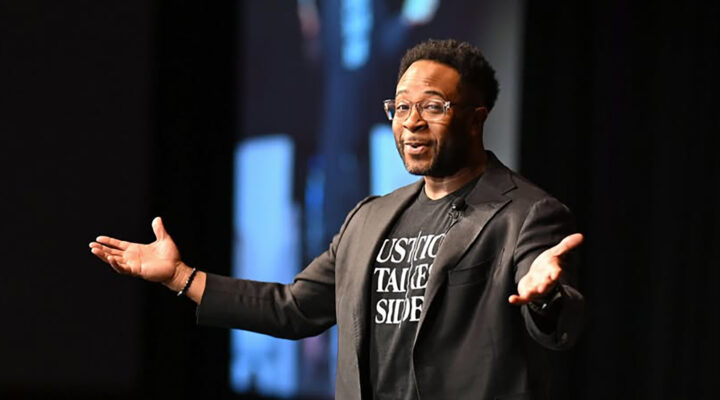
Sen. Cory Booker’s historic 25-hour speech on the floor of the U.S. Senate last week was “the precise embodiment of the historic Black Christian political witness,” Jemar Tisby told a gathering of church-state separationists April 6.
Tisby, professor of history at Simmons College of Kentucky, was the opening keynote speaker for the Summit for Religious Freedom sponsored by Americans United for Separation of Church and State. The event was held in Alexandria, Va., April 6 and 7.
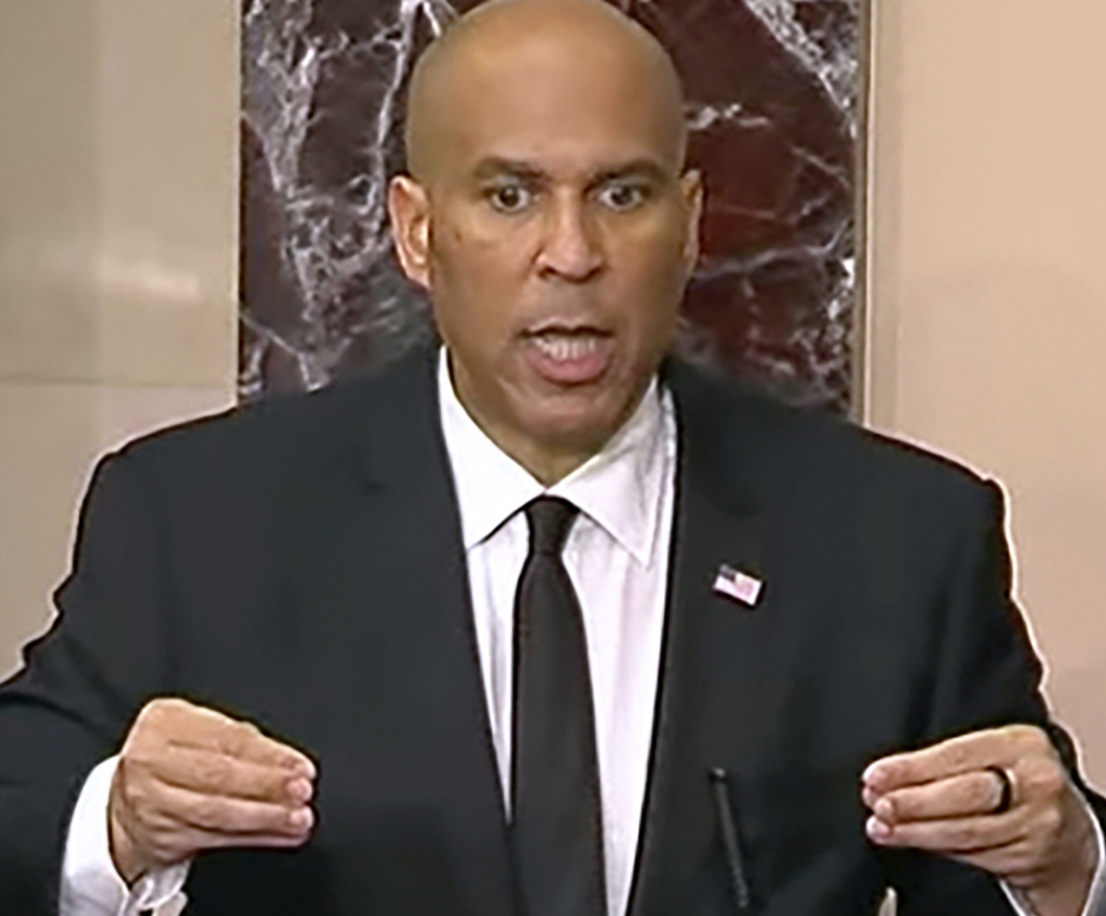
In this image provided by Senate Television, Sen, Cory Booker, D-N.J. speaks on the Senate floor, Tuesday morning, April 1, 2025. (Senate Television via AP)
The professor and bestselling author noted not all separationists want to talk about religion’s influence on politics, but Booker’s speech, he said, was important because of how his understanding of religion shaped his politics.
“I appreciate the whole Bible,” Tisby said, “but in his words there was less Ten Commandments, more Sermon on the Mount, less dominance and authority, more compassion and love, less judgment and punishment, more equality and justice. And as we look at history, that’s what the Black Christian political witness has traditionally been about. It looks very different from the religion that’s often trotted out as Christianity, which I would call white Christian nationalism.”
Booker’s speech is not something you would hear Speaker of the House Mike Johnson give, he noted. Johnson, a conservative Republican, is an avowed Christian nationalist.
“There’s a contrast there. There’s a different story. There’s a different narrative to tell about the way religion and politics can interact,” Tisby said.
‘Holy but not hijacked’
His keynote was titled “Holy but Not Hijacked: The Black Christian Political Witness in the Face of White Christian Nationalism.”
In a Q-and-A after the speech, he explained the movement he’s describing may be called either white Christian nationalism or just Christian nationalism.
“There is no Christian nationalism in the U.S. context without white supremacy.”
“I’m not a stickler whether you call it Christian nationalism or white Christian nationalism,” he explained. “What I want to emphasize when I call it white Christian nationalism is that this is a hierarchical ideology that has a gendered hierarchy. It also has a racial hierarchy. There is no Christian nationalism in the U.S. context without white supremacy, no matter how other people of color, other races and ethnicities may fit in or be used as mascots.”
In his keynote address, Tisby said Black Christians “come from a historically marginalized place in this nation’s history” and “didn’t practice the kind of Christianity the people in power approved of. Our brand of Christianity wasn’t their brand. Holy but not hijacked means we pursue our religion sincerely, but we avoid being hijacked by the promises of empire.”
And that should serve as a model to those fighting white Christian nationalism today, he asserted.
“I believe in the separation of church and state, but I believe that is distinct from the separation of faith in politics,” he explained. “That belief, that faith, if you will, informs our politics. I’m not advocating that we force faith on others. I’m advocating that we understand how faith informs our politics, how it shapes our political posture. And this actually applies to all of us you see, because you may not use the word faith. You may call it philosophy, you may call it humanism, you may call it decency. But your principles inform your politics. And so what I’m advocating is that we understand how Black Christians apply their religious principles in the realm of politics.”
The Black church in America isn’t perfect on all issues and embodies more diversity than most observers see, he added. But from history, on social issues and faith issues and politics, there are lessons to be learned.
‘Greatest threat’
This matters urgently, Tisby said, because “white Christian nationalism is the greatest threat to democracy and the witness of the church in the United States today. … It’s theocratic, it’s authoritarian. It wants to force, it wants to narrow, it wants to limit, it wants to suppress all fundamentally.”
To define white Christian nationalism, he quoted Philip Gorski and Samuel Perry’s book, The Flag and the Cross, where “they talk about white Christian nationalism … as a deep story, a narrative that people believe. And it says white Christian nationalism’s deep story goes something like this: America was founded as a Christian nation by white men who were traditional Christians who based the nation’s founding documents on Christian principles. And the United States was blessed by God, which is why it’s been so successful. And the nation has a special role to play in God’s plan for humanity. But these blessings are threatened by cultural degradation from un-American influences both inside and outside our borders.”
“White Christian nationalism is the greatest threat to democracy and the witness of the church in the United States today.”
This viewpoint demands adherence to “a narrow fundamentalist interpretation of Christianity” to be blessed by God with material prosperity, he warned. “The United States is the apple of God’s eye, God’s precious nation. But now, all that blessing, all that prosperity is being threatened by un-American forces.”
What are these “un-American” forces? It depends on the day, he quipped.
“Maybe it’s Black folks protesting that we shouldn’t be shot and killed and lynched in the street. Maybe it is LGBTQ folks saying, ‘Hey, we’re full human beings. We should have full rights too.’ Maybe it’s people who, because of the material prosperity of the nation and the veneer of democracy are coming to our nation from other countries just to have a better life for themselves and their children.”
The point of white Christian nationalism is that someone else is “messing it up,” he said.
Echoes of the Klan
He read an excerpt from a 1922 article in The New York Times quoting William J. Simmons, leader of the Ku Klux Klan in the era of Jim Crow laws: “The Ku Klux Klan admits membership to none but native-born, white, Gentile, Protestant Americans whose statement of principles was a reassertion of the fundamental principles of American democracy as embodied in the Constitution of the United States, an organization whose code of conduct was Protestant Christianity.”
That might sound familiar today, he said, because it echoes the desire of white Christian nationalists to place themselves at the top of a hierarchy ordained by God and the Constitution.
The Klan excluded immigrants, Blacks, Jews and Catholics among others and said this was ordained by God and the Constitution, Tisby pointed out, saying it’s not a far leap to the God Bless the USA Bible endorsed by Trump that mixes America’s founding documents with the King James Bible and lyrics to Lee Greenwood’s song “God Bless the USA.”
“What they’re trying to do is elevate these political documents and even this song, ‘God Bless the USA,’ to the level of holy Scripture. That’s the same thing that was happening in 1922 with the nation’s most notorious white supremacist group.”
Other stories of Black inspiration
Tisby drew stories from American history of Black men and women who stood up for right amid the evil of racism. He talked about Charles H. Pearce, an African Methodist Episcopal minister in Florida in the 19th century who declared a minister cannot do their whole duty “except if he but looks out for the political interests of his people.”
“If preaching and teaching the full humanity, dignity and personhood of people is political, then be political.”
“It wouldn’t be good news if it didn’t speak to the political conditions of the people,” Tisby said. “And I contend that if preaching and teaching the full humanity, dignity and personhood of people is political, then be political. If looking out for the prisoner, the orphan, the widow, the children, the vulnerable is political, then be political. If wanting a more perfect union that actually affords all people the right to life, liberty and the pursuit of happiness is political, then be political.”
He spoke of Frederick Douglass, James Baldwin and Fannie Lou Hamer. In the Mississippi Delta, Hamer was born in 1917, the 20th of 20 children in a poor sharecropping family.
“She grew up, she married a sharecropper, she became a sharecropper herself,” Tisby reported. “She would’ve lived and died in obscurity, if not for a fateful meeting at her church in 1962 when she heard about voting rights. … When they asked for volunteers to go and register to vote, she said, ‘I raised my hand as high as it would go.’
“And she went down just to try to register to vote, not actually vote, to try to register to vote. And she was turned away at gunpoint. But that only emboldened her.”
Hamer was harassed, jailed and abused for seeking the right to vote. In 1964, she addressed the Democratic National Convention.
“When she heard about voting rights, she heard the echoes of her faith that were formed in rural black Baptist churches,” the professor said. “She only had a sixth-grade education formally, but she was a brilliant organic theologian. And when she heard about voting rights, she heard ‘All people are created in God’s image.’ When she heard about voting rights, she heard ‘Let justice roll down.’ When she heard about voting rights, she said she heard ‘Love your neighbor as yourself.’ And she understood that democracy is for all people, that nobody’s free until everybody’s free.”
That tradition continues today through a long line of others, culminating most recently in Booker, he said, adding the difference between Christian nationalism and authentic religion is “the difference between holy and hijacked.”
“The Black Christian political witness shows us you can be wholly rooted in your faith or belief system but not hijacked by an anti-democratic agenda. You can love the church and not want the state to force your beliefs on others. You can love Jesus and see justice for all. Whatever your definition of holy is, don’t let it be hijacked by fear. Don’t let it be hijacked by lies. Don’t let it be hijacked by the false prophets of power.”
Related articles:
The gospel according to Cory Booker | Opinion by Hannah Brown
A visual guide to the elected officials who fly Christian nationalist flags at the Capitol | Analysis by Mara Richards Bim
A nation transformed in 70 days: The good, the bad and the retribution | Analysis by Edmond Davis