


When critics accuse April Ajoy of not ever having been a conservative Christian, she shows them the receipts.
One of those she showed for the first time at the Summit for Religious Freedom April 6 was a video of her 18-year-old self singing on The Jim Bakker Show. She wrote and performed the song, titled, “America Say Jesus.” The song corresponded to the theme of a bus tour organized by pastor father to promote a Christian nationalist agenda.
“I grew up a preacher’s kid. … I went to Christian college, Dallas Baptist University, for my undergrad. I went to Pat Robertson’s Regent University. … I was also a TV producer for 700 Club Interactive. So yeah, I was in it,” she said.
 Hearing the experiences of people who grew up amid Christian nationalism is important, she explained. “That’s what I bring to the table. I’m not proud of it. And so I air my dirty laundry out for all to see, just so you can see what it’s like.”
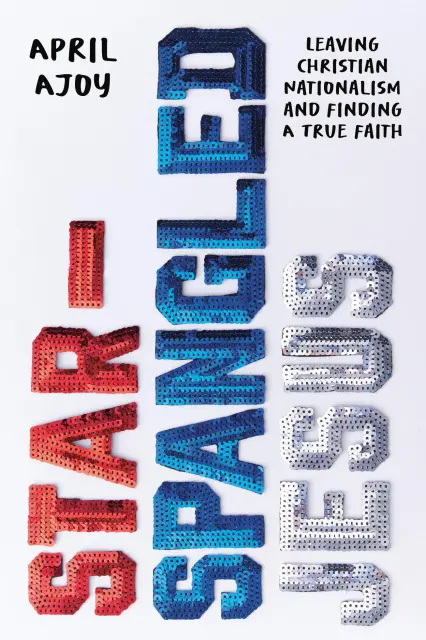
Ajoy is an author, content creator and podcast host known for using humor to push back against the toxic parts of American evangelism. Her new book is Star-Spangled Jesus: Leaving Christian Nationalism and Finding a True Faith.
‘I was a Christian nationalist, but I didn’t know it’
Speaking at the conference organized by Americans United for Separation of Church and State, she narrated her journey from unwitting Christian nationalist to becoming a progressive Christian.
Even the label itself is a barrier, she explained. “Most people who are Christian nationalists would say they’re not. … I was a Christian nationalist, but I didn’t know it.”
For those seeking to oppose Christian nationalism, it’s important to understand this cognitive dissonance, she urged. “They genuinely believe what they’re doing. I genuinely believed this was a war between good and evil. And that good was on the Republican side and that was the Christian side, and bad was everybody else.”
These lessons are taught in sermons, in churches, in families and in homeschool curricula, she noted. For example, she was homeschooled with the belief that it was “good Christians” who were abolitionists in the Civil War. “I was never taught that the Southern states used the Bible to justify enslaving people. … Same thing with even just how we colonized America, the genocide of indigenous people.”
She was taught “in order for God to protect us again, we had to enact laws that were based on our biblical worldview. Also to believe Jesus would not come back until Christians had witnessed to everybody in all society.”
The evangelistic mandate of that belief system easily justifies evil behavior on earth, she said. “I was taught that if I came in contact with somebody and I did not tell them about Jesus and tell them that unless they asked Jesus to their heart, they would burn alive forever in hell when they died, that their blood would be on my hands if they died without being a Christian. And I was a child believing that. And when you grow up in this mindset and you genuinely believe in an eternal hell, you can justify all sorts of atrocities because in your mind, sure, losing human rights now isn’t cool, but that’s way better than eternal burning.”
“When you genuinely believe in an eternal hell, you can justify all sorts of atrocities.”
When others scoff at evangelicals for these beliefs, that solidifies the beliefs, she added, because “we were taught the world will hate you, they hated Jesus. And if you’re not being hated, you’re not being a good Christian.”
Small changes began the journey
But over time, Denker experienced little chinks in the armor of her iron-clad faith. Among those was evangelicals’ support for Donald Trump in the 2016 presidential election.
She grew up in a home where former President Bill Clinton was excoriated for having sexual relations with a White House intern. “I remember my dad drilled into me, ‘Christians care about character, character matters. And if Bill Clinton was lying to his wife, how much worse would he do to the American people?’”
The implication was that “Republicans are good because we were wanting to hold that bad man accountable but Democrats, they’re bad. They do not have morals or righteousness or anything.”
She campaigned for GOP candidates, including Mitt Romney. She was convinced Barack Obama would bring socialism to America. “I didn’t really know what socialism was, but Fox News told me it was bad. So I was like, OK, we’re stopping that.”
How she moved from that mindset to an ecumenical, inclusive and progressive view is a story that illustrates others can change, too, she said. “There were a number of small things that happened throughout a decade or so — little things that didn’t quite make sense that I would tuck away not quite ready to talk about.”
“Gun reform made sense and I didn’t understand why so many fellow Christians were being so callous about that.”
One was the Sandy Hook school shooting. “Suddenly some gun reform made sense and I didn’t understand why so many fellow Christians were being so callous about that.”
Another was her desire to reconcile evangelical opposition to abortion with the theological teaching of an “age of accountability,” that God will not damn babies and children not yet able to make a conscious faith decision. “Wouldn’t an abortion be good?” she asked, “because they would automatically go to heaven.”
Yet another influence was meeting different kinds of people, including a gay couple she interviewed for a TV show. “Their kindness disarmed me,” she said.
Then, her Pentecostal father was diagnosed with stage four lung cancer and thought he could pray his way to healing, which didn’t happen. “I had no doubts that God was going to heal my dad. And he passed away four months later. And I knew that theology was wrong. I knew I could not have had more faith, and God did not answer that prayer.”
Then one of her brothers came out as gay. “I didn’t know what my theology was yet, but I knew I had been wrong,” she said. “I knew in that moment I could either choose the book that told me this is wrong, this is sinful. Or I could choose my brother.”
The final straw, among other life events, was Trump’s rise to power.
“Remember the whole character mattered thing? Trump comes on the scene and suddenly (evangelicals say), ‘Oh, we’re electing a president, not a pastor.’ I’m like, ‘Oh, now you tell me. That’s new.”
As her eyes opened, all the church talk about “biblical values” began to ring hollow, Ajoy said. “Anytime someone says, ‘Oh, we are a biblical, we are a Bible-believing church, that is the dog whistle for being anti-LGBTQ, anti-women, very fundamentalist. Because here’s the thing: ‘Bible-believing,’ what does it even mean? There’s so many ways to believe in the Bible. There’s so many ways to read the Bible. There are 46,000 Christian denominations worldwide today. And yet I believed I had it right. Everyone else was wrong.”
Ajoy’s book details more of her story.
‘Ask questions’
She advised those attending the Americans United event not to paint all evangelicals with the same brush. “They’re so similar, but separating Christian nationalism from regular evangelicalism, holding beliefs versus forcing beliefs. There is a difference. And if we paint this broad brush that every evangelical is a Christian nationalist, they’ll say, ‘You’re anti-Christ or anti-God or anti-Christian, and they’ll immediately stop talking to you.
What finally made the difference for her, she said, was people asking her questions rather than feeding her facts. “It was people who asked me questions, who asked me questions that made me explain why I believed what I believed.”
“Once you start saying out loud your beliefs. there is so much cognitive dissonance that it makes them think on their own. And that’s what we need. We don’t need to tell them what to think. They have people who have done that their whole lives. We need ask questions to teach them how to think on their own.”
Related articles:
Learn from Cory Booker and the Black Church witness, Tisby urges
White Christian nationalism is an ancient story, Denker says