

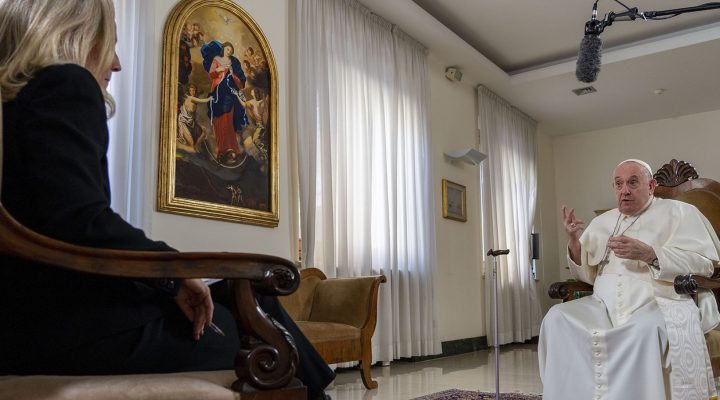
In the broad sweep of world history, some leaders come and go without leaving a lasting impact, while others mark their era indelibly. Pope Francis — born Jorge Mario Bergoglio in Buenos Aires, Argentina, and the first Latin American pontiff — was undeniably the latter.

Edmond W. Davis
From his ascension to the papacy in 2013 until his recent death at 88, Pope Francis reshaped the face of the Catholic Church, both spiritually and socially, from a truly global lens.
First Latin American and Jesuit pope: A historic shift
Pope Francis’ election was itself a monumental moment in church history. A son of Italian immigrants, he emerged from the urban barrios of Buenos Aires with an ethos deeply rooted in humility, compassion and a lived experience of economic inequality. That he was a Jesuit — an order often associated with intellectual rigor and social justice — only added to the anticipation of a new direction.
“This shift in ecclesiastical geography brought with it a fresh understanding of poverty, marginalization and grassroots advocacy.”
He wasn’t just the first pope from Latin America; he was the first from the Global South. This shift in ecclesiastical geography brought with it a fresh understanding of poverty, marginalization and grassroots advocacy that resonated across continents.
In many ways, his background symbolized a bridge between the historical dominance of Eurocentric Catholicism and the surging, diverse populations of the Southern Hemisphere.
Global voice for the marginalized
From his earliest days as pope, Francis demonstrated a commitment to the “peripheries”— not only geographic but social and spiritual. He spoke powerfully against income inequality, environmental degradation and the global refugee crisis. His encyclical Laudato Si’ on climate change echoed across borders, gaining respect even among secular environmentalists and leaders of other faith traditions.
He was not afraid to challenge global superpowers, calling out the selfishness of nations that closed their borders to refugees and the exploitative economic systems that kept billions in poverty. He walked among the Rohingya in Myanmar, washed the feet of Muslim migrants and embraced the LGBTQ community with a level of openness that challenged centuries of Catholic tradition.
His now-famous quote, “Who am I to judge?” regarding gay priests, echoed around the world as a clarion call for empathy and reform, shaking the foundations of conservative Catholic dogma while inviting a new generation to see the church as a more inclusive spiritual home.
Cautious reformer in a conservative institution
And yet, despite his progressive tone, Francis was no revolutionary in terms of structural reform. While he opened new conversations on priestly celibacy, same-sex civil unions and Communion for divorced Catholics, he often stopped short of making sweeping doctrinal changes. His papacy was marked by symbolic gestures and incremental shifts rather than radical transformation — an approach that reflected both his Jesuit pragmatism and the deeply entrenched traditions of the Vatican.
“His papacy was marked by symbolic gestures and incremental shifts rather than radical transformation.”
In Germany and other parts of Europe, bishops pushed for even broader reforms — women’s ordination, lay leadership, more direct accountability — but Francis moved with caution. His convening of the global synod in 2024 created space for dialogue, but ultimately disappointed progressives hoping for more immediate changes.
Ongoing scandal, a generational curse
No discussion of his papacy is complete without addressing the clergy sex abuse crisis, the darkest and most enduring wound in modern Catholicism. While Francis took steps to address it — calling summits, modifying secrecy laws and establishing new mechanisms for accountability — many survivors and advocates felt these actions fell short.
His early missteps, such as defending a Chilean bishop accused of cover-ups, undermined trust. And although he ultimately defrocked Cardinal McCarrick and issued new guidelines, his hesitance to act swiftly and publicly in some instances drew sharp global criticism.
Simpler papacy rooted in compassion
Francis reshaped the image of the papacy itself. He refused the grand papal apartments in favor of modest quarters. He cooked his own meals, used public transport and embraced direct contact with the people. His papacy was defined by mercy, humility and a theological return to the Beatitudes — “blessed are the poor, the meek, the persecuted.”
In this way, Pope Francis will be remembered not simply as a church leader, but as a global humanitarian figure who used his platform to uplift the downtrodden and challenge the elite — not just in the church, but in the world.
Major accomplishments under Pope Francis
- First Latin American and Jesuit pope
- Issued Laudato Si’, a groundbreaking encyclical on climate and environmental justice
- Advocated for refugees, migrants and victims of human trafficking
- Initiated synods focused on youth, the Amazon, church reform
- Opened doors to LGBTQ Catholics and promoted civil unions
- Promoted interfaith dialogue with Muslim, Jewish, Buddhist and indigenous communities
- Implemented reforms for handling sexual abuse cases (although debated in effectiveness)
- Elevated new cardinals from underrepresented regions to shift the global balance of church leadership
His predecessor’s lasting legacy
Before Francis, Pope Benedict XVI (Joseph Ratzinger) presided over a more conservative era in the church. His major accomplishments include:
- Promoting the “New Evangelization” to reawaken faith in secularized Western countries
- Establishing the Anglican Ordinariate, allowing Anglicans to join the Catholic Church
- Reinforcing traditional doctrine and liturgical practices
- Producing three encyclicals (Deus Caritas Est, Spe Salvi, Caritas in Veritate)
- Resigning the papacy in 2013 — the first pope to do so in nearly 600 years
Will the next pope be African?
With the passing of Pope Francis, attention now turns to the College of Cardinals — comprised of many cardinals Francis himself appointed from across the globe. This raises an urgent and fascinating question: Where will the next pope come from?
And will the church embrace an African leader, as Catholicism continues to grow exponentially on that continent? Could we see the first Asian or even female figure in an elevated church role that shakes up centuries of ecclesial norms?
In a world increasingly shaped by diversity, diaspora and shifting spiritual landscapes, the future of the church — and its next pontiff — remains open. As global citizens and students of history, we must ask: Will the next pope reflect the growing vibrancy of Catholicism in Africa, Asia or the Caribbean? Will tradition hold, or will the church boldly move forward?
History, it seems, is once again knocking at the doors of St. Peter’s.
Edmond W. Davis is a journalist, social historian, Tuskegee Airmen global scholar and emotional intelligence expert.
Related articles:
A conservative Baptist’s prayerful appreciation for Pope Francis | Opinion by Benjamin Cole
Remembering the ‘People’s Pope’ | Analysis by Steven Harmon