

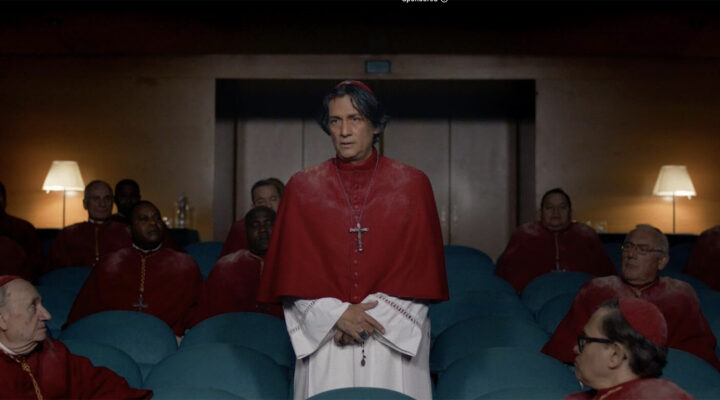
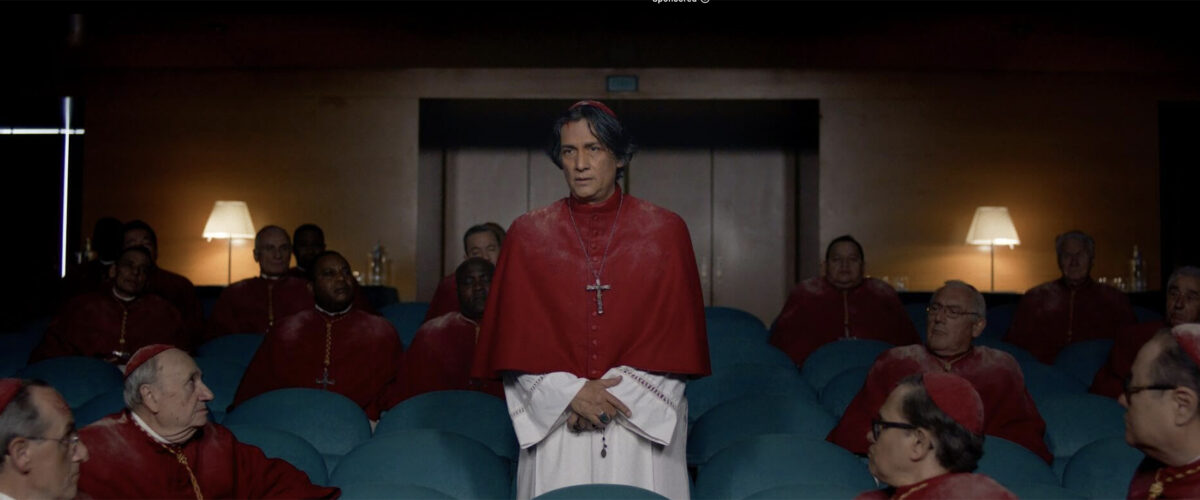
Toward the end of the movie Conclave, members of the College of Cardinals regroup following a series of bomb explosions that have rocked the Vatican. After a seasoned cardinal demands militant action against Muslims, a younger Cardinal speaks:
No, my brothers, the thing you’re fighting is here, inside each and every one of us, if we give in to hate now, if we speak of “sides” instead of speaking for every man and woman. This is my first time here amongst you, and I suppose it will be my last. Forgive me, but in these last few days we have shown ourselves to be small, petty men. We have seemed concerned only with ourselves, with Rome, with these elections, with power. But these things are not the Church. The Church is not tradition, The Church is not the past. The Church is what we do next.
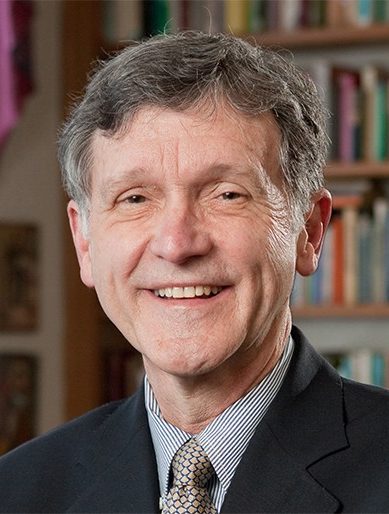
Bill Leonard
The church is what we do next. Right now, in the land of the free and the (supposed) home of the rule of law, truer words never were spoken. Hatred abounds, “sides” already are chosen, and chaos reigns in a nation experiencing divisions not seen since the Civil War and the Civil Rights Movement.
Inside that terribly fragmented culture and body politic sits the varied congregations of the Christian Church, each an expression of the body of Christ. Thus the question: As churches, what will we do next? Like churches of earlier eras, will we choose crusade or community? Retribution or redemption? Autocracy or autonomy?
“Like churches of earlier eras, will we choose crusade or community?”
A recent op-ed in the Charlotte Observer written by Presbyterian elder Shardaé Henry, confronts these questions head on. It begins:
In every age, forces agitate against God’s vision of liberation. They may not wear uniforms or wave flags, but they move with cunning precision — disrupting communities, distorting truth and diminishing the image of God in others. These oppressive agitators are not always new. They just evolve.
Today, they show up in courtrooms, campaign slogans and corporate boardrooms … in school policies and housing applications . . . (and) in pulpits. They are voter suppression bills disguised as “election integrity.” They are “anti-woke” legislation that erases Black history. They are anti-immigrant policies that treat asylum seekers like invaders. … These are not just government and social issues, but spiritual problems. And the church must name them. …
This is not a call for partisan Christianity. It’s a call to be the church that reads the signs of the times and responds with boldness and love. A church that refuses to be neutral when laws are passed that strip away dignity. A church that weeps with children separated from their parents and stands with workers demanding living wages. A church that listens to survivors, protects the vulnerable and tells the truth even when it’s inconvenient.
Henry concludes:
Here’s how we dismantle these oppressive agitators. We dismantle them with truth. We refuse to look away. We expose injustice for what it is, name it clearly and challenge it boldly. We dismantle them through community.
Shardaé Henry’s plaintive cry for what the church should do next sent me back to the book A Spirituality of Resistance: Finding a Peaceful Heart and Protecting the Earth, by Jewish scholar Roger Gottlieb, William B. Smith Professor of Philosophy at Worcester Polytechnic Institute. Gottlieb writes:
A spirituality of resistance, while recognizing the importance of working on ourselves, also directs us toward outer examination, outer transformation, and the pursuit of justice in the world. For a spirituality of resistance, the costs of living a purely “inner,” purely “personal,” spiritual life are too high: too much denial and avoidance of social realities, too much blindness to our own roles in those realities. … To find a peaceful heart, … we need to live on this earth: fully conscious of what is happening on it, actively resisting that which we know to be evil or destructively ignorant.
Such spirituality of resistance Gottlieb finds in Isaiah chapter 58, which reads:
Behold this is the fast that I have chosen — loosening the bonds of wickedness, undoing the straps of the yoke, sending the oppressed free and breaking every yoke of tyranny. Break your bread with the hungry and bring the impoverished into your home; clothe the naked when you see them. … If you reach out to the hungry and satisfy the afflicted soul, then your light shall shine forth in the darkness.
Gottlieb comments:
This wonderful passage carries a simple but powerful message: doing the will of God necessarily includes a response to what is going on around us. That we comply with religious rules is not enough. The general idea is often expressed by the notion that God asks us to engage in “Tikkun Olam,” the “repair of the world.”
While the world is always in need of repair, there are times when such reparations are more dangerous and more essential than ever. We are in such an epoch here and now. In 2024, American voters chose to set in motion a movement that is radically abandoning basic constitutional readings, rights and protections, much of it undergirded by a particular type of self-described Christian authoritarianism. What we do next in response will determine not only the foundations of democracy, but also the very nature of the Christian church in this country.
Changes are under way that will impact every citizen and noncitizen living in the United States, which means no church will be spared that collision. Will Christians and their churches respond with necessary resistance? We’d better. And there are multiple ways to do so.
In Dissent in American Religion, the late Baptist historian Edwin Scott Gaustad wrote: “Should a society actually succeed, however, in suffocating all contrary opinion, then its own vital juices no longer flow and the shadow of death begins to fall across it. No society — ecclesiastical, or political, military or literary — can afford to be snared by its own slogans.”
Said Gaustad: “Consent makes democracy possible; dissent makes democracy meaningful.”
In these troubled times, for the sake of democracy and the spirituality of resistance, let’s make our opinions as contrary as necessary.
Bill Leonard is founding dean and the James and Marilyn Dunn professor of Baptist studies and church history emeritus at Wake Forest University School of Divinity in Winston-Salem, N.C. He is the author or editor of 25 books. A native Texan, he lives in Winston-Salem with his wife, Candyce, and their daughter, Stephanie.
Related articles:
Tikkun olam for today | Opinion by Chuck Poole
Red Dawn: Baptists’ contradictory contributions to the rise and demise of America | Opinion by Brad Bull
We are afraid but we are standing up anyway | Opinion by Catherine Meeks