



As LGBTQ Americans and their allies begin Pride month celebrations, there’s further evidence of a disconnect with conservative voters, no doubt driven by the evangelical base of the Republican Party.
While overall support for same-sex marriage remains steady, support is falling among Republican voters, according to Gallup. That aligns with news the Southern Baptist Convention next week will vote on a resolution that calls for overturning the 2015 Obergefell v. Hodges, the U.S. Supreme Court ruling that legalizes same-sex marriage nationwide.
The proposed SBC resolution links Obergefell to policies that “deny the biological reality of male and female are legal fictions, undermine the truth of God’s design, and lead to social confusion and injustice.”
The resolution calls for “the overturning of laws and court rulings, including Obergefell v. Hodges, that defy God’s design for marriage and family.”
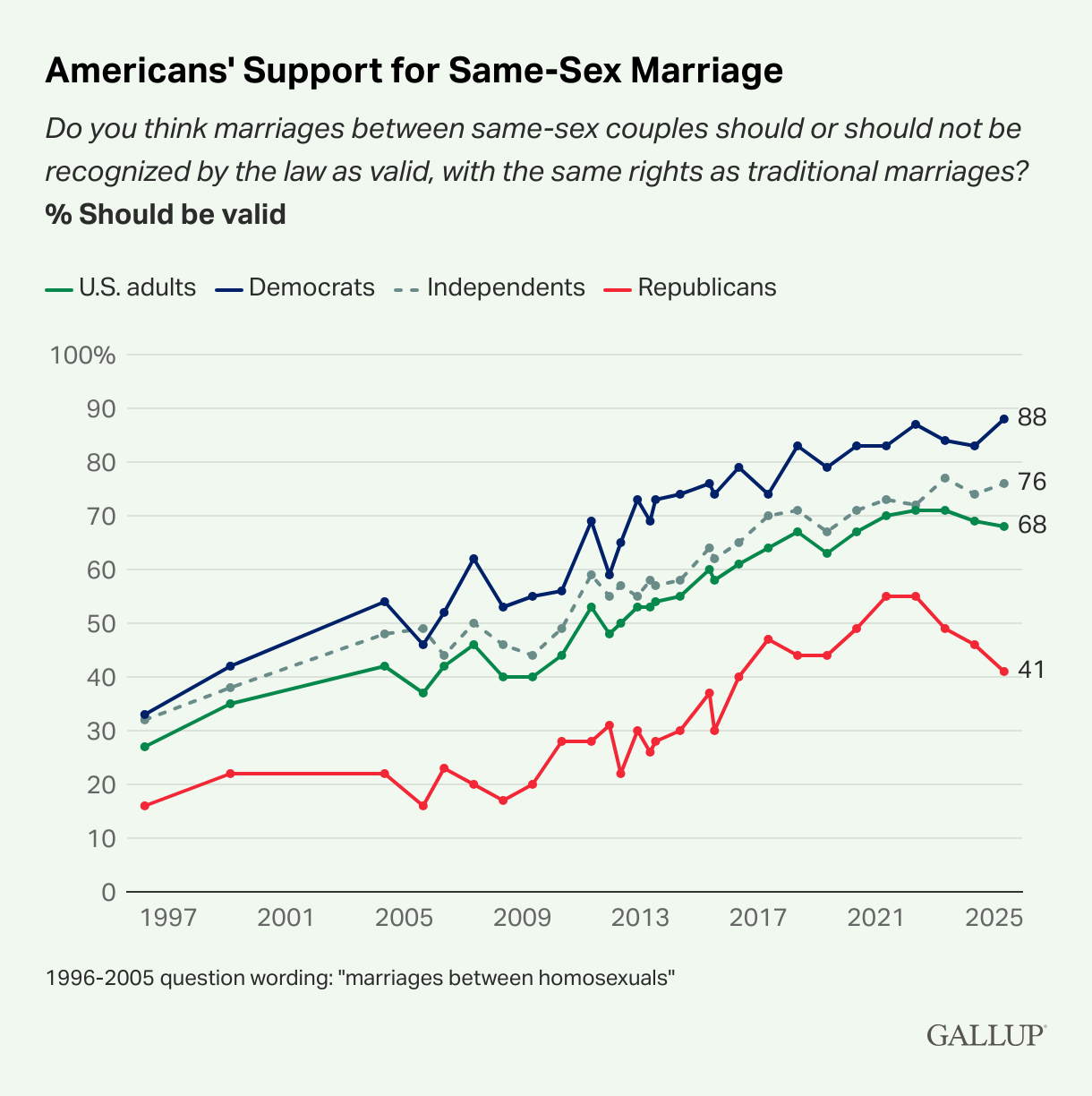
Currently, 68% of all Americans support legalized same-sex marriage, but Republican support — which peaked at 55% in 2021 and 2022 — has dropped to 41%, the lowest point since 2016, one year after the Obergefell decision.
Gallup reports that since 2021, the percentage of U.S. adults who think marriages between same-sex couples should be recognized with the same rights as traditional marriages has ranged from 68% to 71% but remains partisan.
Support among Democrats has risen to 88%, a record high. Support among independents has been relatively stable and currently stands at 76%. It is Republicans who are the dissenters.
The current 47-point gap between Republicans and Democrats is the largest since Gallup first began tracking this measure 29 years ago.
According to Pew Research Center, 85% of white evangelicals identify with the Republican Party or lean Republican, as do 58% of nonwhite evangelicals. Pew says over the past three decades, there has been a 20-point rise in the share of white evangelicals who associate with the GOP. About one-third of those who identify as Republicans today are white evangelicals, according to PRRI.
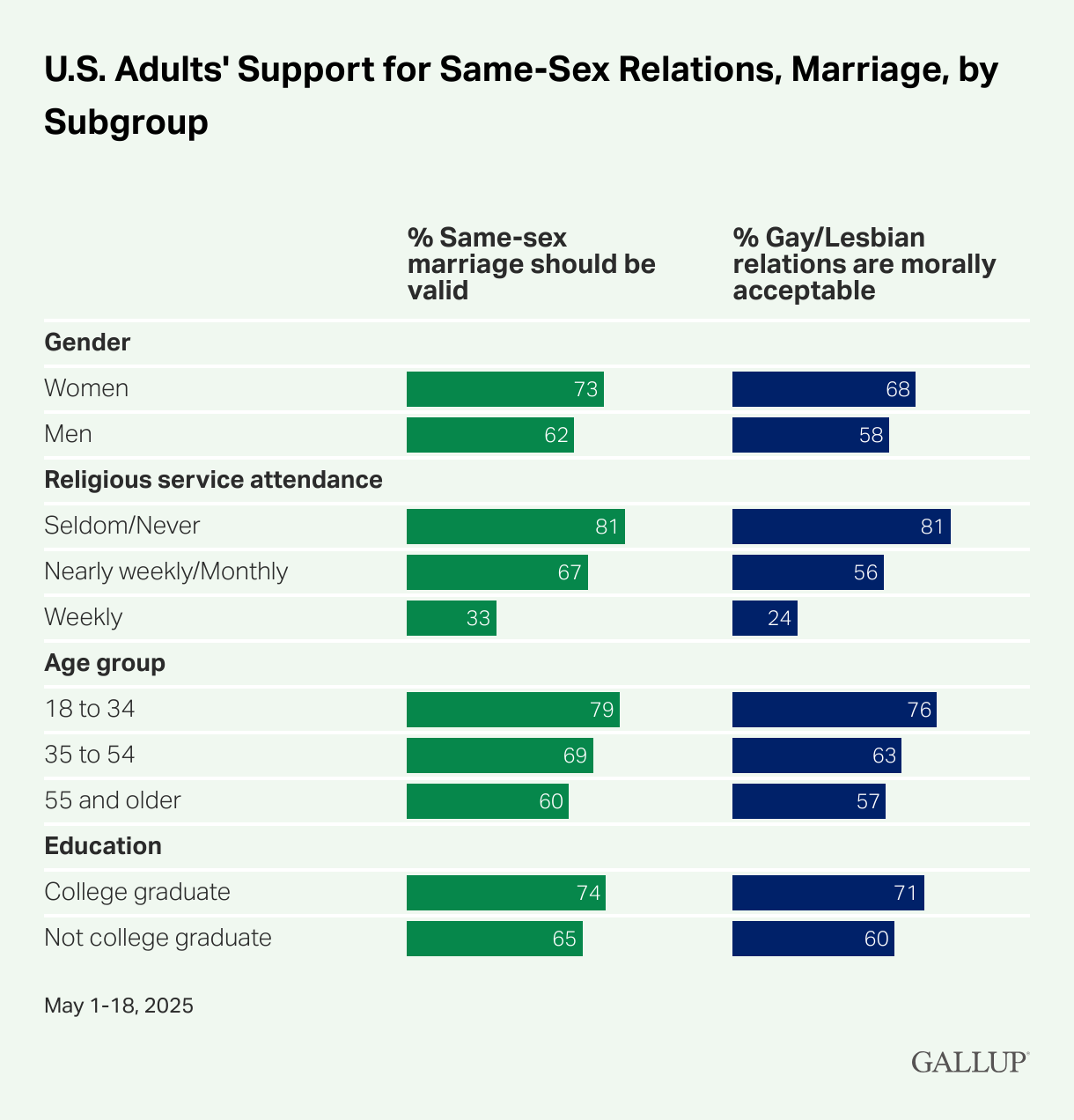
It is not uncommon in evangelical churches to hear sermons denouncing homosexuality and same-sex marriage. This remains the bread-and-butter of evangelical teaching on marriage and family.
Could a Republican majority in Congress, along with a Republican president and a stacked Supreme Court overturn Obergefell? Yes, according to LGBTQ allies and advocates.
Paul M. Collins Jr., professor of legal studies and political science at UMass Amherst, recently wrote about this threat for The Conversation.
“Efforts by state Republican lawmakers to revisit same-sex marriage bans are part of a broader assault on LGBTQ rights taking place in the U.S.,” he wrote. “The timing of these efforts is primarily driven by two factors: Donald Trump’s second term as president and the Supreme Court’s 2022 decision in Dobbs v. Jackson, which overturned the constitutional guarantee of the right to an abortion.
In other words, evangelicals are emboldened by their defeat of abortion law to believe they also could roll back the clock on same-sex marriage.
Collins points out that Republican lawmakers in five states have introduced symbolic bills calling on the Supreme Court to overturn its ruling in Obergefell.
Writing for Gallup, Megan Brenan summarizes the situation: “Ten years after the Supreme Court established same-sex marriage as a constitutional right, national support remains strong and steady at 68%. However, this ostensible stability masks deepening partisan divides.”
She adds: “Despite the stable national backing for same-sex marriage and relations, the widening political divide suggests potential vulnerabilities in the durability of LGBTQ rights. In 2022, Supreme Court Justice Clarence Thomas wrote in his concurring opinion in the Dobbs v. Jackson Women’s Health Organization decision that the high court ‘should reconsider’ its past rulings, including those on same-sex relationships and marriage.”
She predicts same-sex marriage in the U.S. “could face renewed legal and political challenges.”
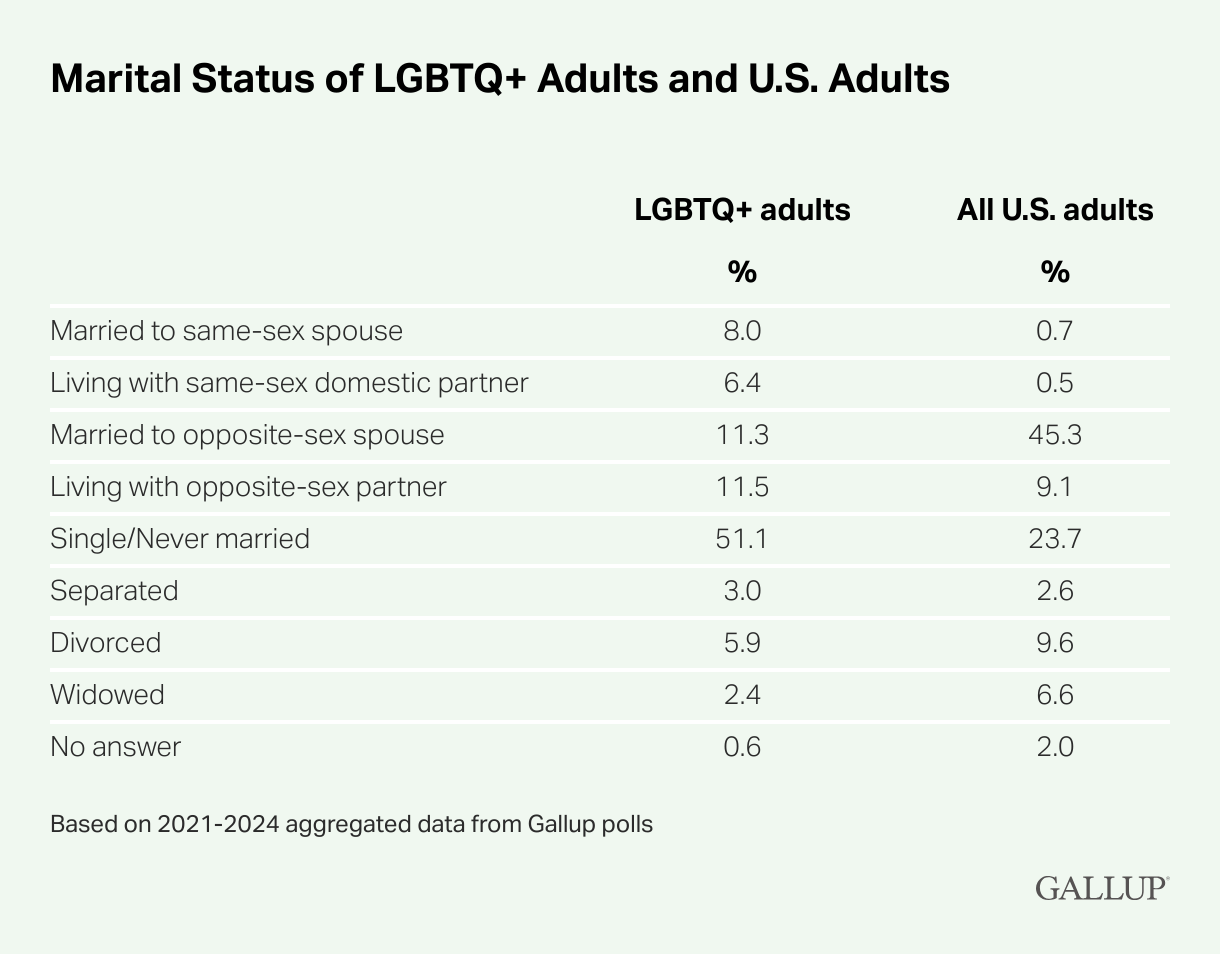
Meanwhile, Gallup also reports LGBTQ Americans in cohabiting same-sex relationships remain more likely to be married than living with a domestic partner. The 55% now in same-sex marriages is down slightly from the high of 61% between June 2016 and June 2017, the second full year after Obergefell.
Within the LGBTQ population, only 14.4% of adults are in a cohabiting relationship with a same-sex partner, including 8.0% who are married and 6.4% who are living with a domestic partner, Gallup says. These figures represent less than 1% of U.S. adults each.
Gallup found a higher percentage of LGBTQ Americans (22.8%) are in a cohabiting relationship with an opposite-sex person, including 11.3% who are married and 11.5% living together.
By comparison, the U.S. Census Bureau says among all adults of all sexual orientations marriage rates in the United States have declined since the mid-1990s — from 55.9% in 1996 to 46.4% in 2023. And the share of cohabiting couples has increased from 3.7% in 1996 to 9.1% in 2023.
Related articles:
Weekly churchgoers are now the primary holdouts against same-sex marriage
Proposed SBC resolutions throw red meat to the base, avoid key issues
Views on LGBTQ rights differ by state, party and religious tradition