

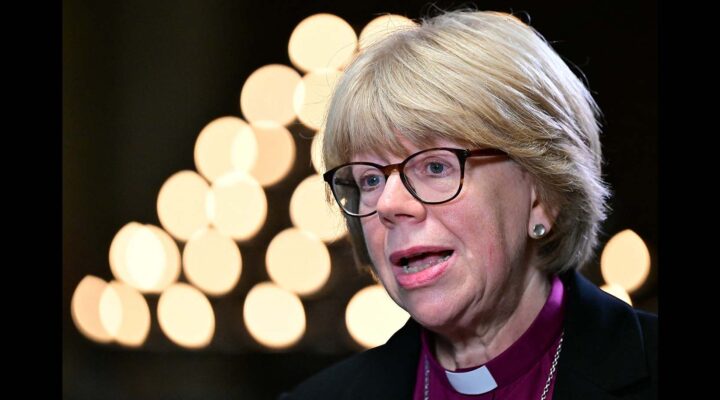

Worlds collided in London on Oct. 3 when Taylor Swift released her latest album, The Life of a Showgirl, and the prime minister’s office released the name of the Church of England’s newest archbishop of Canterbury, Dame Sarah Mullally.
Swift wrote Showgirl during the European leg of her record-breaking Eras Tour, and the album’s 12 tracks ricochet between the euphoria of being in love and the dark side of life on the stage. Ministry involves a similar gauntlet of experiences, especially for the 106th archbishop of Canterbury, who will inherit an institution rocked by scandal and teetering on schism.
Bishop Mullally’s predecessor, Justin Welby, resigned last November following a report that detailed the church’s mishandling and cover up of sexual abuse by a lay leader at Christian youth camps in the UK and Africa. A product of the business world, Welby was more managerial than pastoral. His emotional insensitivity toward survivors made a tragic situation worse.
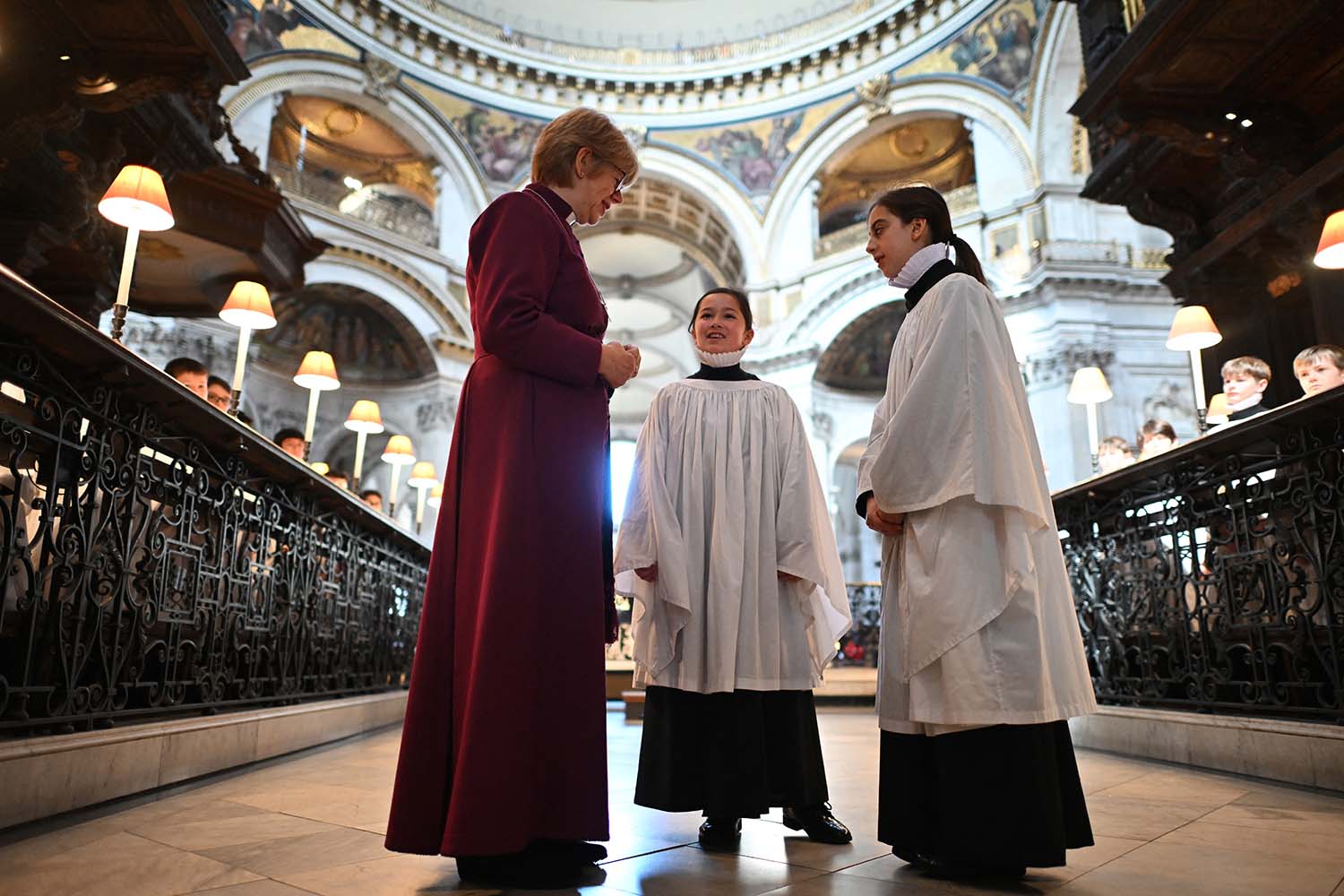
Girl choristers 10-year-old Lois, (C) and 11-year-old Lila, (R) speak to Bishop Sarah Mullally, the first female bishop of London, as they pose for photographers during a photocall at St Paul’s Cathedral in London on June 29, 2024. (Photo by JUSTIN TALLIS/AFP via Getty Images)
Time for a woman
As the Crown Nominations Commission began considering his successor, many in the church felt it was time to pass the miter to a woman, whom they assumed would be more compassionate and able to curb the culture of hyper-masculine evangelicalism that pervaded the camps.
The Church of England has ordained women to the priesthood for the last 30 years, and women have served as bishops for more than 20 years. Currently, a third of the church’s full-time clergy are women, as are most of those training for the priesthood, so a woman in the role of archbishop is a natural next step.
News outlets speculated all summer about who would be the CNC’s choice. Guli Francis-Dehqani, bishop of Chelmsford, who came to the United Kingdom as a refugee fleeing the Islamic Revolution, was an early favorite. Shortly before the Oct. 3 announcement, there also were rumors that Rachel Treweek, bishop of Gloucester and the first female senior bishop, could be the leading candidate. However, both women had signed a letter in support of same-sex marriage for clergy, which may have been a step too far for moderates and conservatives on the CNC.
Instead, church leaders chose Mullally who, prior to becoming a priest, was a cancer nurse and then chief nursing officer for England’s National Health Service. She was appointed Dame Commander of the Order of the British Empire in 2005 for her contribution to the fields of nursing and midwifery.
Mullally’s journey
While still working at the NHS, she attended the South East Institute for Theological Education, now St. Augustine’s College of Theology, part time. This makes her only the second archbishop of Canterbury since the Middle Ages to not have graduated from either Oxford or Cambridge.
About her journey into ministry Mullally has said: “I am often asked what it has been like to have had two careers, first in the NHS and now in the church. I prefer to think I have always had one vocation: to follow Jesus Christ.”
Mullally put her administrative skills to work reforming and modernizing dioceses, including the very diverse and divisive Diocese of London, where she was appointed bishop in December 2017 by Justin Welby.
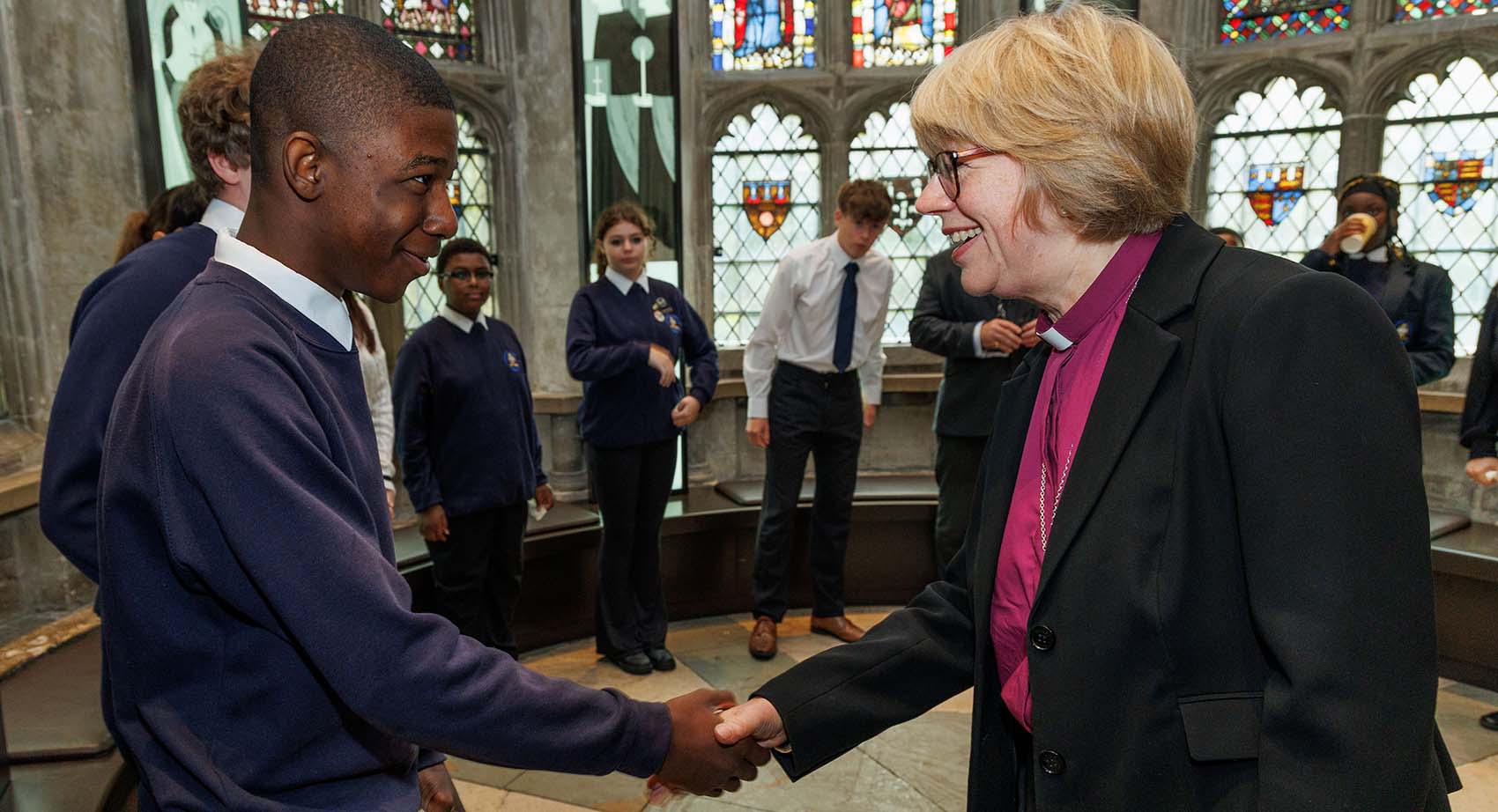
The Archbishop of Canterbury-designate, Dame Sarah Mullally meets with pupils and staff from The Archbishop’s School in Canterbury as well as The Archbishop of York, The Bishop of Dover and Bishop Anthony Poggo, Secretary General of the Anglican Communion at Canterbury Cathedral before the official announcement of her new role on October 3, 2025 in Canterbury, Kent, United Kingdom. (Photo by Neil Turner for Lambeth Palace/Anadolu via Getty Images)
Conflict over ordination of women
Not everyone in the Church of England approves of the ordination of women, and 586 churches continue to limit their participation in ministry. In London, one out of five churches has passed resolutions prohibiting women from serving as vicars or consecrating the Communion elements.
During her seven years as bishop of London, Mullally was hands on and known for her willingness to attend worship services at parishes that did not recognize her authority.
“I am very respectful of those who, for theological reasons, cannot accept my role as a priest or a bishop.”
“I am very respectful of those who, for theological reasons, cannot accept my role as a priest or a bishop,” she said at the time. “My belief is that church diversity throughout London should flourish and grow; everybody should be able to find a spiritual home.”
There are currently seven bishops appointed to oversee clergy and congregations who do not accept the ordination of women. Conservative groups have said they expect this arrangement will continue under the new archbishop. More liberal members of the church believe Mullally’s appointment legitimizes the role of women in ministry and the church should stop enabling this separatism.
Last February at the General Synod, Mullally delivered a moving speech about the microaggressions she experiences as a woman in ministry. Said synod member Helen King: “She was emotional about it, she was not ashamed to show that, and I think that sort of honest pastoral care is what we really need at the moment from an archbishop.”
Blessings of same-sex couples
Another issue inflaming division within the church is the General Synod’s endorsement of blessing ceremonies for same-sex couples. Traditionalists point to church doctrine, which defines marriage as the union between a man and a woman, but progressive clergy want to bless the marriages of LGBTQ members.
While adamant that church doctrine be upheld, Mullally headed the group of bishops working to implement changes around homosexuality in the church. She called the decision to allow priests to bless same-sex couples “a moment of hope for the church.” The General Synod will meet in February to hear the final proposals regarding the blessing ceremonies.

Archbishop Laurent Mbanda
Mullally’s past support of same-sex blessings was too radical for conservatives in the global Anglican Communion. In Africa, where two-thirds of the world’s Anglicans now reside, Archbishop Laurent Mbanda of Rwanda emphasized that most members of the global communion believe the Bible requires a “male-only episcopacy.”
Mbanda’s conservative network GAFCON broke with Archbishop Welby in 2023 over the same-sex blessing issue. It’s unclear what Mullally could do to mend the breech or if healing such divisions should be her priority. Today, Oct. 16, the bishops of the Global Fellowship of Confessing Anglicans announced they are cutting all ties with the Anglican Communion.
In June 2026, the Anglican Consultative Council will consider a plan to share the oversight of worldwide Anglicanism. Welby, who says he spent at least a quarter of his time on communion issues, endorsed the new structure, which will allow his successor to devote more energy to overseeing the Church of England.
History of corruption
The abuse scandal that caused Welby’s resignation is not the only one affecting the church. When Mullally was appointed bishop of London she inherited a diocese likewise riddled with corruption, including embezzlement and sexual abuse. While she did meet with abuse survivors, there are those who feel she didn’t do enough and blame her for the suicide of an innocent priest wrongly accused of sexual abuse.
“I hear from people every week who’ve been harmed in the Church of England and more of them are from the Diocese of London than from any other diocese,” said journalist and advocate Andrew Graystone. In her first address as archbishop-elect, Mullally confessed, “As a church we have often failed to take seriously the misuse of power in all its forms,” and promised to continue to listen to victims of abuse and care for the vulnerable. This past summer the synod approved a redress process for survivors of church-related abuse.
An interim role?
Mullally will be installed by the College of Cardinals on Jan. 28 and officially enthroned as the 106th archbishop in March at a public ceremony at Canterbury Cathedral. The general secretary of the Baptist Union of Great Britain, Lynn Green, said she was delighted by the appointment and would be praying for Mullally, “who is serving in a most demanding role” during “challenging times.”
Mullally will be nearly 64 when she begins her tenure and will have, at most, six years in the role of archbishop of Canterbury before she reaches the mandatory retirement age. Considering how long it takes to become truly acquainted with the post, she won’t have much time to make her mark. This might be intentional on the part of the CNC.
“Some speculate the committee intends for Mullally to be a ‘caretaker’ or ‘interim’ archbishop.”
Some speculate the committee intends for Mullally to be a “caretaker” or “interim” archbishop, who can shepherd the church past the mistrust and discord of Welby’s time in office. Commentators often refer to her as a “safe pair of hands.”
Tom Middleton, director of the conservative group Forward in Faith, said, “She’s not going to do anything rash or inappropriate” — a remarkable statement considering her very appointment is inappropriate to conservatives like Middleton.
Mullally thus finds herself caught between embracing the potentially transformative power of testifying of the truth of her own experiences and meeting the expectation that she will “bring unity, even at personal cost.” It would be a pity for her to sacrifice her convictions and stifle her own unique ministry perspective for the sake of compromises that might make some members feel more comfortable but ultimately will offer only a veil of unity.
With far-right groups co-opting the Cross for their xenophobic politics, the UK needs an archbishop of Canterbury who can offer an alternative, compassionate view of Christianity.
Ultimately, the question facing Bishop Sarah Mullally is the same one Taylor Swift confronted in Showgirl: Will she be an “eldest daughter,” driven mad and made miserable trying to live according to other’s confining expectations? Or like a “showgirl” will she take a risk, be true to herself and do something meaningful and magnificent with her tenure as archbishop?
How Mullally choses to answer that question will either cultivate or stifle the hope and healing so many in the Church of England and the Anglican Communion are longing for.
Kristen Thomason is a freelance writer and journalist living outside Edinburgh in the United Kingdom. She has produced educational and promotional media for national and international religious organizations and public television. Kristen also worked with local churches in Metro D.C. and Toronto, Canada. With a master’s degree in communication and undergraduate degrees in media studies and classics, she is interested in the intersection of politics, religion, history and the arts.
Related articles:
Why I am not without hope for Sarah Mullally | Opinion by Cara Meredith
Who will be the next archbishop of Canterbury? | Analysis by Kristen Thomason
A house divided: The Anglican communion’s great reset | Analysis by David Bumgardner