



Things were not merry and bright for Edison Cantwell and his five children during the 1932 Christmas season. Christmas was not a welcome time for the Cantwells. Even so, the Christmas of 1932 was going to be a memorable one.
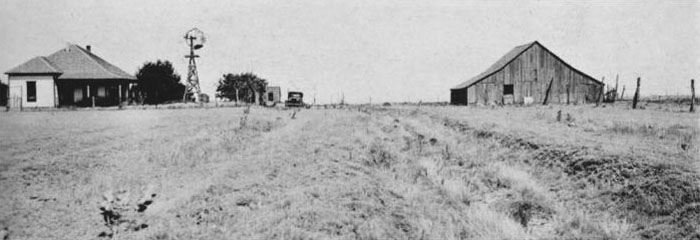
Technically, the Great Depression was over in Linn County, Kan. Linn County was home to 329 poor, struggling souls. Geographically, Linn County was east of the infamous Dust Bowl. Problem was that no one had told the farming communities in and around Linn County where Edison and his family called home. There was too much evidence outside their windows and too little food inside their home.
In 1932 and the five years before, the 60-acre Cantwell farm was where hopes and dreams came to die.

Tom Cantwell
I called Edison “Grandpa.” Edison was Roy’s dad. Roy was my father, legally, through adoption and through his unwavering, unconditional love for me.
Food insecurity and hopelessness and the other lingering effects of the Great Depression and the accompanying Dust Bowl were supporting characters in this tragic drama.
Ellie Cantwell is the lead character. Ellie was my Grandma Cantwell.
Let me back up for a second. Grandma’s absence is the lead character. She died earlier that year, in June, at the age of 36. Grandma left Grandpa, who was 39, with no thrill of hope, a lot of weariness and five hungry children, ranging from 17 to my father, who was 7.
This Christmas, my dad was four days this side of his eighth birthday. This was his first one without his mother. A 7-year-old shouldn’t experience a single day without his mother, let alone a Christmas and a birthday, in the same week.
Grandma had died earlier in the summer, and Grandpa, who had buried Arthur, his youngest son who only lived for five days in 1927, told his surviving five children frequently and emphatically all summer, fall and winter, “There will be no Christmas this year!”
The Cantwells woke up one morning and the calendar told them it was Christmas Eve. There were no Christmas decorations in their home. There was no joyful anticipation.
Dad remembered Elinor, his always optimistic older sister, that morning saying hopefully, “Tomorrow is Christmas.”
Dad remembered Elinor, his always optimistic older sister, that morning saying hopefully, “Tomorrow is Christmas.” When Grandpa heard her hopeful tone, his face went blank, maybe because of his pain, maybe because of his unresolved grief, maybe because of his shame, but ultimately it meant, “We’re not talking about this.”
That was how their household worked or didn’t work. If they didn’t talk about painful things, it wouldn’t hurt as much. It wasn’t effective, then, and it still isn’t.
Later, on that day before Christmas, Grandpa told his clan this day was going to be like every other day: “There is work to be done!” It was the Cantwell mantra.
Yet surprisingly that afternoon, Grandpa went to each one of the children while they were working and told them, “Pick your stuff up and meet me at the house.” Grandpa never stopped working early. He couldn’t. The dying farm would have none of that.
One-by-one, the Cantwell children gathered at the house to see why their father had stopped their work early. After the last child arrived, Grandpa told them to go with him. They noticed he was carrying a handsaw. His expression was grim. Since that fateful June day when his Ellie went to be with Jesus, grim was the only look his face held.
They walked from the house, down a short hill to the far side of a field. There, nestled in one of the fence lines, was what my dad called “a scrub evergreen.” Think of a dwarf Christmas tree that would have made Charlie Brown proud.
They walked from the house, down a short hill to the far side of a field.
Grandpa sawed down the not quite 3-foot tall tree. Edwin, the oldest Cantwell child, carried the scrub evergreen back to the house. Grandpa didn’t say a word. The Cantwell children were quiet, expectant, hopeful, but not sure what exactly was happening as they marched back up the hill.
Once inside, Grandpa propped the scrub evergreen up against the wall and asked William to go to the back porch and bring in what he found on the top shelf. William brought back a couple of strings of popcorn. Grandpa told the Cantwell kids to string it around this makeshift, miniature, wannabe Christmas tree.
They looked at each other, not one of them knowing when or how Grandpa had found popcorn, popped it, and then strung it without one of them knowing. A Christmas tree, no matter how pitiful, was welcome sight to this grief-stricken family.
That evening, by the flickering light of the candles, stood the only sign of Christmas in the Cantwell home. After their meager supper of beans, Grandpa told them it was time to go to their bedroom where all five children slept. They left the living room in bewilderment about what had just happened.
It was a silent night but all was not calm and all was not bright.
The Cantwell children awoke the next morning, remembering Grandpa’s words, “There will be no Christmas this year!” juxtaposed with the sad Christmas tree adorned with popcorn in their living room.
No one jumped out of bed, eyes all aglow, to rush to the living room to see what Santa had brought them.
My dad said he woke up first and ran to the living room. He stopped in the doorway. He closed his eyes, poked his head around the door frame and his eyes found six of Grandpa’s work socks nailed to the wall, next to the sad little Christmas tree.
There was a bulge in each sock. The fifth one from the right, since he was the youngest, my dad guessed, was for him. He walked over and felt it. It was round. What was it? He reached his hand in the sock and pulled out an orange.
An orange might not be your dream Christmas present, but fruit was in high demand and in very short supply in poverty-ravaged Linn County.
Dad said he looked at it, rubbed it against his face and then held it tight to his chest as if it would disappear should he drop it. He scurried back to the bedroom where his siblings were still sleeping and woke them up and excitedly told them what they could find in the living room.
Dad said he started crying as his brothers and sister ran out of the bedroom.
Dad said he started crying as his brothers and sister ran out of the bedroom. He had cried buckets since his mother died. He didn’t understand why he was crying so much. No one had taken the time to tell him what his tears were all about. It’s likely they simply didn’t know about the ins and outs of a child’s grief.
As the years went by, Dad said he became more acutely aware of the back story of that Christmas. He never asked Grandpa for the details, but he couldn’t imagine all the sacrifices a poor Kansas farmer would have had to make in 1932 to have been able to buy five oranges.
An orange in your father’s work sock nailed to a wall was an extravagant act of love from a man whose ability to say, “I love you!” to his children or anyone else disappeared along with his belief in God as he drove away from the Littell Cemetery.
In this season where we celebrate the gifts of the wise men of frankincense, gold and myrrh, an orange obtained with great sacrifice and given with extravagant love is just as precious.
My dad loved oranges for as long as I can remember.
I eat an orange every Christmas. It is my Cantwell Christmas tradition. It reminds me of extravagant love and hope. An orange was what my grandfather used to say, “I love you!” when he felt he couldn’t or wouldn’t verbalize it.
Tom Cantwell is a hospital chaplain in Madisonville, Ky.