


It happened before Sunday school, the way the most interesting conversations often do — not inside the carefully prepared lesson, but earlier, during chit chat, before anyone officially called the class to order.
Someone mentioned Elon Musk had become, or was on the verge of becoming, the world’s first trillionaire. I said I just couldn’t think about it. Not that I didn’t have thoughts — I had too many, and none of them were quite right. Another person in the group was more direct: “I don’t think anyone should be a trillionaire. I don’t even think there should be any billionaires.”
I’ve been wrestling with that ever since.
Grady Throneberry
It’s the kind of statement that sounds radical until you sit with it long enough to realize the honesty it represents. And yet, I’m not sure it’s entirely right, either. Which puts me in the uncomfortable middle — a place I seem to inhabit more and more as I get older. Not because I lack conviction, but because some questions are genuinely hard, and pretending otherwise is its own kind of dishonesty.
So let me try to think through this out loud.
The first impulse, at least for those of us shaped by anything resembling free-market sensibility, is to defend the idea of wealth accumulation on principle. Innovation deserves reward. Risk deserves return. The people who built Apple, Amazon, Tesla and Microsoft didn’t just stumble into their billions. They created things, employed people, changed how we live, and yes, often just got lucky.
There is a legitimate argument that the promise of extraordinary reward is part of what drives extraordinary effort. You can disagree with that argument, but you can’t dismiss it without engaging it honestly.
And yet. A trillion dollars.
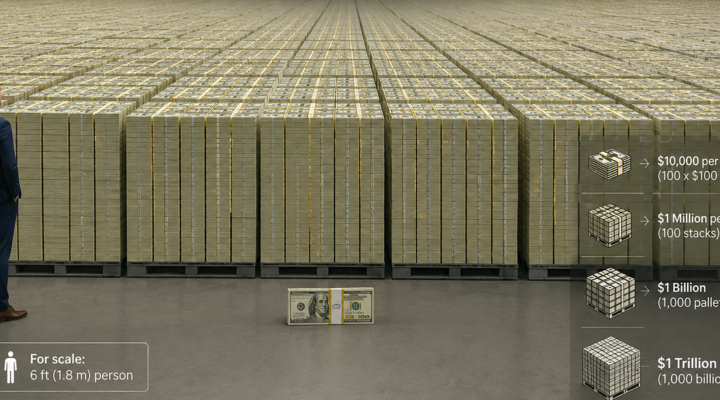
“If you spent a million dollars every single day from the birth of Christ to now, you would not yet have spent a trillion dollars.”
Let’s be clear about what a trillion dollars actually is, because the number is so large it loses all meaning if we’re not careful. If you spent a million dollars every single day from the birth of Christ to now, you would not yet have spent a trillion dollars.
That is not a number that represents earned reward for innovation. That is a number that represents a qualitatively different kind of power — not economic power alone, but political power, social power, the power to shape governments, influence elections, fund wars or end famines. Not metaphorically. Literally.
Which brings me to the real question, and I don’t think it’s actually about the money.
I’m not sure the right question is how much money is too much. I’m not sure we can draw that line in any meaningful way. Is $10 million too much? I doubt many people would say so. What about $100 million? Most would still say no. Or $500 million? You start to get some disagreement. Is $10 billion too much, or $100 billion?
At some point, the number becomes absurd on its face, but there’s no clean threshold, no obvious bright line where “earned success” becomes “obscene excess.” Any number we pick is arbitrary, and in a free society, arbitrary lines have a way of not holding.
The better question, I think, is what people do with it.
Consider what we actually see:
- MacKenzie Scott has given away billions — not pledged to give it away someday, not created a foundation bearing her own name with generous administrative salaries, but actually transferred enormous sums to organizations working on the ground in communities that needed it.
- Melinda Gates has spent decades doing serious work on global health and women’s empowerment with real results to show for it.
- Warren Buffett, for all the things one might say about him, pledged the overwhelming majority of his wealth to charity and has been making good on that pledge.
- Michael Bloomberg has given billions to public health, education and the environment.
These are not perfect people, and these are not perfect institutions. Philanthropy has its own power dynamics, its own blind spots, its own problems. But there is a meaningful difference between someone who accumulates vast wealth and then directs substantial portions of it toward reducing human suffering and someone who accumulates vast wealth and uses it primarily to protect and expand their own position.
The Walton family comes to mind. Walmart is the largest private employer in the United States. The Walton heirs collectively hold more wealth than the bottom 40 percent of Americans combined. And yet their charitable giving, as a percentage of their wealth, is among the lowest of any comparable family. Larry Ellison has spent his fortune on yachts, islands and vanity projects. Larry Page has largely retreated from public life and public accountability altogether.
None of this is illegal. But it does seem like a relevant moral distinction.
“There is something deeply wrong with the spectacle of people who will never know hunger funding the political effort to reduce food assistance.”
And then there is the category that troubles me most — not the indifferent wealthy, but the politically active wealthy. The billionaires who bankroll the campaigns of candidates pledging to cut SNAP and WIC benefits — programs that put food on the tables of children — while their own net worth grows by billions in a single year are engaged in something that goes beyond the personal accumulation of wealth. That is the purchase of policy. That is the use of private fortune to shape public life in ways that cause measurable harm to the most vulnerable people among us.
Whatever you believe about the proper role of government in addressing poverty, there is something deeply wrong with the spectacle of people who will never know hunger funding the political effort to reduce food assistance to people who already know it too well.
On the other side of that same ledger, the billionaire who chooses to direct his wealth toward ending hunger in Sudan, or building hospitals in communities without healthcare access, or funding research on diseases that don’t attract pharmaceutical investment because they primarily afflict the poor — that person is doing something categorically different. Still imperfect. Still operating with a level of power no private individual probably should hold. But different.
I said at the beginning I couldn’t think about Elon Musk becoming the world’s first trillionaire. What I meant was the number itself felt morally incomprehensible to me — not necessarily because any one person having that much is inherently wrong, but because of what we know about what’s happening in the world at the same time and Musk’s MAGA perspective.
Children are dying of preventable diseases. People are going hungry in the wealthiest nation in human history. We have problems we know how to solve that remain unsolved primarily because we’ve decided, as a society, that solving them isn’t worth the cost.
A trillion dollars would more than solve most of them.
I don’t have a clean answer to the question my Sunday school neighbor raised. I’m not ready to say no one should be a billionaire. I think that statement, while emotionally satisfying, doesn’t quite hold up under examination.
But I am willing to say this: At the scale of wealth we are now talking about, the accumulation itself becomes a moral act, not just an economic one. And the use of that wealth — toward healing or toward harm, toward the common good or toward the consolidation of private power — is a question we are all entitled to ask, and those who hold it are obligated to answer.
The ancient question still is the right one. What does the Lord require? The prophets were specific: Do justice. Love mercy. Walk humbly.
A trillion dollars doesn’t make that easier. If anything, it makes the test harder.
Grady Throneberry is a speaker, author, coach, pastor, retired police chief and member of Crescent Hill Baptist Church in Louisville, Ky.
Related:
Why is it immoral for one man to be a trillionaire?
Beware the billionaires who promise to make America great