



One of the things I love about my job is that I get to read many manuscripts before they enter the public arena. This is usually a request for an endorsement.
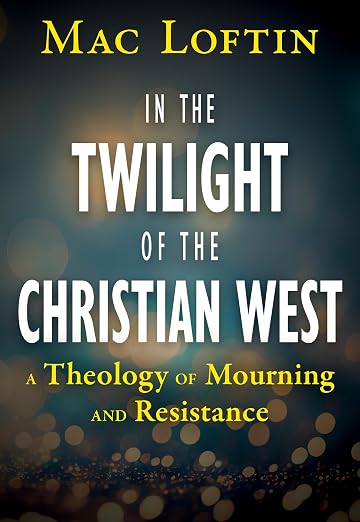
Last year, I had the opportunity to consider Harvard theology lecturer Mac Loftin’s provocative first book, In the Twilight of the Christian West: a Theology of Mourning and Resistance. I was very happy to offer that endorsement. Here I would like to say more about this book and discuss its implications for the kinds of people who read Baptist News Global.
Loftin’s thesis can be summarized in four steps:
- The Christian West (Christianity in the West) is in its twilight stage, fading.
- The loss of this civilization, the Christian West, is worth mourning over; at least, many of us feel this way, including Loftin.
- Fascism in the fading Christian West is, in part, the religio-political effort to use violence and state power to resist both that fade and any mourning for it, instead attempting to crush those deemed the architects or embodiments of the fade.
- We need to retrieve intellectual resources from within the Christian West that can teach us both how to mourn and in so doing how to resist fascism.
What is the ‘Christian West’?

Mac Loftin
Loftin does not spend much time defining what he means by what he variously calls the Christian West, Western civilization or Western Christian civilization. This is probably fine, as academics often agonize unduly over definitions.
He appears to mean something along the lines of those societies that once identified themselves as Christian, those governments that once allied with some dominant version of Christian church, those cultures that once believed themselves to be the center of the world by God’s fiat. You know, the old European Christian colonial powers and their colonial descendant powers such as the United States and the people who most strongly identify with this old order.
Is the Christian West in its twilight years? Is Loftin correct in saying the Christian West is “dying”? To the extent these regions or countries no longer identify themselves as Christian, officially or unofficially, no longer (meaningfully) involve partnerships between government and church, no longer carry the old confidence that they are the center of the world by God’s fiat, no longer see themselves as the civilizing power and the bearer of true civilization — then, yes, that old order has died or is dying.
Loftin also appears to rather straightforwardly be referring to the numerical decline and loss of influence of (many) Christian churches in the old Western Christian civilization, including the U.S. Here I think Loftin overreaches in his timeline, especially in the U.S., as there are numerous expressions of robust churchgoing here. Despite major examples of decline, all is not decay and death.
But then, at a far deeper level, Loftin means to say Western Christian civilization has lost much of its moral credibility with thoughtful people through many a misdeed; for Loftin, as for Dietrich Bonhoeffer (whom he often cites), the rise of Nazism and Christian complicity in that era are determinative: “Christianity in the West had been so bankrupted by its complicity with fascism … that nothing remained of it but ruins.”
“Loftin means to say Western Christian civilization has lost much of its moral credibility with thoughtful people through many a misdeed.”
Morally, that may well have been true. Christian credibility never fully recovered in the postwar West. But institutionally, the churches in Germany and Europe and everywhere else just kept on going after the war, whether adjudged morally bankrupt or not. More of it remained than ruins.
Is this civilization worth mourning?
Loftin’s yes is, obviously, not uncritical. All the wrongdoings of Western Christian civilization are what they are, and a great many people around the world will not mourn if every vestige of that civilization disappears once and for all. Loftin is simply honest in saying this is his background, his world, his loyalty, and he feels keenly evidences of its decline, as one would with any person or institution to whom one feels deeply connected.
More deeply, Loftin believes the inability to mourn honestly is bad for the soul, whether individual or collective.
Relationship between ultra-right-wing politicized Christianity and ‘fascism’
Loftin has made clearer than anyone else I have read that fascism as a Western political movement is the spawn of a degraded, reactionary and usually “Christian” panic over perceived threats to, precisely, “Christian civilization,” whether national, regional or global.
 This also helps explain why there is always considerable popular and leadership-level Christian support for fascist-adjacent or straightforwardly fascist politicians and agendas. This is not just because fascist demagogues feint in the direction of Christian populations and their concerns, fooling the masses, but because fascists and Christians share in common the terrifying fear that their “Christian civilization” is threatened or dying.
Bonhoeffer, for one, understood the susceptibility of the German Protestant churches, people and leaders alike, to Nazism was precisely that many warmed to “this attempt to preserve Christianity at all costs,” in Loftin’s summary.
After all, so it was believed, Weimar Germany was too liberal, Hitler promised “positive Christianity,” the Nazis were going to clean up society, and people were back in church again! I never will forget learning about how excited many church leaders were when Nazi SA stormtroopers started filling the churches — those strapping young men are back in church, it’s a revival!
But now it is 2026, and Loftin is not reticent to name many of the very same U.S. thinkers Laura Field analyzes in her wonderful book Furious Minds as falling prey to the very same kinds of apocalyptic civilization-loss fears that animated right-wing movements of the past — and the very same temptation to grasp for state power to forestall or defeat the perceived enemies of Christian civilization.
Says Loftin: “The barest glimpse of a future in which church and sacrament will be absent from the world provokes in the postliberals a violent revolt against mourning, driving them to clutch at the levers of the state in order to crush into submission all those they see as undermining Christian culture: queer people, feminists, Muslims, immigrants and … Jews.”
This is an acutely interesting and of course enormously provocative way to re-narrate what is now often called Christian nationalism and what I have chosen in my work to call authoritarian reactionary Christianity. It has more of a psychological or even psychiatric dimension — these movements of the right, for Loftin, are examples of collective failure to deal in a healthy manner with anxiety, fear and mourning, especially mourning.
“These movements of the right are examples of collective failure to deal in a healthy manner with anxiety, fear and mourning.”
But Loftin is a theologian, and he sees a theological problem here, not just a psychiatric one.
Coming to terms with mourning
Loftin attempts to retrieve theological resources from ancient and (post)modern texts that can help Christians come to terms with mourning the loss of Western Christian civilization. Here we see an emerging constructive theologian doing some serious work, bringing together voices such as Dietrich Bonhoeffer, Simone Weil, Hadewijch, Angela of Foligno, Adrienne von Speyr, Hans Urs von Balthasar, Judith Butler, Walter Benjamin and Michel de Certeau. I don’t want to forestall your reading of these ultra-rich discussions, but let me offer you Loftin’s crisp theological summary near the end of the book:
In creation, God effaces Godself to make the world; in the incarnation, God gives up what we imagine as divinity to live as a squalling infant; in the passion, Jesus renounces self-preservation and retaliation to lay down his life in love; in the Eucharist, he empties himself into the fragile works of bread and wine; in the resurrection, he leaves the tomb empty; in the ascension, he withdraws from his friends and leaves behind a bewildered, loving community. Always the same movement of withdrawal, as Weil said.
Loftin’s theological sources incorporate loss, death and mourning into the very character of God, creation, Christ and church. He argues that Christians schooled on this understanding of God will be ready to live without Western Christian civilization, because the triumph of our people, our culture — our God, for that matter — never was what or who we believed in.
He joins Bonhoeffer in hoping for a “Christianity beyond self-preservation, one that could view the falling silent of its great and ancient words as a death on the other side of which might arise unfamiliar and unexpected life.” For Loftin, this readiness to mourn and even to accept the death of Christianity in our countries is central to becoming resistant to fascism and fascist-adjacent politics.
With this proposal, the issue between Loftin and the reactionary Christian civilization types is fully joined. I can picture the Rod Drehers and JD Vances of the world saying, “No thanks, Mac Loftin, we will never join you in your readiness to watch Christianity fade and die in our country. Your religion is too passive, you are mourning prematurely, and your God is too weak. We want a fighting religion, and we want a country where our religion predominates as it once did and rightly should.”
Such an argument always will find a following. I understand this now. The tendency appears to be perennial in decaying “Christian civilizations.” It is a far more “natural” response than simply being willing to mourn and let go. And that is what makes it so very dangerous.
The urgent question I am left with is this: What theological, moral and ecclesial options are available to anti-fascist Christians beyond the necessary work of criticizing fascism on the one hand, while being willing to mourn the fading of Western Christianity and to let it go? What, after that, are we called to believe, defend and renew?
Asking such questions by no means discounts the significance of Mac Loftin’s In the Twilight of the Christian West. Indeed, this work advances the conversation about our religio-political crisis in a crucial way.

David Gushee
David P. Gushee serves as Distinguished University Professor of Christian Ethics at Mercer University, chair in Christian social ethics at Vrije Universiteit Amsterdam and senior research fellow at International Baptist Theological Study Centre. He is past president of the American Academy of Religion and Society of Christian Ethics. He also is author of 30 books, including Righteous Gentiles of the Holocaust; Kingdom Ethics; Defending Democracy from Its Christian Enemies; Changing Our Mind; and The Moral Teachings of Jesus.