


The data post from Ryan Burge caught my eye — as usual. But one of the comments below the post really got my attention.
“Let’s be real, non-denoms are basically Baptists,” the commenter said.
 This was in response to Burge’s post on shifts in the composition of American Protestantism: “In 1972, 22% of all Protestants were Methodists. Today, it’s 8%. Baptists have gone from 32% to 29% Lutherans fell from 14% to 8% Presbyterians were 8%. Now 5%. The biggest gainer? Non-denominationals. The same size as Episcopalians in 1972. Now the largest of all.”
Burge and other religion researchers have well documented this trend in recent years, showing how nondenominational churches — if they could be counted as a denomination — would be the second-largest Protestant body in the nation, second only to the shrinking Southern Baptist Convention. Except now, news flash: The nondenominational churches outpace all Baptists in share of Protestant adherents.
The claim that nondenominational churches are Baptists without the label has some basis in fact but isn’t ultimately accurate. And ironically, a whole lot of Baptist churches are acting more like nondenominational churches these days too.
Here’s what I mean:
Nondenominational churches share a common rootage with Baptists in that they formed apart from the Reformation tradition that created Presbyterians and Lutherans and Episcopalians and such.
In the past, nondenominational churches shared a congregational style of governance with Baptists, but that has been changing on both fronts. More and more nondenoms have moved to elder governance, and more conservative Baptist churches have been moving that way too. This is largely due to the influence of resurgent Calvinism, but it’s also the result of pragmatism promoted by megachurches.
This is the heart of the lawsuit filed by members of Second Baptist Church in Houston after their former pastor changed the bylaws to create a small group of hand-picked leaders to control the church. Here, the line between Baptist churches and nondenominational churches is more blurry than ever, but not in a Baptist way.
“Congregational governance alone is not enough to make a church Baptist, though.”
One of the hallmarks of Baptist churches is congregational governance. This has not been true of capital-B Baptists alone but has encompassed lower-case-b baptists as well. This includes Congregational Churches, Disciples of Christ, some Pentecostal churches and others.
Congregational governance alone is not enough to make a church Baptist, though. Another hallmark of the Baptist movement is cooperation, the kind that has found expression in denominationalism — the very thing nondenoms eschew.
American nondenominationalism has its roots in the Stone-Campbell Restoration Movement of the 19th century. Thomas Campbell and Barton Stone started a movement in the early 1800s in Pennsylvania, Virginia and Kentucky to move away from traditional denominational squabbles. They wanted to reestablish a simple “New Testament church.”
That movement found greater expression in the Jesus Movement of the 1970s, particularly beginning in California, where independent churches popped up everywhere. This in turn sparked the creation of networks of churches, such as Calvary Chapel.
Meanwhile, in Dallas in 1924, a pivotal event happened. Dallas Theological Seminary was founded to provide education that countered the perceived liberal drift of existing seminaries — almost all denominationally affiliated. From there, DTS became the leading exporter of pastors and church planters for so-called “Bible churches.”
“Bible churches” are by definition nondenominational and were taking root long before nondenoms became the growth industry they are today. Although often featuring congregational governance, these churches were intentionally independent. And while the worship experience might often parallel what was happening at the Baptist church down the street, Bible churches lacked the missional drive of Baptist congregations.
Another key distinction between Bible churches and Baptist churches is that no one has done Sunday school and small-group Bible study better than the Baptists, particularly the Southern Baptists. Bible churches tend to have pastors who act like teachers, delivering “sermons” that last 45 minutes or longer and are so expositional as to be Bible study. Baptists, on the other hand, have placed intensive Bible study in the classroom and typically featured more broad-themed sermons from the pulpit.
“All this is changing as conservative Baptist churches become more like Bible churches.”
But again, all this is changing as conservative Baptist churches become more like Bible churches. This is the great melting pot of evangelical church life in America today.
Despite all this, the one big reason nondenominational churches cannot be called Baptist churches in disguise is the very fact that they have chosen not to have denominational connections. In Baptist life, affiliation with a local association, state convention or national denomination is purely voluntary. It is a choice each congregation makes and continues to make.
Whatever flavor of Baptist you choose — except for the independent fundamentalist Baptists — an essential idea is cooperation for missions. Baptists have believed they can do more together than they can apart, and they have chosen to collaborate.
Some nondenominational churches have informally replicated these structures through parachurch ministries, but the bond is not the same.
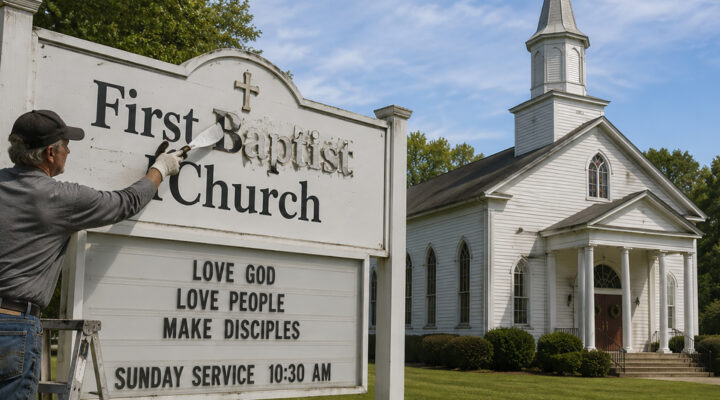
I’d be hard-pressed to call nondenominational churches “Baptist,” but I am increasingly concerned that many Baptist churches are becoming nondenominational. This is seen in dropping the name “Baptist” from the church sign and moving to more narrow forms of governance. It’s also seen in decreased giving to denominational mission budgets as Baptist churches chart more independent courses. And the larger the church, the more likely this is to be true.
These trends transcend Baptists, however. The current dispute at Highland Park United Methodist Church in Dallas illustrates this well. The second-largest UMC church in the nation has changed its governing documents to become essentially a free agent.
And ironically, some observers are saying this Methodist church is trying to become more Baptist.

Mark Wingfield
Mark Wingfield serves as executive director and publisher of Baptist News Global. He is the former associate pastor of Wilshire Baptist Church in Dallas and was raised in the SBC.