


American clergy must stand up and preach against President Donald Trump’s attack on birthright citizenship and call it what it is, civil rights activist Bishop William J. Barber II said during a rally in Washington, D.C.
“To end birthright citizenship now would be a sin against God and a sin against humanity. And no sin is more serious than a sin against children,” said Barber, president of Repairers of the Breach and founding director of the Yale Center for Public Theology and Public Policy.
“Trump’s crusade to undermine birthright citizenship and deny children of basic rights is yet another example of his warped, wannabe God complex. Like the emperors of another era, he rejects the inalienable rights of all people and believes he gets to determine who’s a citizen of the United States and who benefits from the laws of this country,” Barber said in remarks also posted on his Substack.
Barber was part of a surge of faith-based and secular civil rights leaders who rallied as the U.S. Supreme Court heard oral arguments April 1 in Trump v. Barbara, a federal lawsuit challenging the president’s 2025 executive order ending birthright citizenship as guaranteed under the 14th Amendment.

John Sauer
“Trump’s order has never gone into effect; since then, every federal court that has considered a challenge to the order has struck it down,” Amie Howe explained in a SCOTUSblog post summarizing the hearing. “After just over two hours of oral arguments on Wednesday, before an audience that included (at least for part of the morning) Trump himself, a majority of the Supreme Court seemed likely to do the same.”
U.S. Solicitor General John Sauer argued the citizenship clause of the 14th Amendment was intended to grant citizenship specifically to slaves born in the country and that its expansion to include the babies of immigrants rewards illegal immigration and feeds a “birth tourism” industry.

Cecila Wang
Arguing for the challengers in the case, Cecillia Wang noted the historic agreement in the U.S. that “everyone here is a citizen,” Howe reported. “The 14th Amendment, she said, established a ‘fixed bright-line’ rule for citizenship that is ‘workable’ and ‘prevents manipulation.’”
Both sides cited an 1898 case in which the Supreme Court ruled a man born to noncitizen parents of Chinese descent was a citizen under the Constitution.
Wang, an attorney with the American Civil Liberties Union, said the case underscored the longstanding interpretation of the amendment in U.S. law. But Sauer argued the citizenship clause requires noncitizen parents to be “domiciled,” which he defined as residing legally in the country.
“Justice Neil Gorsuch expressed skepticism, telling Sauer the United States did not have strict immigration laws when the 14th Amendment was ratified. Anyone, he suggested, could show up in the United States in 1868 and establish domicile.”
Chief Justice John Roberts pushed back against Sauer’s claim that “birthright tourism” is bringing people to the U.S. solely to have their children born in the country. He asked Sauer just how common the practice is.
SCOTUSBlog reported: “Sauer acknowledged that ‘no one knows for sure’ how widespread it is. Birth tourism, Roberts suggested, certainly wasn’t a problem when the 14th Amendment was ratified in the 19th century.”
Sauer agreed but added the country is living in a “new world,” to which Roberts replied the nation has “the same Constitution.”
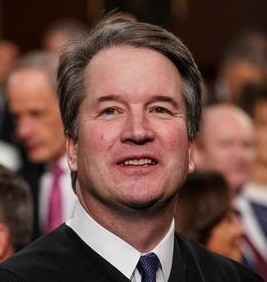
Brett Kavanaugh
Justice Brett Kavanaugh disputed Sauer’s repeated claim that birthright citizenship should be abolished because it is not practiced in many other countries.
That claim has been a frequent talking point for Trump, who after the hearing called the U.S. “the only country in the world STUPID enough to allow ‘Birthright’ Citizenship!”
“Kavanaugh dismissed the issue as ‘a policy matter,’ stressing that ‘we try to interpret American law with American precedent based on American history. Why should we be thinking about” the “many other countries in the world (that) don’t have this?”
The administration’s arguments didn’t fare any better among the civil rights, religious and political leaders who spoke up on April 1.
The “United States has operated under the premise that every baby has an equal right to belong and engage in the ‘pursuit of happiness,’” Barber said. “The 14th Amendment protects babies from a caste-like system based on the race, ethnicity, country of origin or immigration status of their parents.”
Interfaith Alliance said birthright citizenship has been the law of the land for 150 years and “President Trump does not have the power to change that.”
“An attack on this indisputable right is an assault on the Constitution itself,” said Norm Eisen, executive chair of the Democracy Defenders Fund. “If this indisputable legal principle is up for grabs, so is anything in the Constitution and American law.”

Juan Proano
More than 200,000 children born each year would suffer great harm if Trump’s order is allowed to stand, said Juan Proaño, chief executive officer of the League of United Latin American Citizens.
“What was evident today is that our case is about far more than legal theory. It is about real families, real children and the future stability of our nation,” he said. “Stripping or limiting birthright citizenship would introduce uncertainty into the lives of hundreds of thousands of newborns each year and cast doubt on the foundation of America’s identity.”
During a rally in D.C., U.S. Sen. Alex Padilla, D-Calif., said the president’s order is un-American and dangerous, adding that he too was born a U.S. citizen to immigrant parents.
“And I’ll be damned if Donald Trump tries to take that away from me. I’ll be damned if he tries to take it away from anybody here.”
Related articles:
Advocates rally for Supreme Court hearing on birthright citizenship
What the birthright debate reveals about race, wealth and belonging | Opinion by Javien Baker