


The Book of Kells is an iconic symbol of Irish culture. Illuminated images from the Medieval masterpiece adorn everything from pennies to postage stamps to pub signs across Ireland.

Victoria Whitworth
However, new research by Victoria Whitworth is challenging the Book of Kells’ Irish identity. In The Book of Kells: Unlocking the Enigma, Whitworth draws on her expertise in early Medieval sculpture, research from other art historians and the results of a recent archaeological excavation to argue the manuscript with its fanciful animals, intricate spirals and ornate script is the product of a Pictish monastery in Northeast Scotland.
The 1,200-year-old Book of Kells is a Gospel book comprised of the first four books of the New Testament in Latin along with prefaces, summaries and canon tables. Unfinished and missing roughly 30 folios (60 pages counting the verso and recto, or right and left), the Book of Kells occupies pride of place in the Old Library at Trinity College Dublin. Prior to Trinity’s acquisition in 1661, the book resided at the Abbey of Kells in County Meath, Ireland. Although the book received the moniker “Kells” from the monastery, it wasn’t created there.
Consecrated in 814 CE, the Kells Abbey scriptorium was too new to produce something approaching the magnitude of the Book of Kells. Early Medieval books required financial backing, specialized facilities to produce vellum and paint, as well as monks with language and calligraphy skills. It’s more likely the book, whose composition paleographers date to around 800 CE, arrived at the abbey with a contingent of monks from a sister monastery on the island of Iona.
 Whitworth explained: “Iona was founded in the 560s by St. Columba, who’d come from Donegal (in Ireland) to Iona, which is this little island off the southwest coast of Mull in modern Scotland.”
St. Columba and the Picts
If St. Patrick is responsible for bringing Christianity to Ireland, then St. Columba is credited for doing the same in Scotland a century later. Columba traversed the highlands of Scotland where legend says he rebuked the Loch Ness Monster and converted the king of Pictland to Christianity near present-day Inverness.
The name “Pict,” from the Latin word for “painted,” was originally a pejorative term used by the Romans for the people in the north of Britain because of their tattooed or painted bodies. During the early Medieval period, English monk and chronicler Bede and Adomnan, the abbot of Iona, used Pict to refer to tribes living north of River Forth in Scotland.
 Columba’s monastery on Iona, which long has been considered the most likely candidate to have created the Book of Kells, was an “intellectual powerhouse,” according to Whitworth, producing high-quality manuscripts in its scriptorium. However, the confirmed literary artifacts from Iona, such as the stark Vitae Sancti Columbae, lack the lush illustration and whimsical wordplay found in the Book of Kells.
“If you wanted to argue that the Book of Kells was made on Iona, you would have to also argue for a kind of revolution in the scriptorium,” Whitworth said, “a revolution in the grammar of legibility where they’ve gone from one extreme of clarity and communication to the complete other.”
Even the color and quality of the vellum differs. The parchment of the Vitae is refined and lighter in color, whereas the Book of Kells’ parchment is brown and riddled with holes.
For decades, art historians have mused about a possible connection between the Book of Kells and Pictish artisans. Known for their intricate stone carvings, the Picts of Eastern Scotland presided over an artistic golden age in the north, a brilliant cultural light shining during Britain’s Dark Ages.
“The Picts were great artists, producing highly sophisticated Christian sculpture,” Whitworth said. “If the Book of Kells was made in Pictland, this rewrites our understanding of early Medieval Scotland.”
An Iona of the East
 A Scottish Book of Kells would require an “Iona of the East,” and in 1994 Martin Carver, with a team from York University, discovered such a site in Portmahomack, Scotland, north of Inverness on the Tarbat Peninsula. In the heart of Medieval Pictland, Carver uncovered a monastery founded in the sixth century, perhaps by Columba himself.
The Portmahomack monastery reached its zenith between 700 and 800 CE when it became an important religious, political and creative center. Vikings attacked the monastery around 820 to 830 CE, burned it to the ground and killed several of the monks.
During the 20-year dig and post-excavation analysis, Carver’s team located pits for soaking calf skins in a bath of seaweed and shell ash, which experimental archeologist and artist Thomas Keyes confirmed would produce a darker, fragile parchment like that of the Book of Kells. They also unearthed bone pegs for stretching the wet skins, an iron half-moon knife and various stones for smoothing and stripping the hides, as well as a stylus and book clasp.
“If you just look at the archaeology of our top early Medieval monasteries, Portmahomack stands out as exceptionally literate and book orientated,” Carver said.
Fragments of high-quality Pictish sculpture and a fine stone-carving chisel also were discovered in the vellum workshop — which Whitworth says suggests “an intimate relationship between the making of books and the carving of cross-slabs.”
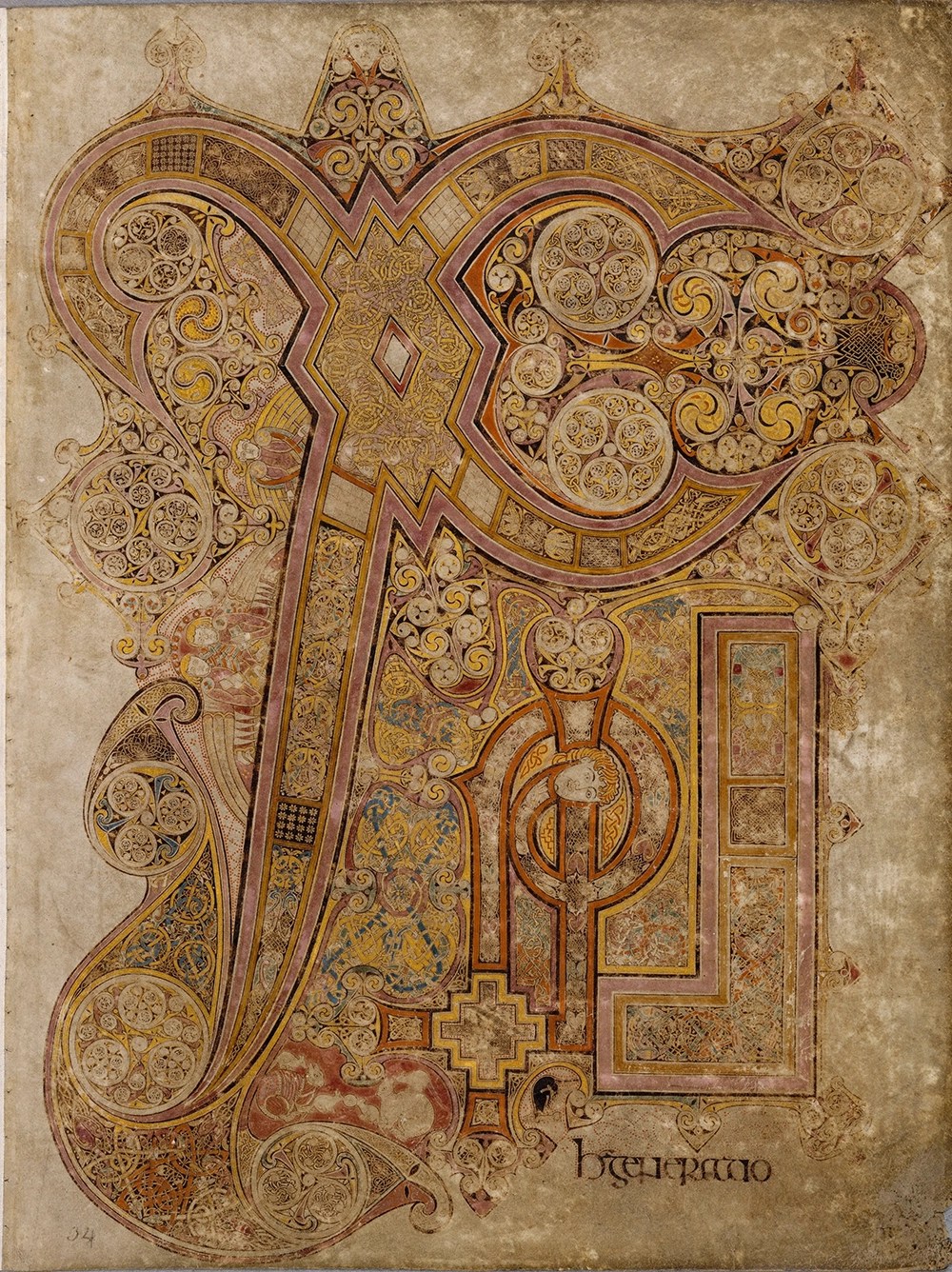
Chi Rho page
One stone fragment (TR10) retrieved from Portmahomack is inscribed with the same insular majuscules script used in the Book of Kells and may have been painted in similar bold colors.
Another (TR201) has the face of a holy man whose expressive almond-shaped eyes mirror those of the Book of Kells’ Christ. The swirling spirals and concentric circles on the nearby Nigg Stone cross-slab could have been the inspiration for the Chi-Rho page.

“Given the mobility of scribes and books, … it is impossible to draw firm conclusions about the manuscript’s origin.” Whitworth said. “It is, however, possible to ask why and how the artists chose to work in such a Pictish idiom.”
An answer may lie with Columba himself.
Reason for the creatures
Columba preached that the natural world reflected its Creator, saying, “God is everywhere in his immensity, and everywhere close at hand.” This resonated with the Picts, whose pre-Christian art drew from nature and included life-like renderings of animals which they later repurposed.
The same body scroll work that defines animal figures like the wolf illumination, which we think of as synonymous with the Book of Kells, is in fact Pictish, as is evident in the Calf Stone discovered at Portmahomack. The crouching lions on the pediment of the Nigg Stone are not unlike the lean, dog-like lions in the Book of Kells.

Scanned transparancies
All the wonderful creatures in the Book of Kells aren’t there just for decoration. Whitworth believes they’ve been inserted into the text to grab the reader’s attention and emphasize the words in the Gospel.
“This is unique to Kells, this interweaving of all these funny little animals and some people as well in between the lines of the text. This wolf, when you look at his feet, the pads of his feet are almost gripping the letter. It’s incredibly naturalistic … and he’s walking on the words ‘adenditis,’ which means ‘take heed.’” A leaping lion in the Gospel of Matthew links the Latin words for “knows,” “father” and “son,” visually underscoring the theological connection.
Medieval Christians saw Gospel books as incarnational, believing if Christ was the Word, then codices that contain the words of Christ are by extension embodiments of Christ. While such books were used in the mass as ceremonial objects and symbols of Christ’s presence, the minutia of the Book of Kells suggests it may have been intended for private contemplation as well.
Two scribes
The scribes behind the illustrations deliberately crafted a manuscript whose images provoke a response from the reader. Whitworth’s book highlights research by paleographer Donncha Macgabhann suggesting the book is the work of two scribes, a master-artist who created the elaborate Chi-Rho page and Eight-Circle Cross page, and a scribe-artist who inked the text and scenes like the Virgin and Child and is responsible for the playful interlinear animals.


Christ Enthroned
The color plates of Whitworth’s book and the accessible information she provides for nonacademics make it a useful resource for those wanting to delve more deeply into the symbolism of the portraits in the Book of Kells. For example, in the painting of Christ Enthroned by the scribe-artist, Christ sits on a low-backed throne flanked by two chalices, a vine laden with grapes (for the eucharist) springs out of one, and a branch with olives (for anointing oil) grows out of the other. On each perches a peacock, a symbol of immortality for the ancients who believed the peacock’s flesh never rotted. He holds a book in his left hand, while his right makes the gesture of benediction, a sign of his human and divine natures.

In the Arrest of Christ, Jesus’ awkward elongated arms and legs form a Chi, the first letter of “Christ” in Greek, or perhaps a saltire cross foreshadowing the crucifixion to come. He stands between two men, each of whom grasps an arm, as if to snap his body in half like a Communion wafer. Narratively these men are the authorities who’ve come to arrest Jesus. However, the scribe-artist has changed the text of Matthew 26:26-30 to read, “This is my body co-broken for the life of the world.” This may refer to a legend wherein Columba and a visiting priest break the “bread of the Lord together” during the mass. Whitworth suggests Christ with his upraised hands is both the priest celebrating the sacrifice and the sacrificial victim being broken.
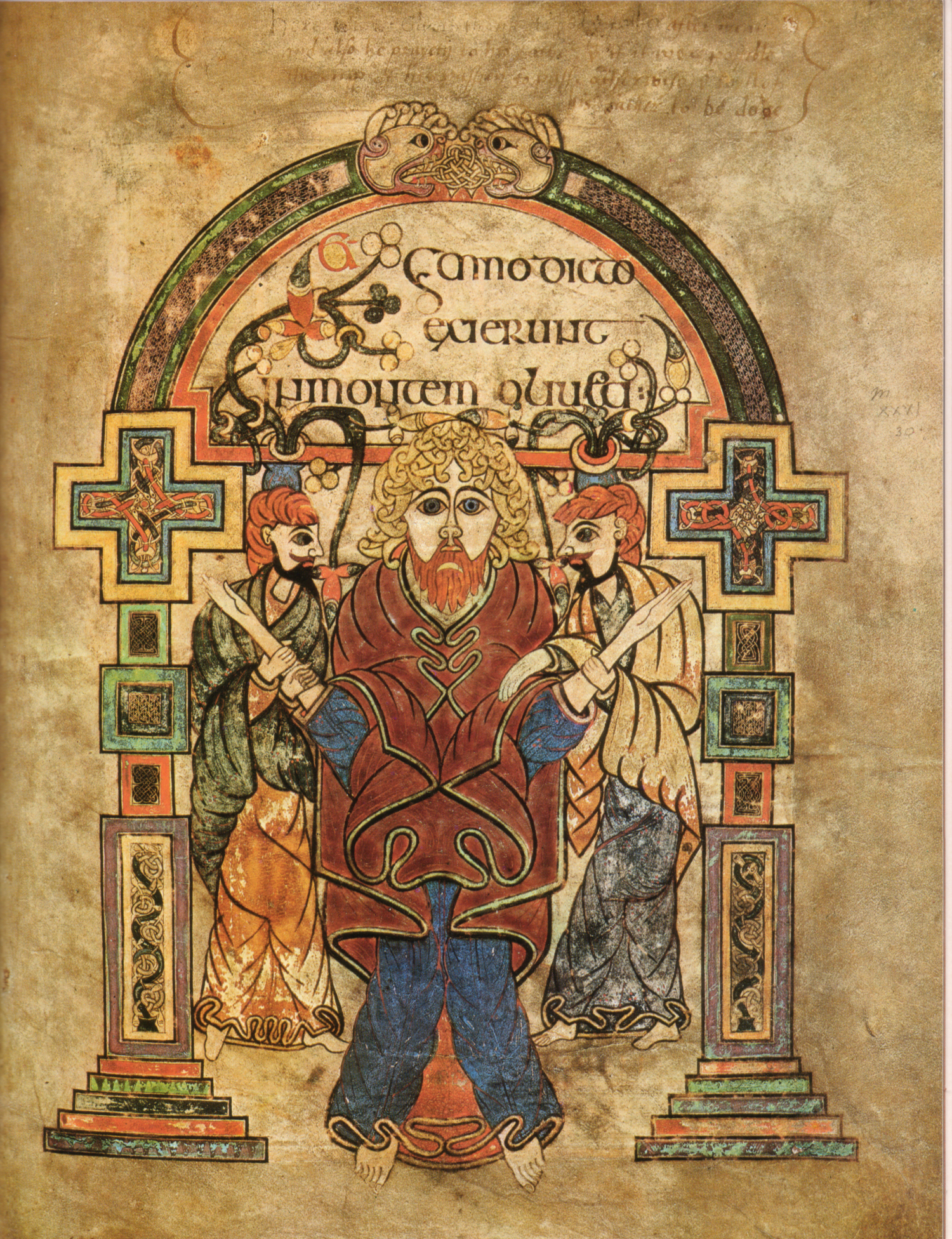

Arrest of Christ
If Whitworth is correct that the Book of Kells is heavily influenced by Pictish art and culture, if not directly the product of such, her scholarship will change the way we think about the early Medieval church and Scotland itself. Since Roman times, the Picts have been dismissed as backward and primitive, and discrimination toward the people of Northern Scotland by English elites has continued down through the ages.
If a Pictish monastery could produce a work as artistically and theologically engaging as the Book of Kells, then the religious practices and religious expressions of the Pictish church should be taken as seriously and esteemed as highly as those of the Irish monastic tradition.
The Book of Kells: Unlocking the Enigma with its engaging and enthusiastic exploration of the manuscript, Pictish art and other illuminated Gospel books of the era, makes a compelling argument.
Kristen Thomason is a freelance writer and journalist living outside Edinburgh in the United Kingdom. She has produced educational and promotional media for national and international religious organizations and public television. Kristen also worked with local churches in Metro D.C. and Toronto, Canada. With a master’s degree in communication and undergraduate degrees in media studies and classics, she is interested in the intersection of politics, religion, history and the arts.