


Some of you who have seen the movie Ocean’s 13 may remember the line near the end when George Clooney’s character, Danny Ocean, confronts Al Pacino’s character, Willie Bank, with this gem: “You should know better. You shook Sinatra’s hand.”
In the movie, that last phrase is merely a figure of speech. “Shaking Sinatra’s hand” refers to an unspoken code of honor among old-school Las Vegas casino and business owners, the idea being if you were old enough and connected enough to have shaken the hand of Sinatra back in the day, you were among those who helped establish that code and agreed to abide by it.

David Breckenridge
Sinatra plays no essential role in you knowing this code, other than setting the time and context of its development. But sometimes, your knowledge of what is good and right and honorable is conveyed in part by the person whose hand you shake. We know better because we know that individual and what he taught us, in word and deed.
Of all of my Civil Rights heroes, John Lewis, despite his short stature, stands the tallest.
No, he wasn’t Martin or Malcolm with their charisma and eloquence. He wasn’t Jesse Jackson with his organizational wisdom and sense of humor. He wasn’t James Lawson with his deep spiritual centeredness and contagious love of nonviolent resistance. And no offense to John, but he wasn’t as attractive as Andrew Young.
But he was there, always there, consistently there, filling in when they couldn’t show up, fielding the questions when no one else would and, when most of the above named personalities were dead or gone, stepping up to run for office and faithfully represent his congressional district in Georgia and the disenfranchised in every district.
And he did all this despite real sacrifice and ongoing threats to himself and his family by antagonists of every stripe. The symbol of that sacrifice was, of course, the scars and memory loss he bore from the beating he received on Bloody Sunday as he and others tried to cross the Edmond Pettis Bridge in Selma, Ala., as part of a peaceful protest in 1965.
I’ve often wondered if John got hit in the head by that Billy club simply because he was short, or maybe the trooper singled him out because he was small (and young, only 25 at the time), thinking, “He’ll stay down. He won’t get back up.”
If so, no greater underestimation of character and will ever has been made.
A chance encounter
Early in my tenure as pastor of First Baptist Church of Memphis (2008 to 2018), I became convicted about addressing the issue of Civil Rights, especially racial justice. It was not the only social issue I engaged through sermons and programs. Nor should it have been. I also addressed issues related to LGBTQ acceptance and rights, environmental concerns, poverty, the role of women in church and society, immigrant rights and so forth. But I remember thinking: “One day, when I get to heaven, God’s grace will cover a multitude of ills, but if I cannot give an accounting of what I have done to further the cause of racial justice, that is going to be a longer conversation.”
The Black Lives Matter movement was the call beyond conviction to action for me. So I got busy. I read and studied. I attended meetings and listened. I became a member of the first board of the Lynching Sites Project. And I began to meet with two fellow pastors, both African American, allowing them to teach me and to lead me into what we and our congregations might do together to bring about some genuine justice, healing and hope.
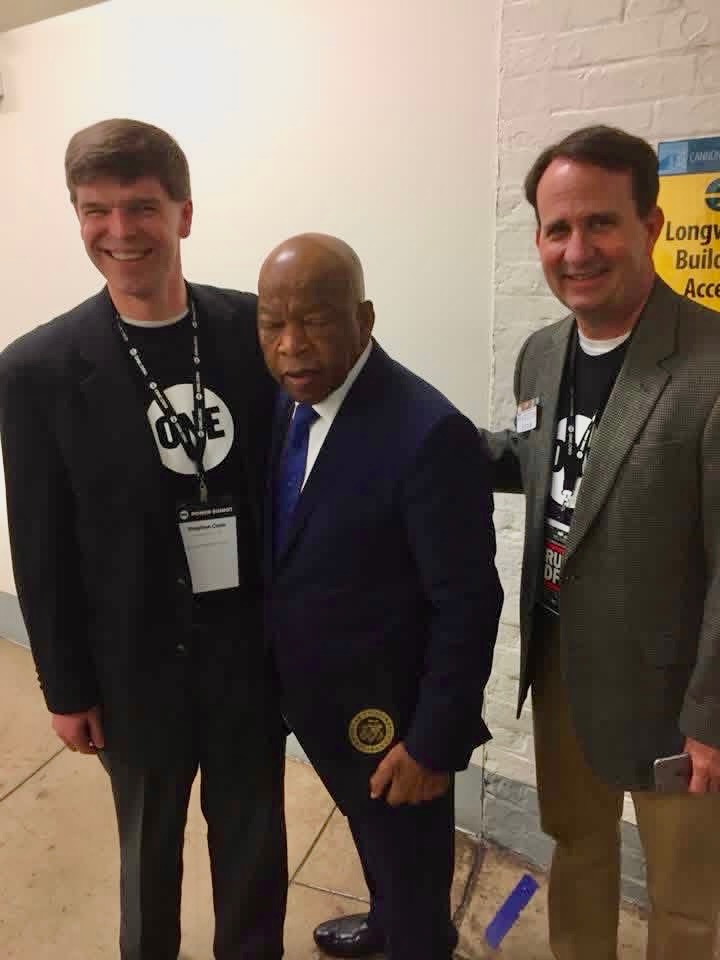 The first time I met John Lewis and shook his hand was a matter of chance, so to speak. I was in Washington, D.C., lobbying members of Congress as a part of the One Campaign, an advocacy group for third-world poverty, encouraging first world nations to commit at least 1% of their federal budget to foreign aid (a cause in prior days that was generally an easy sell to members on both sides of the aisle due to its obvious humanitarian and geo-political benefits).
My group of amateur lobbyists just ran into Lewis in the hall. He was, of course, busy, en route to a meeting, but he stopped and shook our hands and granted a photo.
A second meeting
The second time I shook John Lewis’ hand was more personal. I was at the National Civil Rights Museum in Memphis, located on the grounds of the Lorraine Motel where Martin Luther King was shot, walking through it with a group of friends visiting from out of town, when, once again, here comes John Lewis down a hall in front of me.
As before, despite being busy, he stopped and greeted us. Like a nervous groupie, I made mention of having met him before (as if he would remember that chance occurrence in D.C.). He shook my hand and looked at me puzzled, “Tell me your name.” I did.
He said, “Oh, I’ve heard of you. I saw Rev. Jones last night and he told me about the good work you are doing together. Thank you for what you are doing. Keep it up. Don’t stop. Together is the only way we get there.”
And then he continued on his way.
Later, I reflected on the grace-filled absurdity of that moment. John Lewis told me “thank you.” And he shook my hand, yet again.
Voting Rights Act
On the occasion of the recent U.S. Supreme Court decision that gutted most of the Voting Rights Act, I went in search of photos from the signing of that bill. Some of the photos and the people in them are rather predictable. A lot of politicians, almost all white and male, standing around congratulating themselves on this remarkable piece of legislation. No matter how aggressively or reluctantly they signed on to it, they wanted to get credit for doing so.
But then there are the photos that contain Martin Luther King, and in almost all of them, he is smiling or fighting back a smile. I can only imagine what that day meant to him and all the other leaders of the Civil Rights Movement.
Smile on, Dr. King, smile on, indeed.
And then there is a photo of John Lewis. He is greeting others in the room. He isn’t smiling visibly. Truth is, after the head trauma at Selma, he struggled to smile as he once did. And remember, at this point, he was just five months removed from that head trauma.
But, as always, he was there, standing tall despite his stature. He wasn’t going to miss this. And that man shook my hand.
Because I knew you
I sometimes find myself in conversations with white moderate-to-liberal friends who talk about the present state of politics and court decisions like this one, from a rather detached perspective. They speak of how, in the big picture, they hope our present reality is but a phase, that the pendulum will swing back, that we as a nation are going to make it through this as we always have.
These conversations always seem to center the conflict on the divisions in our country and our need to come together. And, granted, the division is so hard. None of us like being at odds with our neighbor.
But I can’t do that. Not anymore. Because by God’s grace, I’ve know too many people of color, too many immigrants and children of immigrants, too many LGBTQ folk, too many people needing health care, too many poor people and those seeking to aid them who are affected, deeply, by decisions like this one.
I know too many people who are put down, told they don’t matter, whose hopes and dreams of living a better life consistently get subjugated to the needs of others with more privilege. I know too many Civil Rights workers in my native Mississippi and in Memphis and across the South who are increasingly demoralized by the state of our country.
Because I know them, I can’t remain detached, I cannot be silent, I cannot call for “unity” as though there are two equally guilty parties that need to kiss and make up.
I want to do more. I need to do more. We all need to do more.
We must have those conversations with our neighbors. We must teach our children better. We must stand up stronger.
I must do better because I shook John Lewis’ hand.
David Breckenridge serves as Minster of Pastoral Care at River Road Church, Baptist, and as a Licensed Professional Counselor with Westhampton Family Psychologists in Richmond, Va.