


“I will ask off work if you really want me to. But I think you need to do this trip solo. And just heal.”
Heeding those words from my wife, here I am, south of Daytona Beach, Fla. — in solitude for a week for only the second time in my 60 years. As an extreme extrovert, there was a time when this would have terrified me, but after my divorce almost 10 years ago, I got really good at being alone instead of lonely. Truth be known, I was excited when My Protector suggested a solo pilgrimage.
I had wanted to go to a monastery but couldn’t quickly find one with a cafeteria, and I didn’t want to spend the week cooking. My Protector blessed me going to the beach condo of some extended family and using the money saved on lodgings to indulge my love for seafood and my proclivity for mom-and-pop eateries where leather-skinned female servers in T-shirts call you “sweetie,” and the manager chats you up.

Brad Bull
Today, though, my breakfast chair was a towel on beach sand, just after 5 a.m. Having gotten situated with my mug of hot chocolate, I saw no flashlights or silhouettes for miles in any direction. Stars speckled the ebony sky, dimmed only by the glow of the Ponce Inlet lighthouse and intermittent colonies southward toward Cape Canaveral, the focus of my eyes and my iPhone’s camera.
I’ve seen a few launches from here over the years — some in the daytime, some at night, none without cloud obstructions. This was going to be beautiful.
At 5:33, a dome of orange light bloomed on the southern horizon. Then, from behind a condo tower 3 miles away, an orange ball 30 miles away lumberingly rose.
The rocket tracked east until it dipped behind a previously unseen line of clouds just above the horizon. Oddly, I noticed the exhaust plume was growing brighter instead of dimmer. Had the rocket blown up? I stood there too entranced to search my phone to see if there had been a “rapid unplanned disassembly” — Elon-Musk-speak for “Oh well, I just dropped one of my dimes in the ocean.”
Suddenly, beside me, a man appeared — he, too, with boyish fascination and a cellphone camera. I asked about the brightening plume. He said, “I’ve lived here since 2017, and I’ve never seen that before. I think maybe it’s the sunrise.”
Pointing four hand widths south, I said, “But the sun comes up over there.”

(BNG photo by Brad Bull)
The man replied, “Yeah, but see how it’s starting to lighten up over there? Sunrise is in about an hour. I think maybe those low clouds over there are blocking us seeing early light, but we’re seeing the sunlight reflecting off the plume over here.”
“Good point.” I stood up and extended my hand to him. “I’m Brad.”
“I’m Bob — you know, one of those names that’s both a noun and a verb.”
I laughed and asked if he knew my hosts. He didn’t, but he had heard their names.
I told him I was on a solo pilgrimage after several horrible months — that my dad had been diagnosed with stage four liver cancer in March and died in June — and that that was just the tip of the iceberg of a dreadful year. My AFib was back and I was scheduled for a second ablation at the end of September. “There’s no family history at all. My grandfather smoked a pack or so a day and lived to be 86. Turns out anger is more deadly than nicotine.”
“I feel you. I’m lucky to be here. I was an actuary. So much stress. Plus, you can’t change your genes. No man in my family had made it out of our fifties without a heart attack until I made it to my 60s and had open heart after mine. Just glad to make it to 70.”
“Hey, look at that!” I said. The plume was now snaking out, looking like abstract Japanese art — except, I pointed out, “That looks like a bull’s head.” Then I agreed when Bob said, “That part in the middle looks like a snowy egret.” We each took photos, complaining they never could capture the actual colors and textures.
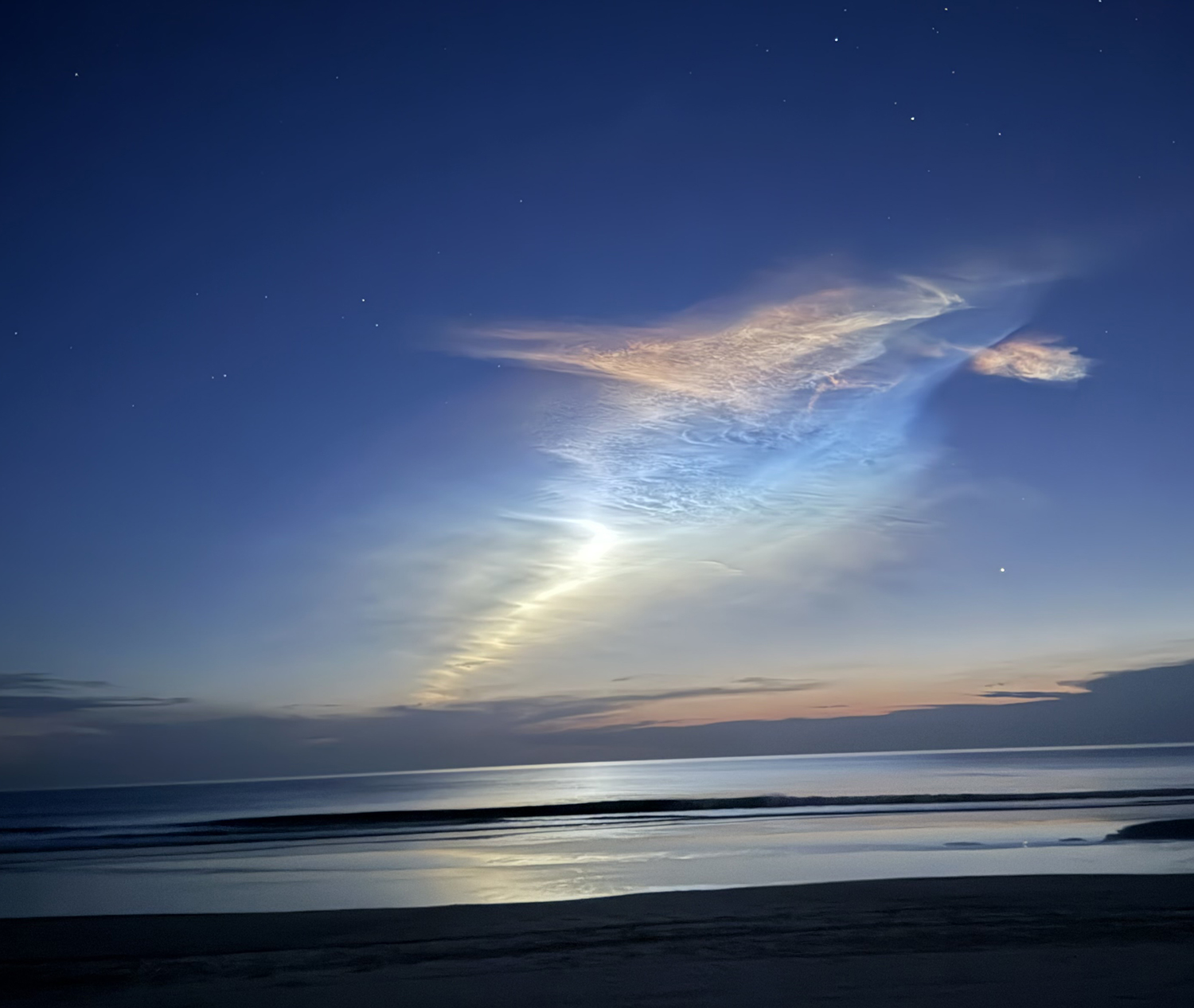
(BNG photo by Brad Bull)
I would later learn we were seeing a “space jellyfish”— a rocket’s exhaust plume illuminated by sunlight not yet visible to the viewer — like the way the moon reflects the sun’s light.
Between pauses to take photos of the changing shapes and colors, we swapped stories like two guys at a breakfast café. His father was born in 1917 and saw his first airplane at age 9. Bob was 10 when Neil Armstrong landed on the moon. But his father, who grew up witnessing the age of flight, said the moon landing was staged in New Mexico. He saw the dark skies over the astronauts as proof. “‘Why would they have done a landing at night?’” (Bob’s father didn’t know the moon’s sky always looks dark because it doesn’t have an atmosphere.) I said, “Bias confirmation just hurts doesn’t it?”
Bob was feeding my soul as we swapped stories as naturally as combat veterans or college roommates at a reunion — except with more depth about family and heartbreak. He had no idea what he was doing for me. I recently had mentally prepared for being asked if I miss my dad: “Every day since 1989. That’s when he started listening daily to Rush Limbaugh and then Fox News. There’s a documentary titled, The Brainwashing of My Dad. I’ve never finished it; it’s too painful.”
I didn’t share that with Bob, and he had no way of knowing that the day before I had finished a roller-coaster-reading of Pat Conroy’s The Death of Santini — his autobiography about a father-son relationship that made my own look like a meadow of daises with but a few flowering cacti. Still, it had stirred deep remorse. But as I heard the love Bob had for his moon-landing-denying father, my frustrations with my own wonderful but maddeningly luddite father softened.
Reveling in the communion with Bob, I felt frustrated when my previous night’s supper would wait no longer for exit. It angrily bade me make apologies for a hasty departure.
Bob said with supreme sincerity, “I’ll be praying for you and your ablation, Brad.”
Thanks, Bob. I don’t even know your last name. We were two brothers on a beach, both of us with heart problems. You reflected light with a beauty that this wordsmith has trouble capturing. I rejoice that solo pilgrimages often lead us to — people. And that sometimes — by showing love to be both a noun and a verb — those people are as priestly as the residents of any monastery.
Brad Bull grew up working on his maternal grandparents’ beef and cattle farm. At age 30, he discovered a toxic multi-generational family secret that cut deeply and healed but left jagged scars. He has served as a UPS seasonal driver helper, hospital chaplain, pastor, professor and private therapist. He can be reached at his website DrBradBull.com.