


It can be overwhelming to consider that there won’t be a presidential election for nearly four years, or even the possibility of winning either the House or Senate away from the control of Christian nationalists for another two years. One recent CNN headline said, “Democrats confront their powerlessness as Trump flexes authority.”
The level of powerlessness at least half the population feels borders between helpless and hopeless.
To be clear, the issue here is not even a complete divide between conservatives and liberals. As I wrote two weeks ago, conservatives with a more libertarian bent should share many of our concerns about the authoritarian instincts of Trump and his Christian supremacist supporters.
But while the news on the national front may look bleak, the reality is we are not powerless, helpless or hopeless. Instead, we may simply need a reminder that the opportunities for loving our neighbors may be closer to home.
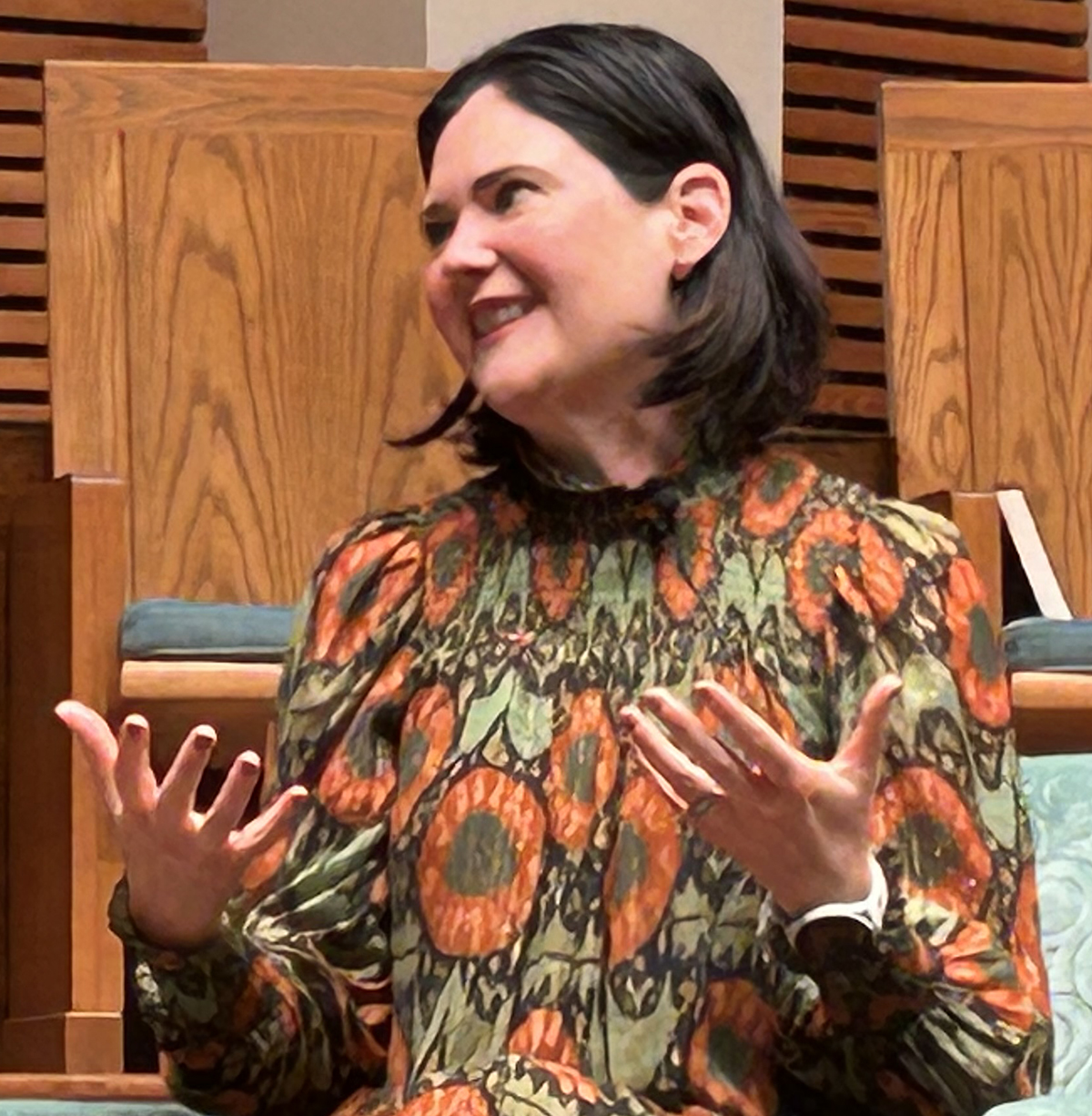
Amanda Tyler (BNG photo by Rick Pidcock)
That was the message of Amanda Tyler, executive director of Baptist Joint Committee for Religious Liberty and author of How to End Christian Nationalism, in a conversation last week with Carol McEntyre, senior minister at First Baptist Church of Greenville, S.C. The auditorium was filled with members of First Baptist, along with many people from the community.
As I sat on the second row, I thought about a number of people I knew were there who hadn’t stepped foot in a church in years, some of whom due to the deep trauma that comes from spiritual abuse. In addition to progressive Baptists, the room included atheists, agnostics and even some conservative evangelicals who walked through the doors like Nicodemus in the dark of night with some nagging questions.
Despite whatever religious or political differences we had with one another, there was one common concern that brought us all through the doors of First Baptist.
We all wanted to hear what Tyler had to say about how to end Christian nationalism.
Reckoning with our own violence against neighbors
While it’s easy to focus our conversation about Christian nationalism on “those people … out there,” Tyler’s emphasis on local communities led to her recommendation of considering our own complicity in what has grown over time.
“We are in a Baptist church in the South,” she reminded us. “We are not in a Southern Baptist church. But most of the churches in this area once were Southern Baptist churches. The whole reason there is a Southern Baptist Convention is in part because of Christian nationalism. It was a choice that was made to choose the false idol of power over the gospel of love, to say as the Southern Baptist Convention said in 1863 that slavery is an institution of heaven.”
Then Tyler asked, “Have we really fully dealt with the violence that choice had, not just on our neighbors … but what it did to us, what it did to our theology, what it did to how we understand Jesus?”
Speaking out and giving space for others
Because we have been complicit in creating the dynamics of silencing women, minorities and LGBTQ people, Tyler believes we all have a responsibility to speak up.
“People of all faith and none have the right and responsibility to engage constructively in the public square,” she noted. “The separation of church and state has never meant, nor should it be, the separation of religion or religious people from public life. As the majority in this country, we have to also understand that we as Christians do not have the right to take up all the space in the public square, that in order to celebrate our pluralistic democracy, it’s important that people of all faiths and none have an equal right to that public square.”
In order to create a more equitable table conversation with mutually valued partners, Christians need to learn how to refer to their faith “in ways that give space to and respect for people of other faith traditions,” she said. “And because of the Christian privilege and the Christian dominance in so many of our communities, that means being very mindful of the ways we are not perpetuating Christian nationalism in our public advocacy by assuming we have the greater right to the space than others.”
Focus locally
Rather than sitting around waiting for the next election, Tyler suggests we get busy loving our neighbors locally. She says to end Christian nationalism, we’re going to have to commit to a “multi-generational effort” of “long-haul work,” beginning by asking the right questions.
We’re going to have to commit to a “multi-generational effort” of “long-haul work,” beginning by asking the right questions.
“How do we better understand our community? How do we understand the pain points of our community and how harms of Christian nationalism are impacting people in our immediate space? And how do we work together in ways that are truly collaborative, that are truly working from the ground up to try to fashion interventions and really organize for change?” she asked.
To answer these questions, she focused on three buckets: awareness, advocacy and organizing.
“In the awareness bucket, that’s about learning about Christian nationalism — what it is, how it’s showing up, reading books about it … having conversations with people in book clubs or other reading opportunities or learning opportunities, going to hear different speakers on the topic.”
 Advocacy can be “contacting your elected representatives, going to the school board meeting, going to the state board of education, making your voice heard.” Local schools need to be a point of emphasis because Christian nationalist ideas are being incubated or tested in places like Texas and Oklahoma with the desire to spread the ideas elsewhere, she added.
One example is that Christian nationalists are pushing to have “chaplains” in public schools who have “no special training, no licensure, no demonstrated ability to work with children, no restrictions on how they would talk to the children or what they would do.” According to Tyler, this is “a deliberate attempt to try to have proselytization in public schools.” But she noted how Christian nationalist policies like this fail when local groups of parents and even chaplains themselves stand up and resist.
For organizing, she recommended connecting with groups already working for justice in the local community.
After Tyler’s conversation with McEntyre, First Baptist’s Minister of Community Engagement Matt Rollins shared how First Baptist Church is partnering with four local groups in loving their immigrant neighbors: World Relief of the Upstate, Lutheran Services of the Carolinas, The Immigrant Connection and The Hispanic Alliance.
Rollins also mentioned how many churches like First Baptist are utilizing Just Faith small group modules with a variety of topics that include advocacy, antiracism, civil dialogue, eco-justice, migration, poverty, indigenous justice and preventing gun violence, among others.
Additionally, Tyler said BJC recently sent out an email asking for people who would be interested in forming local Christians against Christian Nationalism groups. “Within 24 hours, we had responses from 80 different communities around the country,” she reported.
In addition to joining 40,000-plus people who have signed their petition, people can partner with them by joining a private Facebook group for discussion, as well as starting or joining local groups like First Baptist has to get involved in local advocacy.
As Tyler noted, “Christians have a particular responsibility to explain: ‘As the majority, I don’t want the Ten Commandments on the public school classroom walls. I don’t want a Christian prayer said here. And this is why: Because I respect religion so much, I don’t want my religion being used as a prop. But also because I respect my neighbors and I know they don’t all share the same religious views.’”
Rick Pidcock is a 2004 graduate of Bob Jones University, with a bachelor of arts degree in Bible. He’s a freelance writer based in South Carolina and a former Clemons Fellow with BNG. He completed a master of arts degree in worship from Northern Seminary. He is a stay-at-home father of five children and produces music under the artist name Provoke Wonder. Follow his blog at www.rickpidcock.com.
Related articles:
BNG webinar delves into how to end Christian nationalism
Amanda Tyler on when and how to talk about Christian nationalism at Christmas dinner