

One recurring story in recent years has been Christian nationalist worship leaders wielding worship as a weapon for dominating their neighbors rather than as a vehicle for liberating them.
The insurrection of January 6 unfolded as New Apostolic Reformation charismatics sang worship songs. The 2024 election was won as events like the Courage Tour used worship songs led by independent charismatics to get out the vote for Trump. Sean Feucht led a 50-state-capitol worship tour that culminated in spiritual warfare on the National Mall, welcomed on video by Donald Trump himself. The recent riots in Seattle unfolded as independent charismatics led worship songs in spiritual warfare against LGBTQ people.

Rick Pidcock
At the event in Seattle, one of the worship leaders yelled: “This is what we do! Prayer is a weapon! Worship is a weapon! Praise is a weapon! Your voice is a weapon! Your sound is a weapon!”
While the independent charismatics who are leading worship as a weapon of political warfare against their neighbors may get the headlines, there are many charismatics who consider their worship to be an opportunity for embodied healing. So rather than completely rejecting charismatic worship altogether, the path toward healing may involve being honest about the charismatic worship leaders who cause harm, as well as the ones who provide healing.
This summer, I attended the 2025 Summer Institute for Global Charismatic-Pentecostal Studies at Emory University’s Candler School of Theology, which was led by historian Leah Payne. The conference was one of the most encouraging and courageous events I’ve ever attended for exploring many of the most controversial questions and concerns about the problems and possibilities for modern worship many evangelicals aren’t even aware of.
Evangelical insecurity and Contemporary Christian Music
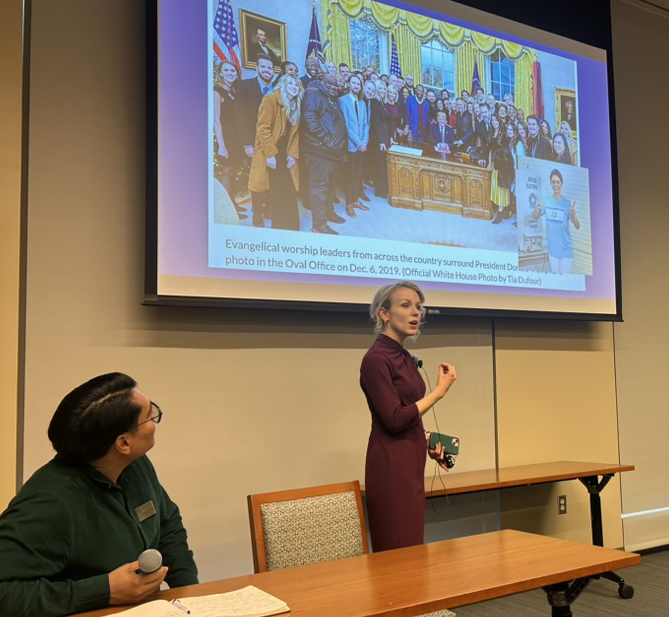
In the first session, Payne explored how CCM shapes the culture through the insecurity of evangelical parents hoping to save their nation and their kids. While the consumer of CCM has been the Christian teenager in youth groups, the customer has been the mom who buys the music or subscriptions and who determines what kids are allowed to listen to.
Because evangelicals have been overwhelmingly shaped by fear of the rapture and fear of hell, their primary concern for decades has been saving their teenagers from missing the rapture, having to face the tribulation and being sent to hell. As Payne put it, “Evangelicals … became convinced that teens were in a particularly precarious spiritual state, which meant that CCM sales had cosmic importance.”
Evangelical battles for the future of their teens also were connected to the future of the nation.
“The teen years were this must-win battlefield in the war for the future of the Christian faith and the nation and even the world,” Payne explained. “And mass media was an effective weapon to be deployed in that fight for them. And they set out to save the souls of the young and to shape the nation through music.”

Leah Payne speaking at the symposium
Industrializing a personal encounter
Along with the angst of fighting a war for the future comes the trappings of turning worship into an industry. “What does it mean to industrialize a personal encounter … a formative moment?” asked Caleb Maskell, associate national director of theology and education for Vineyard USA.

Caleb Maskell
Maskell was addressing a panel of worship industry insiders. And as awkward as it may feel for many people to consider the financial dimension of worship, it was refreshing to hear the insiders talk so candidly.
“We know where these consumers sit every Sunday. We’re all in church together. We might be broken apart by creed or different things, but we’re generally very faithful people,” one of them said. “And so you have a target audience that’s all gathered together once a week. And so when you introduce songs into that context, and then there’s money to be made by songs being sung together on Sunday morning, you have an entire industry that just shifts its focus honestly toward that bucket of money.”
Christian Copyright Licensing International
The way that bucket of money gets tracked in churches is through Christian Copyright Licensing International. Songwriters used to make their money when hymnals were sold. But with churches moving to slides, hymnal sales began to fall. So CCLI created a way for publishers and songwriters to get paid by churches signing up for licenses to print or display lyrics. Then when churches report which songs they displayed lyrics for during a service, the publisher and songwriter get paid from CCLI. While it’s natural to have concerns when so much money is involved, songwriters also shouldn’t have to work for free.
And there’s a lot of money to be made. One of the insiders said, “Just in the United States, just out of these white evangelical churches largely that subscribe to this license who reported their usages, if a song is at No. 1, that’s about a million dollars a year to that publisher and that songwriter.”
Then they added, “You extrapolate that over the time it takes to reach No. 1 and the time it takes to fall off the face of the earth, there’s a lot of money there.”
Sex, the stage and social media
Imagine combining the power of money and social media with white evangelical scripts about men and women and Western assumptions about beauty.

Kelsey Kramer McGinnis
“In contemporary worship music, if you want to sell a ballad, you have a woman sing it, and preferably an attractive white woman,” Christianity Today worship correspondent Kelsey Kramer McGinnis said about what she’s observed in the worship industry. “Certain faces are better for marketing certain kinds of music. And female faces and bodies are better for marketing intimacy.”
She went on to add, “It may make it more palatable to a male audience or congregation if there’s a little bit of turning toward a female figure.”
McGinnis noted how Christian magazines have described worship leader Kari Jobe as “ethereal, angelic, and that she has a presence that allows people to drop their guard and truly enter into an experience with God. There is a way of thinking about the marketing of music, especially using women, to kind of use that desirability to create the impression of intimacy with God.”
So are evangelical worshipers experiencing intimacy with God or with Kari Jobe? Is it even possible to know? And is there anything we can really even do about it? Women should be affirmed in having a voice. For the women who are on stage, we should affirm them being who they are rather than expecting them to be someone they’re not. And it’s not their responsibility how men feel or respond.
That said, it’s also true the worship industry can commodify their bodies and voices. As one of the insiders said, for “most of the worship movements that are recording and producing songs, 0 to 18 need not apply, 33 to 105 need not apply because it doesn’t fit in the frame.”
Leah Payne
When McGinnis and I discussed this tension further in a recent episode of BNG’s “Highest Power: Church + State” podcast, McGinnis told me: “Because the worship music industry is so closely tied to the Christian music industry, which is so closely tied to the entertainment industry more broadly, things like physical attractiveness, body size, race, all impact the kinds of people who tend to rise up as the main characters of contemporary worship music. … There are certain types that are allowed. And I think the more media we get from the worship music industry, the more the line between entertainment media and worship media is blurry. We’re going to continue seeing the impacts of the entertainment industry on what that looks like, what we think worship looks like, what we think worshippers look like, who we think is worth putting on a platform, who we’re used to looking at.”
Then she rhetorically asked, “When is the last time you saw someone over the age of 60 on the stage in a popular worship music video, right? There’s fat phobia, there is racism, there is ageism, all of those things show up.”
Race and money
Another disturbing revelation of the event came when we discussed the effects our nation’s history of racism have had on Black songwriters.
Remember, worship songwriters get paid when churches report to CCLI that they sang their songs. But one of the elephants in Christianity’s closet is that the worship industry is still segregated.
Kirk Franklin
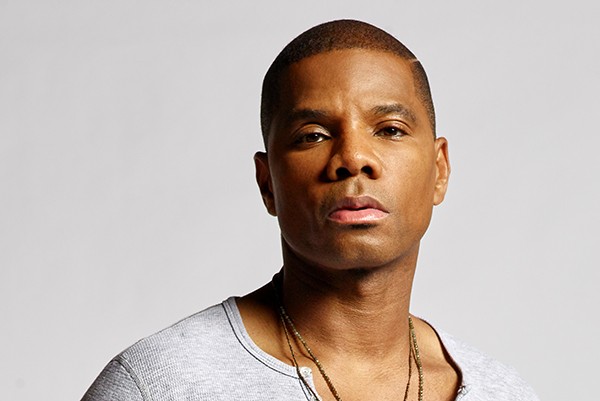
According to gospel music legend Kirk Franklin, “For so long, the (musical) terms ‘Christian’ and ‘Gospel’ for many are code words for ‘white’ and ‘Black,’ which history may teach us was a setup for this unfortunate place we find ourselves in today.”
Because worship has been segregated into two different genres based on race, the institutions built in white evangelical worship have long been controlled by and largely limited to white people. CCLI is one of these institutions.
Because CCLI has grown in the white world of worship, most Black churches aren’t signed up for CCLI. And who could blame them? But this means Black churches aren’t reporting what songs they sing to CCLI, and thus Black songwriters are not getting paid. So while white songwriters who create a No. 1 song are getting paid around a million dollars a year for just that one song, Black songwriters are getting paid nothing for their songs.
Speaking of a popular gospel artist, one of the industry insiders said, “He is sung in every Black church in this country, every one of them, just all Black churches. Unless it’s on the radio, he’s not getting paid for that record. He’s not getting paid for usage of the church. That’s because the church isn’t signed up for CCLI. If the church was signed up for CCLI, then he could get paid. But he can’t get paid because there’s no recording of that usage to pay him.”
So Black songwriters have to make their money on radio. But as one of the other insiders said: “CCM radio is a death trap for Black artists. It’s a one-way swinging door. Nobody wants to touch the conversation. It’s taboo. Like let’s not get into it. Let’s not talk about it.”
Propaganda
One of these taboo conversations took place as the entire room was processing these racial injustices. A gospel music insider asked a Christian worship music insider why Black gospel artists have to include songs written by white songwriters on their albums, but white Christian worship artists won’t put songs written by Black gospel artists on their records. The answer, of course, was related to what audiences will buy.
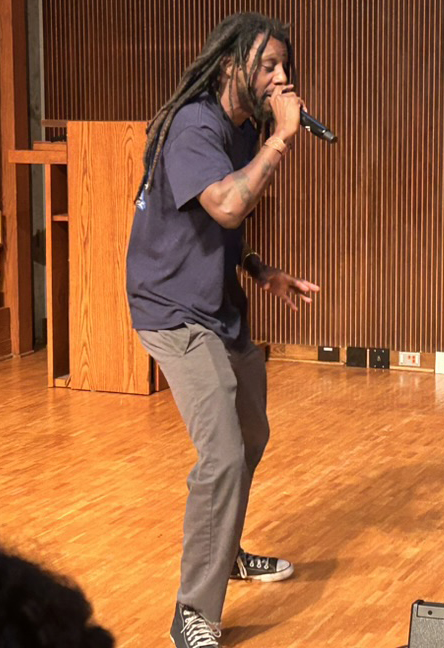
“We’re talking about a uniquely American experience,” the rapper Propaganda said the following day. “As far as America is concerned, the business of making Christian music is a Nashville CCM thing. So in some senses, it’s theirs. They made it. So that’s their house.”
He added, “I had a person say to me directly to my face, the program director, ‘You’re my favorite artist. We’ll just never play your music.’”
Propaganda concluded: “Christian syndication, it’s supposed to be safe. It’s not supposed to be Christian. It’s supposed to be safe. So you have to make safe music for the person controlling the radio station. ‘Safe for the whole family.’ That’s the tagline.”
Liberation through Pentecostal worship
In contrast to the unjust systemic structures built at the center of white evangelical worship are liberating contexts on the fringes.

Gabriel Salguero
“Most of the intellectual journey of liberal and liberation and neo-Barthian theology says that prophecy is speaking truth to power,” said Gabriel Salguero, pastor of The Gathering Place in Orlando. “That is true. But it is incomplete. Prophecy is speaking truth to power. But it is also speaking truth from the power challenged. It doesn’t just have a ’to.’ It has a ‘from.’ That’s a holistic view of Pentecostal theology. It is not just that God brings the prophets to speak truth. It is that they are from a community of the power-challenged.”
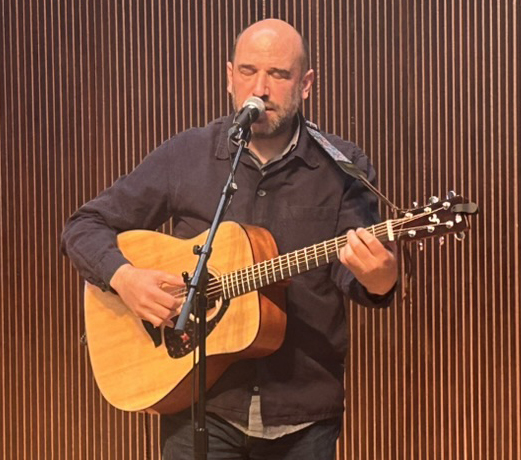
The songs and perspectives of the power-challenged on the fringes were featured throughout the event as artists like David Bazan and Propaganda along with scholars like Leah Payne and Jonathan Calvillo explored the development of gospel and hip hop music.
David Bazan
Salguero spoke about how Pentecostal worship heals through practices like repetition for highly illiterate congregations or through longer services due to churches gathering in spaces with plumbing and heating. “To divorce liturgy from socioeconomic and political realities is to engage in intellectual white privilege,” Salguero said. “Our hymnody is not escapism. It’s refugeeism.”
To those who criticize Pentecostals for overly engaging their bodies, Salguero said, “Don’t tell me I can’t use my body if I can use it to clean your house, if I can use it to pick your strawberries. Don’t tell me I can’t use my body to dance in church, that somehow my ecstatic manifestations of worship is lunacy, but when you exploit my body to make money, it’s not.”
Being honest about the harm and the healing
What was perhaps most encouraging to me about the Summer Institute for Global Charismatic-Pentecostal Studies was how liberation entails being honest and brave enough to explore how unjust much of our theology and systems have been, and also about the ways our traditions have been a part of our healing.
The willingness to explore both the harm and healing by all the speakers and panelists led to depths of questions and conversations I haven’t seen explored regarding the worship industry to this degree before.
Salguero said it this way: “There’s things in Pentecostalism that I don’t just value, they are true to me. I know what God did through that tradition for my family. The tradition saved my family, but God used that tradition. I also know the nightmares I had about being left behind. I also know how sometimes if you were too innovated, you were demonized. So I live with that tension. I’m a Pentecostal pastor. And so how do I with intellectual honesty present at its best the redemptive, liberative traditions, while being critical of the deleterious, nefarious, oppressive traditions?”
Then he concluded, “We are capable of great sin and great self-transcendence.”
Rick Pidcock is a 2004 graduate of Bob Jones University, with a bachelor of arts degree in Bible. He’s a freelance writer based in South Carolina and a former Clemons Fellow with BNG. He completed a master of arts degree in worship from Northern Seminary. He is a stay-at-home father of five children and produces music under the artist name Provoke Wonder. Follow his blog at www.rickpidcock.com.