


Before there were megachurches, Wieuca Road Baptist Church stood on a prestigious corner of Atlanta as one of the most prominent tall-steeple Baptist churches in the American South. Its longtime and legendary pastor Bill Self urged everyone to show up “5,000 Bibles strong” on Sunday mornings.
When Barry Howard assumed the pastorate at the renamed Church at Wieuca in January 2020, there were fewer than 300 resident members meeting on the 12-acre site at the corner of Wieuca Road and Peachtree Road in the affluent Buckhead section of Atlanta. The congregation no longer was meeting in its ornate Georgian sanctuary that seats 1,300 but instead gathered in the Peachtree Room, its fellowship hall.
Now the church is preparing for one of the largest real estate deals in American church history and hoping the infusion of cash will help it reset its ministry in a “live, work and pray” community.
Although church officials declined to confirm the price of the upcoming deal, knowledgeable sources have placed it north of $40 million.
About half the proceeds will be used to reconfigure the central part of the campus, and the remainder will create a missions endowment fund. About half the property will be sold, with single-family homes to be built on one side and two high-rise towers to be built on the other side. One tower will be office space and the other will be condominiums.
The cavernous sanctuary will be cut in half with a nonpermanent wall, and the pews will be removed to be replaced by moveable chairs. The back half of the sanctuary will become a multipurpose room, and a part of the narthex will become a small chapel for weddings and funerals.
The basement under the sanctuary will be reconfigured to house the church’s popular day school and Sunday morning children’s education. A new building to adjoin the sanctuary will house offices and classrooms.

Existing sanctuary at The Church at Wieuca
Reimagining on a large scale
Churches rightsizing their space is nothing new. But doing so at this scale is unusual.
What makes this deal possible is the location of the church, founded in 1954.
The Gadberry Group ranks one of Buckhead’s ZIP Codes (30327) as the second wealthiest ZIP Code in the South. Forbes says Buckhead’s 30327 is the ninth-wealthiest ZIP Code in the nation, with an average household income in excess of $341,000.

A condominium tower already stands near the church property
Unbeknownst to its founders, Wieuca Road Baptist Church was planted on what would become some of the priciest real estate in the American South.
Property vs. people
Unlike so many once-grand churches in America, the Church at Wieuca has experienced growing assets even while its membership and attendance declined.
How this Cooperative Baptist Fellowship church went from thousands to hundreds is a long story. In a recent interview, one member said there had been “a series of challenging pastor transitions.”
Self led the church from 1964 to 1990 and presided over its rapid growth in an era when Baptist churches in good locations grew almost naturally. His charisma and wit sparkled in the pulpit and community.
Then, just about the time the church was leaving the Southern Baptist Convention to help found CBF — a movement Self was deeply involved in — the pastor left with a nudge. A year later, he became pastor of a new church start in the Gwinnett County suburbs, Johns Creek Baptist, that also was a relocation of another Atlanta church, Chamblee Baptist. Self served there from 1991 to 2012. That church also grew by leaps and bounds amid new subdivisions.
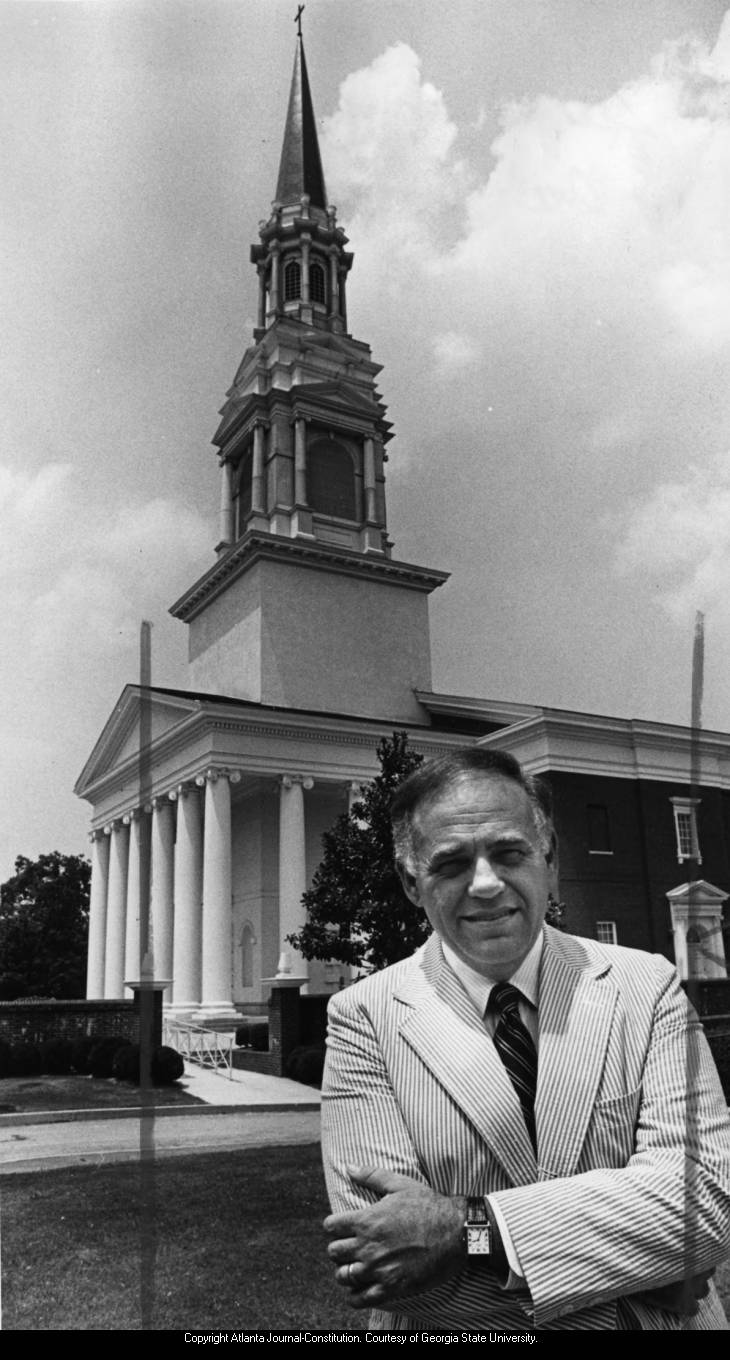
Bill Self with Wieuca sanctuary in background. (Photo courtesy of Georgia State University Digital Archives)
Self quipped that in the heyday at both churches, he could have read out of the phone book and people would have come to worship.
Some people jokingly called Johns Creek Baptist Church “Wieuca North” because of the number of former Wieuca members who changed churches.
Howard says it is important to note that apart from whatever went wrong with pastoral transitions, Wieuca’s challenges had contextual roots as well.

Barry Howard
“There was a tremendous sociological and demographic change,” he said. Longtime members of the Buckhead church who lived near the church said they intended to stay but developers offered them more for their homes than they could imagine. They discovered they could sell their homes, make a lot of money, and build their dream homes in Gwinnett County — which put them in close proximity to Johns Creek.
Added to that, traffic in Atlanta increased significantly as the city boomed in preparation for hosting the 1996 Olympics.
Former Wieuca members ended up not only at Johns Creek but at other suburban Baptist churches, including Dunwoody Baptist, among others.
And then Andy Stanley moved in almost next door.
North Point Ministries’ Buckhead Church was established in 2001 as Buckhead Fellowship, a satellite campus of North Point Community Church, led by Stanley. It began as biweekly meetings, initially using a church building for Sunday evenings, then later moving to a hotel and finally to a renovated grocery store in 2003.
North Point’s current Buckhead campus is located 1 mile from The Church at Wieuca. North Point is one of the largest churches in America. Its attraction is centripetal.
Another factor is the overall disappearance of Baptist churches in Atlanta’s core. The city is circled by a freeway known as “The Perimeter.” As recently as 40 years ago, there were more than 100 Southern Baptist churches inside the Perimeter. Today, there about 30 churches inside the Perimeter that are part of Atlanta Metro Baptist Association. Among Baptists, church growth is happening in the suburbs, not in the city’s core.
From the time of Self’s departure, the church endured years of conflict around various issues, including subsequent pastoral leadership. One church consultant declared it was a “one-generation church” that could not reinvent itself for a second season of life.
Those who remain today disagree with that assessment and point out they are still there, even if smaller in numbers.
While an infusion of cash isn’t the sole solution to their challenges, it certainly will help, they predict. One important caveat, they say, is they want to change the metrics by which churches are measured. It’s not just about how many people are in the sanctuary on a Sunday morning but about the reach of the church into the community seven days a week.
On that score, The Church at Wieuca boasts a highly regarded day school and a popular summer camp program called Camp Wieuca.

Photo on a history wall at The Church at Wieuca
Change is coming
Even working a property deal has not come easily for the church. The current plan — there were others before — has spanned three pastors and involved a zoning dispute that went all the way to the Georgia Supreme Court.
Some of the neighbors in a nearby condominium tower do not want to lose their views. Ultimately, the state’s high court refused to take the case, effectively ruling in the church’s favor.
And, by the way, COVID happened in the midst of this and put a damper on everything. Zoning offices and courts closed, and the development process slowed to a crawl.

Where the cars are shown in this parking lot is where the new church building will go up.
To be clear, the church will not own or develop the new projects. It will sell the land that will be developed by others. As things currently stand, the first of those two deals should close in the first quarter of 2026 and the second deal should close soon after that.
Although the property is being sold, not leased, the church entered a “neighborhood covenant” with the developers that provides for thematic landscape design, shared costs for road maintenance and security, and the right of architectural review by the church for buildings within the development.
Reconfiguring the remaining church property — known as the Sanctuary building — and adding new space cannot begin until at least some of the money is in hand. So timing is critical. And these days, every month the project is delayed means costs increase due to rising prices and tariffs. Construction costs in Atlanta have been increasing about 3% a year.
But those who remain at Wieuca are committed to the process. A few years ago, the congregation voted to pursue this course among three other options, one of which was to merge with another nearby CBF church, one of which was to shut down and sell the entire property, and one was to relocate within Atlanta.
Church members voted overwhelmingly for the current plan, and they’re eager to see it develop. The project has its own mission statement: “To envision a welcoming, active, sacred, flexible, accessible and fiscally responsible campus that will serve members and the Buckhead community for future generations with transformative worship and daily programs that connect people to each other and Christ.”

Architect rendering looking north from Wieuca Road. The wider sidewalk, greens cape, and inviting front porch provides a warm welcome to the community.
Another pastor transition
Now, the church is living through another pastor transition, but this time in a healthy way. Howard retired last year, and Kevin Head was installed as the new senior pastor May 4. He came from just up the road in Roswell, Ga.
Howard said he and his wife, Amanda, “never dreamed we would have to leave before the sanctuary renovation was finished.” Even that may take another two years to complete, “and we knew we couldn’t see it through until the end. That’s a long time. So we needed a younger, more energetic pastor.”

Sanctuary exterior at The Church at Wieuca
Howard, building on the peacemaking work of his predecessor, Mark Wilbanks, left the church with a much healthier attitude, said longtime member Susan Stewart.
“We had gotten to be such an adversarial congregation. It was polar. Everybody was fighting with each other. And Mark Wilbanks came in and he spent his whole time teaching the congregation how to love each other. He had gotten us to the point where we were a loving congregation and then Barry came in and increased on that. But his years were really balancing all this development stuff.”
In the end, “Barry left it to a point that Kevin has a much stronger place to start,” she added. “There’s still a whole ton of stuff to do, but he has a stronger place to start.”
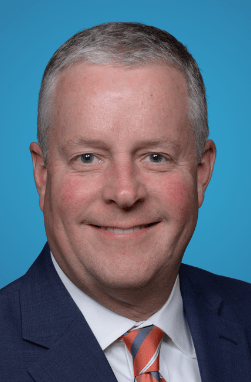
Kevin Head
Head has no church construction experience, but he is energized by what’s coming down the pike at Wieuca, he said. “When I started talking with the pastor transition team and they were describing this whole project, it just seemed like a really exciting thing to be a part of.”
Josh Speight came as the church’s associate pastor in 2021. While meeting with the search committee, he asked each member to tell him why they were still at Wieuca. “I’ve heard all the stories and wanted to understand why you’re still choosing to be here,” he explained. “And that really influenced my understanding of my ministry here. There’s been a lot of conflict here. … But the people who are here are choosing to be here. They’re all in and they know it’s going to be hard work.”
For those who remain, the question has not been about how to make the most money but how to create the most missional possibilities, Howard said. “How do we use this treasure that we’ve been given of 12 acres that’s some of the most valuable property in [the] Southeastern U.S., and how do we become good stewards of it and develop it so it continues to serve good purpose?”