

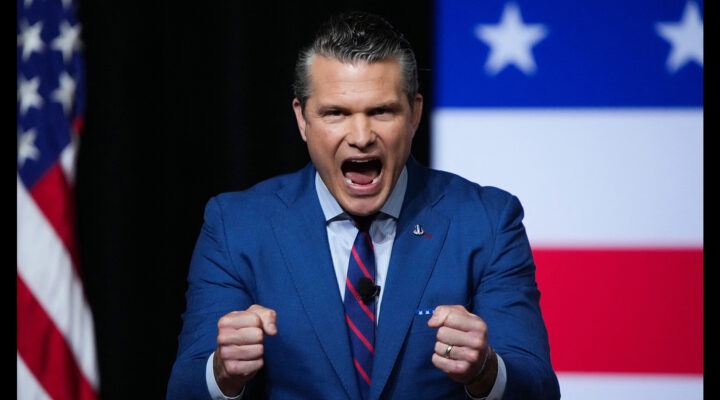
In a two-and-a-half-minute-long video posted on X, self-styled Secretary of War Pete Hegseth announced all United States soldiers age 30 and over will undergo mandatory screening for testosterone deficiency. Those with lower levels of testosterone will be given the option for testosterone replacement therapy.
Hegseth’s reasoning is that the military has a “sacred duty” to ensure that service members are operating at peak health and “operating at (their) absolute best.”

Josh Olds
This is being done as part of a larger focus on what Hegseth calls Warfighter Performance Optimization, which seeks to hold U.S. service members to the same rigorous standards of maintenance as weapons systems and military equipment — identifying them as a “readiness capability” just like “every asset that preserves combat power.” Hegseth also has implemented height, weight and appearance standards at all levels of the military along with more rigorous physical fitness standards.
While it is commendable to focus on the human element of warfare and the health and flourishing of service members — particularly given the high prevalence of disability and mental health issues among veterans — Hegseth’s particular emphasis in this case appears not to be combating a medical deficiency. Only about 0.5% of men need testosterone therapy for medical reasons. That number hardly justifies a mandatory evaluation of every male in the military.
Instead, Hegseth’s focus is on combating, natural age-related decline. Hegseth is demanding mandatory testosterone screenings for any service member over age 30, which is about the age testosterone levels begin to drop naturally. He speaks to soldiers about testosterone “restoring and optimizing your natural capabilities” because “as we age, testosterone levels naturally drop.”
There is nothing in Hegseth’s video announcement, the official memorandum to Pentagon leadership or the Department of Defense press release that speaks of combating unnaturally low testosterone levels or using testosterone medicinally for medical issues, but a singular focus on combating naturally lower testosterone levels as part of a performance-enhancing regimen meant to keep soldiers “operating at (their) absolute best.”
Testosterone and toxic masculinity
This emphasis on high testosterone levels fits with Hegseth’s view of masculinity. Testosterone is the main male sex hormone, responsible for male sex differentiation and the development of male secondary sexual characteristics.
“In Hegseth’s worldview, testosterone is what makes a man manly.”
While women also produce testosterone, they do so at significantly lower rates. In Hegseth’s worldview, testosterone is what makes a man manly. Women have low testosterone levels; therefore, men with low testosterone are more “womanly” than men with higher testosterone levels.
In conservative circles, calling someone “low T” — low testosterone — rarely has anything to do with a medical condition. Rather, it’s used by conservatives to describe something or someone perceived as weak or effeminate. Along with terms like “soy boy” and “beta male,” “low T” is used to insult men they view as insufficiently manly. Originating in alt-right message boards about a decade ago, the term became a favorite within the manosphere and now has moved into the mainstream.
Just recently, Texas Republican nominee for U.S. Senate, Ken Paxton, lobbed a series of insults against his opponent, Democrat James Talarico, calling him “tofu Talarico,” “James Talafreako,” and “Low-T Talarico.” Of these, the low-T insult must have hit the hardest with Paxton’s supporters because Paxton followed it up with a video advertisement that ends with “Radical Talarico: Too Low-T for Texas.”
Conservative messaging is clear: Power and authority are tied to testosterone, which is now a litmus test for manliness.
From this conservative worldview, for men to be true men, their testosterone must be high. That’s why, in 2016, while then-candidate for President Donald Trump refused to release his tax returns, he did release his testosterone levels. It’s why Health and Human Service Secretary Robert F. Kennedy Jr. recently claimed Trump has “the highest testosterone levels that he’s ever seen for an individual over 70.” Testosterone has become a cultural shorthand for a particular type of conservative masculinity.
“Testosterone has become a cultural shorthand for a particular type of conservative masculinity.”
Hegseth might couch his testosterone screening program under the guise of physical health, but his culture war terminology — insinuating this screening will lead to a “High T Department of War” — show his true concern isn’t that service members are healthy but that they fit into this mold of masculinity. Rather than see the military as a system enhanced by diverse people of diverse backgrounds with diverse perspectives, personalities and genetic constitutions, Hegseth believes diversity in the military makes the military weak. He derides diversity as “the absolutely dumbest,” and says it leaves out “the masculine men who make up our warrior class.”
TRT as gender-affirming care for cisgender men
Hegseth’s push for targeted testosterone treatments is not about physical health, but about cultivating a right-wing conservative aesthetic of masculinity. In his announcement, he says he is offering soldiers testosterone replacement therapy in order to ensure they “have the biological foundation required to sustain the fight.”
In other words, he wants his men to feel more manly, more masculine, more in line with what he believes makes a man. Testosterone replacement therapy is a real medical treatment for a real medical problem, but what Hegseth is promoting is gender-affirming care for cisgendered men.
“What Hegseth is promoting is gender-affirming care for cisgendered men.”
Ironically, Hegseth often has railed against gender-affirming care — famously claiming there would be “no more identity months, DEI offices, dudes in dresses” in his military and going so far as to ban gender-affirming hormone therapy for transgender service members. Hegseth’s reasoning comes from his book The War on Warriors, where he claims transgender troops receiving gender-affirming care such as testosterone treatments are a liability on the battlefield. He imagines a scenario where a deployed individual is unable to access their needed medical care, saying “a ‘trans’ soldier who doesn’t have his/her meds is combat ineffective — and gets people killed.”
Despite this, Hegseth is apparently ready to deploy any number of cisgender soldiers equally dependent on synthetic testosterone treatments who could face the same scenario. And if that scenario is unlikely, they will certainly face some of the other negative effects of testosterone therapy — infertility, sleep apnea, gynecomastia, prostate growth and an increased risk of blood clots.
The irony is difficult to miss. The same administration that condemns gender-affirming care as an ideological attempt to reshape the body is now championing the same hormone therapy to mold men into their own ideological ideal of masculinity.
Military service always has demanded sacrifice, discipline and physical excellence, and there is nothing wrong with expecting service members to be healthy and mission-ready. But there is a meaningful difference between treating illness and enhancing healthy bodies to conform to a particular cultural ideal.
If the Pentagon truly wishes to improve the health of its troops, it should invest in evidence-based medicine, mental health care, nutrition, sleep, rehabilitation and treatment for those with genuine medical need. Instead, Hegseth’s testosterone initiative reflects a broader political fixation on testosterone as both a performance enhancer and a symbol of masculine virtue.
That may make for effective culture-war messaging, but it is a more-than-questionable foundation for military medicine.
Josh Olds is a public theologian and pastor for those disillusioned with institutional church. He is the creator of the small-group video series “Year on the Mountaintop” and a featured contributor to Fostering Hope: A Prayerbook for Fostering and Adoptive Parents. Follow his work on Facebook or at JoshOlds.com.