

Cynthia Vaughn spent years consumed with rage over her mother’s 1984 murder and felt no relief whatsoever when the killer — her stepfather — finally was executed in 2019.
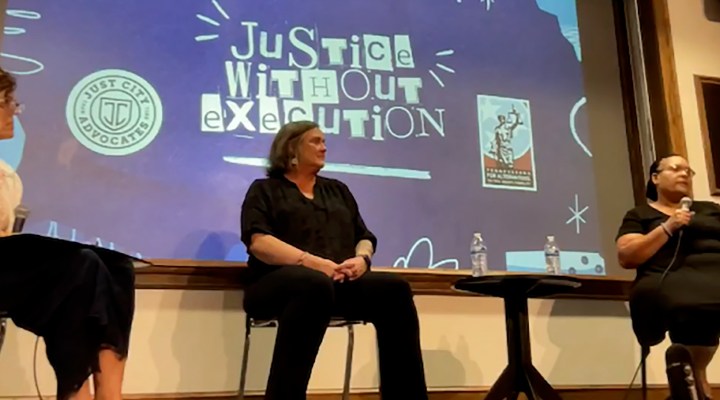
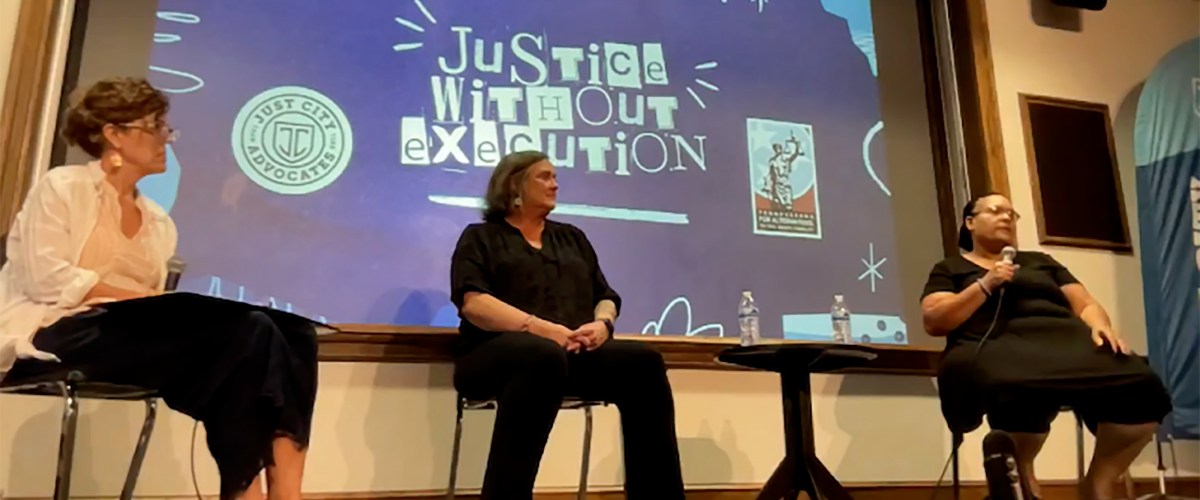
“I didn’t get the closure people think comes with an execution. After he was executed, nothing in my life changed,” Vaughn said during a panel discussion led by Tennesseans for Alternatives to the Death Penalty in partnership with Just City Advocates, a student-led advocacy group at Rhodes College in Memphis.

Cynthia Vaughn
Vaughn, who was 7 when the homicide occurred, said she now understands the true source of her anguish was a criminal justice system willing to spend millions on executions while ignoring the needs of crime victims.
“We didn’t have any kind of therapy. We didn’t have anybody to talk to about any of it,” she said of herself, her younger brother and the alcoholic aunt who took them in without the resources to care for the children.
Adding to the pain were the execution dates that kept getting rescheduled and, in the process, reminding Vaughn of the depth of her loss.
“I’m 7, my mom’s gone and all I could think about was who’s going to make my hot dog sandwiches?”
“There were no resources,” she said. “But there was so much anger, so much rage. I’m 7, my mom’s gone and all I could think about was who’s going to make my hot dog sandwiches? Who’s going to tuck me in at night? And there was nobody because my aunt wasn’t going to do it. To anybody who has a loved one who’s been murdered, it is excruciating.”
Vaughn was joined on the livestreamed panel discussion by Mississippi Death Row exoneree Sabrina Butler-Smith and Stacy Rector, executive director of Tennesseans for Alternatives to the Death Penalty.
The Sept. 30 panel was sparked in part by the 2025 resumption of executions in the state after a five-year pause. Organizers also wanted to highlight the growing secrecy around lethal injection chemicals and concerns about the unmet emotional and material needs of the families of homicide victims.
“If we want to find effective responses to crime, we should focus our resources and our energy on healing trauma and on crime prevention,” Rector said. “Investing in trauma-informed solutions that center on accountability, mental health, early intervention and on solving more unsolved murders. Tennessee has a 50% unsolved homicide rate.”
Expense also is a major downside of capital punishment. Death penalty cases can cost $1 million to $3 million more than prosecutions seeking life imprisonment, according to the Death Penalty Information Center.
“We are investing into the death penalty what could be spent on assisting surviving family members of murder victims.”
Meanwhile, Tennessee’s victim services budget “remains woefully underfunded,” Rector added. “We are investing into the death penalty what could be spent on assisting surviving family members of murder victims like Cynthia.”
Worse still, capital punishment doesn’t prevent crime, is unfairly applied and often lands innocent people on death row, she said. “At least 200 people sentenced to death since 1973 have been exonerated when evidence of their innocence was finally considered by some court somewhere, including Sabrina Butler-Smith.”

Sabrina Butler-Smith
Butler-Smith was 17 when her infant son died in 1989 from an undiagnosed hereditary medical condition. She later was coerced by detectives to sign confession saying she had killed her own child.
“A lot of people say, ‘If you didn’t commit a crime, why would you sign it?’ You have to be interrogated by police officers to know the tricks that they pull in order to get a confession out of you. Well, when I signed the paper, they charged me with capital murder. They charged me with a child abuse statute that wasn’t even a law until 23 days after I was already incarcerated.”
Then her 1990 murder trial was heard by an all-white jury. “I knew my life was over because nobody looked like me. I said, ‘My life’s over, they’re going to throw me away.’ I just knew it in my heart. And I was right. They found me guilty.”
But the Mississippi Supreme Court overturned her conviction in 1992 and she was acquitted in December 1995 after a second trial.
“It was an experience I wouldn’t wish on my worst enemy,” Butler-Smith said. “I was never given an apology, not an ‘I’m sorry,’ nothing.”
Nor was she given any kind of assistance to help rebuild the life the state had wrongly taken from her.
“Exonerated people are forgotten.”
“Exonerated people are forgotten,” she said. “There are 200 of us and no one has said, ‘Let me take care of you. Let me give you a job. Let me give you a house.’ When I got out, I had nothing. If it wasn’t for my family, where would I be? Something’s wrong with that picture.”
A case similar to Butler-Smith’s is that of Robert Robertson, an autistic Texas man facing execution Oct. 16 after being convicted in the 2003 death of his infant daughter.
“Mr. Robertson’s case is riddled with unscientific evidence, inaccurate and misleading medical testimony, and prejudicial treatment,” according to the Innocence Project. “In 2002, Mr. Roberson’s 2-year-old, chronically ill daughter, Nikki, was sick with a high fever and suffered a short fall from bed. Hospital staff did not know Mr. Roberson had autism and judged his response to his daughter’s grave condition as lacking emotion. Mr. Roberson was prosecuted, convicted and sentenced to death for Nikki’s death.”
Organizers also hoped the Memphis gathering would inspire Tennesseans to plead with Gov. Bill Lee to commute the death sentence of Harold Nichols, who is scheduled to die Dec. 11. If executed, he will follow Oscar Smith (May 22) and Byron Black (Aug. 5).
Recent polling found 53% of Tennesseans prefer alternatives to the death penalty in cases of first-degree murder, Rector said, and most believe the families of murder victims should receive the help they need in the aftermath of violence.
“We want a system that is fair and that is accurate, not just for some folks, but for everybody. We want to be good stewards of our resources, our tax dollars. We want those to go to policies and programs that are the most impactful, the most effective.”
Related articles:
Trump orders death penalty restored in DC and nationwide
Newsom urged to eliminate death penalty in California
Younger adults driving decreased support for death penalty